PRÁTICA COM QUESTÕES OFICIAIS
Questão 80 da UFPR 2018 (inglês)
O texto a seguir é referência para as questões 76 a 80. · 1ª fase
Britain bans gasoline and diesel cars starting in 2040
Britain will ban sales of new gasoline and diesel cars starting in 2040 as part of a bid to clean up the country’s air. The decision to phase out the internal combustion engine heralds a new era of low-emission technologies with major implications for the auto industry, society and the environment. “We can’t carry on with diesel and petrol cars”, U.K. environment secretary Michael Gove told the BBC on Wednesday. “There is no alternative to embracing new technology”. Almost 2.7 million new cars were registered in the U.K. in 2016, making it the second biggest market in Europe after Germany.
Meeting the 2040 deadline will be a heavy lift. British demand for electric and fuel cell cars, as well as plug-in hybrids, grew 40% in 2015, but they only accounted for less than 3% of the market. Still, experts say sales of clean cars are likely to continue on their dramatic upward trajectory.
The car industry says that demand for electric vehicles will only reach a tipping point once they're cheaper to own than conventional vehicles.
The deadline was announced by the government on Wednesday as part of a plan to reduce air pollution. The blueprint highlighted roughly £1.4 billion in government investment designed to help ensure that every vehicle on the road in Britain produces zero emissions by 2050.
Gove said action was needed because gasoline and diesel engines contribute to health problems, “accelerate climate change, do damage to the planet and the next generation”. Roughly 40,000 deaths in Britain each year are attributable to outdoor air pollution, according to a study published last year by the Royal College of Physicians. Dirty air has been linked to cancer, asthma, stroke and heart disease, among other health issues.
The problem is especially pronounced in big cities. London surpassed the European Union’s annual limit for nitrogen dioxide exposure just five days into the new year, according to King’s College. The university estimates that air pollution is responsible for 9,400 premature deaths in the city every year.
The timeline for ending sales of internal combustion engines mirrors one proposed in early July by France. President Emmanuel Macron has given the auto industry the same deadline to make the switch to cleaner tech.
“We are quite rightly in a position of global leadership when it comes to shaping new technology”, Gove said. But the auto industry, which supports over 800,000 jobs in the U.K., is wary of hard deadlines.
Other countries have been even more ambitious than the U.K. India is planning to stop selling gas-powered vehicles by 2030.
The German car industry and government officials will meet in early August to discuss the future of diesel engine technology. Manufacturers are trying to avoid diesel cars being banned from German towns and cities.
(Disponível: <http://money.cnn.com/2017/07/26/news/uk-bans-gasoline-diesel-engines-2040/index.html>. Adaptado. Acesso: 26 de julho de 2017.)
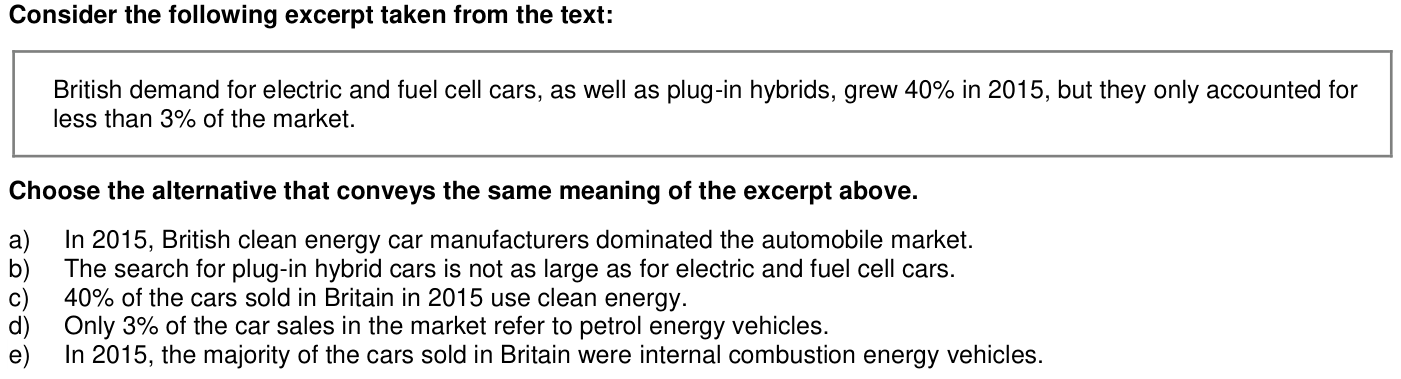
Consider the following excerpt taken from the text:
British demand for electric and fuel cell cars, as well as plug-in hybrids, grew 40% in 2015, but they only accounted for less than 3% of the market.
Choose the alternative that conveys the same meaning of the excerpt above.
- AIn 2015, British clean energy car manufacturers dominated the automobile market.
- BThe search for plug-in hybrid cars is not as large as for electric and fuel cell cars.
- C40% of the cars sold in Britain in 2015 use clean energy.
- DOnly 3% of the car sales in the market refer to petrol energy vehicles.
- EIn 2015, the majority of the cars sold in Britain were internal combustion energy vehicles.
Você já respondeu questões neste aparelho. Crie sua conta grátis para guardar o histórico e refazer as que errou.
Resposta salva no seu histórico.
Reportar erro na questão
Resolução comentada
O trecho diz duas coisas: a demanda por carros elétricos, de células de combustível e híbridos plug-in cresceu 40% em 2015 (crescimento, não participação), mas esses carros representavam menos de 3% do mercado.
Se os carros limpos eram menos de 3% do mercado, o restante, mais de 97%, era formado por veículos não limpos, ou seja, movidos a motor de combustão interna (gasolina e diesel). Logo, a maioria dos carros vendidos era de combustão interna.
Conferindo cada alternativa:
- (A) diz que os fabricantes de carros limpos dominaram o mercado, o que contradiz o "menos de 3%".
- (B) compara híbridos plug-in com elétricos e de células de combustível, algo que o trecho não faz; ele agrupa os três tipos.
- (C) confunde o crescimento de 40% da demanda com a fatia de mercado.
- (D) inverte os dados: os 3% são dos carros limpos, não dos movidos a petróleo.
- (E) é a única coerente com o trecho: se os limpos são menos de 3%, a maioria é de combustão interna.
Alternativa E.
Pegadinha: A alternativa C engana ao transformar o crescimento de 40% da demanda em participação de mercado, e a D inverte quem representa os 3%.
Por que as outras alternativas estão erradas
- AAfirma que os carros limpos dominaram o mercado, mas eles eram menos de 3%.
- BCompara plug-in com elétricos e células de combustível, o que o texto não faz; ele os agrupa.
- CTrata o crescimento de 40% da demanda como se fosse a participação no mercado.
- DAtribui os 3% aos carros a petróleo, quando são os carros limpos.
Assuntos: Informações explícitas e detalhes, Referência pronominal e pronomes.
Reportar erro na resolução
Ver como caiu na prova
Fonte: UFPR 2018 · 1ª fase. Prova oficial ↗