PRÁTICA COM QUESTÕES OFICIAIS
Questão 79 da UFPR 2016 (inglês)
The following text refers to questions 77 to 80. · 1ª fase
Voices: The Pope's powerful message to Cubans
Rick Jervis, September 24, 2015
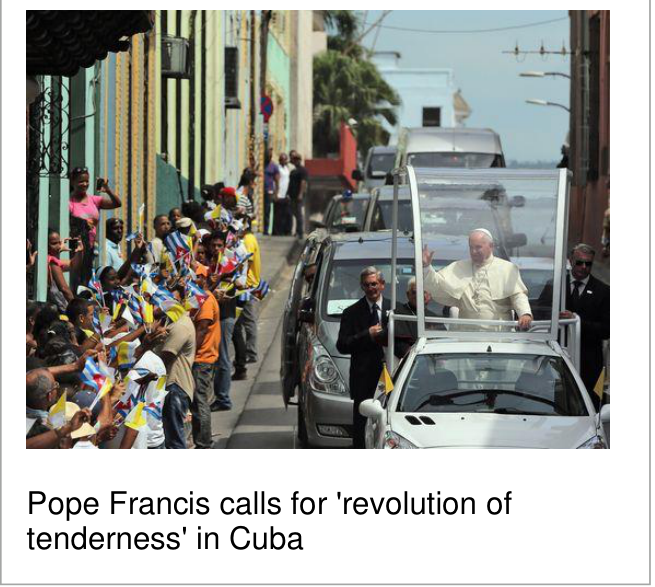
SANTIAGO DE CUBA – I’ve always been fairly skeptical about how much power one man can exercise, even if that man commands the attention of 1.2 billion Roman Catholics.
I understand that Pope John Paul II visited Poland in the 1970s and ‘80s and gave speeches so stirring that they helped launch the Solidarity opposition movement and lead to the collapse of communism in the country. And I know that popes throughout history have had influential moments.
But, really, how much can one man and one microphone do? How literally do people take his message? These were the questions that kept my mind busy when I left for Cuba last week to cover Pope Francis’ four-day trip. I was curious to see how much impact the words of this 78-year-old man can have on a population of 11 million.
I’m becoming fairly familiar with Cuba. I’ve been to the island three times this year, five times overall, and grew up in southern Florida. My parents are Cubans who left the country in 1962. Cuba today continues to fascinate and dismay. It’s a place of beauty and jolting contradictions. The re-establishment of relations between the U.S. and Cuban governments, begun last December, continue to stir excitement and hope in Cubans, and changes are trickling in.
I followed Pope Francis from Havana to Santiago and heard him talk of reconciliation, love for mankind and the importance of family. I interviewed Cubans who glowed with the fervor of the faithful as they pledged their love for the Pope and promised to follow his message. But my question remained: What does all of this mean? How does it translate to actual change on the island?
To help me sort through this, I visited Father Jorge Catasus, a popular parish priest here who helped welcome the Pope to the city. We sat in the cool, cavernous back room of his 18th-century church, safe from the 37-degree heat outside. Catasus said “don't focus on any grand political or social changes stemming from the papal visit”. The most important changes, he said, come from within. That’s what Pope Francis offered as a first step, and that’s what Cubans across the island, in chants, cheers and tearful acceptance, agreed to abide by.
“The lives of men are decided in their hearts”, Catasus told me. “That’s where we’ll see the change”. This may not be 1980s Poland, and Solidarity may still not be anywhere in sight. But first things first. A change of heart can often lead to a world of good.
Adapted from <http://www.usatoday.com/>.
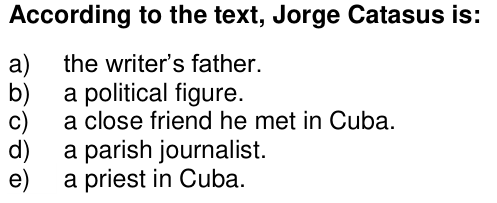
According to the text, Jorge Catasus is:
- Athe writer’s father.
- Ba political figure.
- Ca close friend he met in Cuba.
- Da parish journalist.
- Ea priest in Cuba.
Você já respondeu questões neste aparelho. Crie sua conta grátis para guardar o histórico e refazer as que errou.
Resposta salva no seu histórico.
Reportar erro na questão
Resolução comentada
A pergunta pede quem é Jorge Catasus segundo o texto. Procure o trecho em que ele aparece pela primeira vez.
No sexto parágrafo, o autor escreve: "I visited Father Jorge Catasus, a popular parish priest here who helped welcome the Pope to the city". Em português: "visitei o padre Jorge Catasus, um popular pároco daqui, que ajudou a receber o Papa na cidade".
Dois detalhes confirmam isso:
- O título "Father" antes do nome indica que ele é padre.
- "parish priest" significa pároco, o padre responsável por uma paróquia. A igreja do século XVIII, onde conversam, é a dele, e a cidade é Santiago de Cuba.
Logo, Catasus é um padre em Cuba. Ele não é parente do autor: os pais do autor são cubanos que deixaram o país em 1962, mas o texto não os liga ao padre. Também não é político, pois o próprio padre diz para não focar em mudanças políticas ou sociais. Por fim, não há indício de que seja amigo próximo: o autor o visita para entender melhor a situação.
Alternativa E.
Pegadinha: A alternativa D engana quem lê "parish" isoladamente e inventa uma profissão; o termo completo "parish priest" significa pároco.
Por que as outras alternativas estão erradas
- AO texto fala dos pais do autor (cubanos que saíram em 1962), mas nada os liga ao padre.
- BCatasus é religioso e até recomenda não focar em mudanças políticas; não é político.
- CO autor o visita para entender o impacto da visita do Papa; não há menção a amizade próxima.
- DConfunde "parish priest" (pároco) com jornalista; quem é jornalista é o autor.
Assunto: Informações explícitas e detalhes.
Reportar erro na resolução
Ver como caiu na prova
Fonte: UFPR 2016 · 1ª fase. Prova oficial ↗