PRÁTICA COM QUESTÕES OFICIAIS
Questão 73 da UFPR 2016 (inglês)
The following text refers to questions 73 to 76. · 1ª fase
Forget Texting While Driving: AT&T Survey reveals drivers do a lot more with their smartphones
By Menchie Mendoza, Tech Times | May 20, 10:10 AM
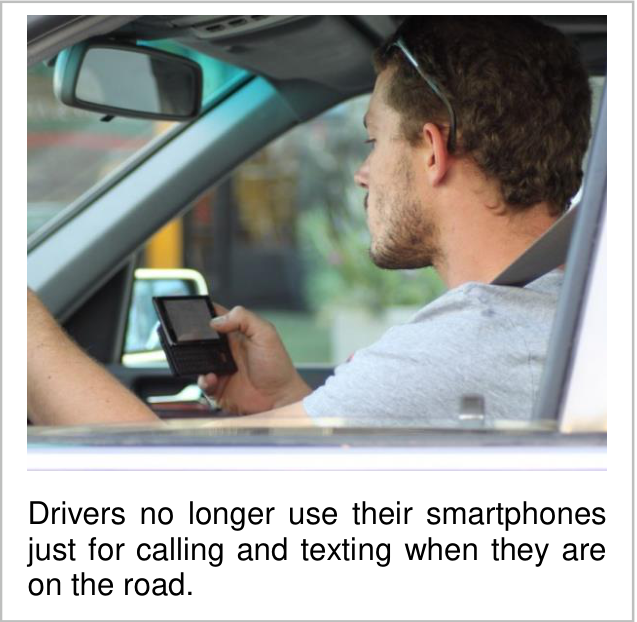
Drivers who continue to use their smartphones while driving are not only distracted when they call and text. Apart from calling and texting, drivers are also browsing the Internet, tweeting, video chatting, taking selfies and sending email with their devices, according to a study by AT&T.
The research was conducted as part of the carrier's "It Can Wait" campaign launched in 2010. It hopes to increase awareness of the dangers posed by using smartphones while one is behind the wheel. The study polled 2,067 U.S. residents ages 16-65 who use their smartphone and drive once or more per day.
Seventy percent of those surveyed admit they use their smartphones for a number of activities while they are driving: 61 percent say they text and 33 percent send email while they are behind the wheel. Posting or interacting on social media is also one of the most common activities that drivers engage in. Using Facebook ranks first on the list, with 27 percent of drivers logging in while driving. Other social media channels that keep drivers "multitasking" include Instagram and Twitter (14 percent) and Snapchat (11 percent).
The results also show that there is a deeper problem involved when people use social media while driving. Among those surveyed, 22 percent blame their addiction to social media.
Other revelations show 62 percent keep their smartphones within easy reach, and that 30 percent of those who post to Twitter while driving do it "all the time". Drivers also don't seem to run out of other activities using their smartphones since most apps are now easily accessed with just a simple tap. Because of this, 28 percent of drivers browse the web; 17 percent take selfies (or groupies); and 10 percent video chat.
"One in 10 say they do video chat while driving", said Lori Lee, AT&T's senior VP for global marketing. "I don't even have words for that". AT&T plans to expand the "It Can Wait" campaign in order to add more focus on the topic of texting while driving by including other driving distractions that result from using the smartphones. "When we launched 'It Can Wait' five years ago, we pleaded with people to realize that no text is worth a life", said Lee. "The same applies to other smartphone activities that people are doing while driving. For the sake of you and those around you, please keep your eyes on the road, not on your phone". AT&T will also launch a nationwide virtual reality tour in summer in order to spread the word that driving and using a smartphone don't and will never mix.
Adapted from <http://www.techtimes.com/>.
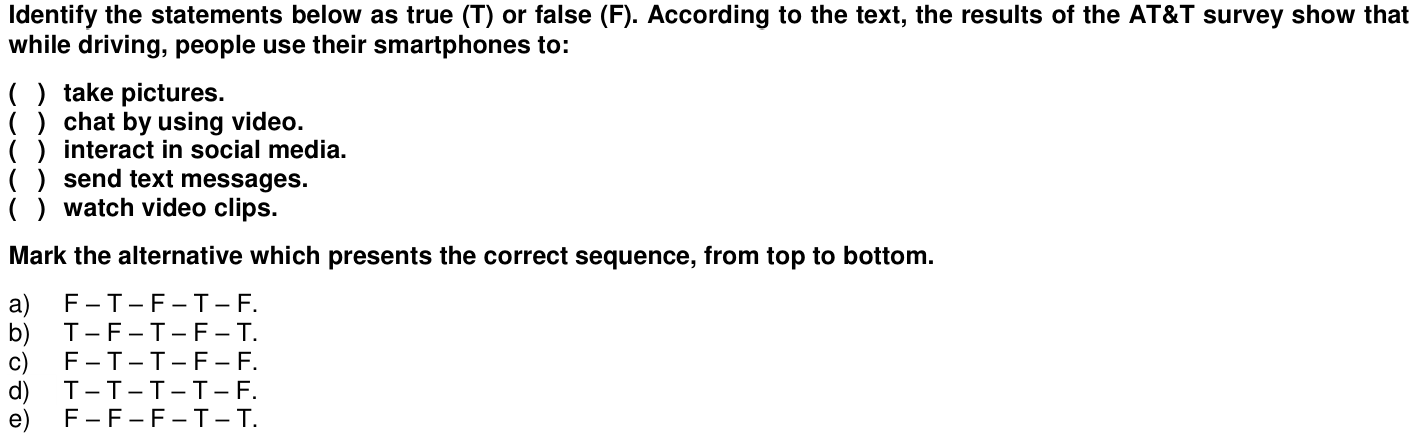
Identify the statements below as true (T) or false (F). According to the text, the results of the AT&T survey show that while driving, people use their smartphones to:
( ) take pictures.
( ) chat by using video.
( ) interact in social media.
( ) send text messages.
( ) watch video clips.
Mark the alternative which presents the correct sequence, from top to bottom.
- AF – T – F – T – F.
- BT – F – T – F – T.
- CF – T – T – F – F.
- DT – T – T – T – F.
- EF – F – F – T – T.
Você já respondeu questões neste aparelho. Crie sua conta grátis para guardar o histórico e refazer as que errou.
Resposta salva no seu histórico.
Reportar erro na questão
Resolução comentada
Cada item deve ser conferido com o que o texto diz sobre o uso do smartphone ao dirigir.
- Take pictures: o texto fala em "taking selfies" e diz que 17% tiram selfies (ou groupies). Selfie é uma foto que a pessoa tira de si mesma, então o item é verdadeiro (T).
- Chat by using video: o texto diz que "10 percent video chat". Verdadeiro (T).
- Interact in social media: o texto diz "Posting or interacting on social media is also one of the most common activities", com Facebook, Instagram, Twitter e Snapchat. Verdadeiro (T).
- Send text messages: o texto diz "61 percent say they text". Verdadeiro (T).
- Watch video clips: nenhum trecho menciona assistir a vídeos. Video chat é conversar por vídeo, não assistir a clipes. Falso (F).
A sequência é T – T – T – T – F.
Alternativa D.
Pegadinha: A alternativa B engana quem confunde "video chat" com assistir a vídeos e esquece que "text" também é citado, além de não perceber que selfies são fotos.
Por que as outras alternativas estão erradas
- AMarca como falsos os itens de tirar fotos e de interagir em redes sociais, ambos citados no texto.
- BMarca como falso o chat por vídeo e o envio de mensagens de texto, ambos citados, e como verdadeiro assistir a vídeos, que não aparece.
- CConsidera falsos o envio de mensagens de texto (61%) e as fotos (selfies), ambos presentes no texto.
- ENega os itens que o texto cita (fotos, video chat, redes sociais) e aceita assistir a vídeos, que não é mencionado.
Assunto: Informações explícitas e detalhes.
Reportar erro na resolução
Ver como caiu na prova
Fonte: UFPR 2016 · 1ª fase. Prova oficial ↗