PRÁTICA COM QUESTÕES OFICIAIS
Questão 79 da UFPR 2014 (inglês)
Texto-base das questões 78 a 80 · 1ª fase
Climate change: forecast for 2100 is floods and heat ... and it’s man’s fault
By Nick Allen
9:04PM BST 16 Aug 2013
Climate scientists have concluded that temperatures could jump by up to 5°C and sea levels could rise by up to 82 cm by the end of the century, according to a leaked draft of a United Nations (UN) report.
The UN Intergovernmental Panel on Climate Change (IPCC) also said there was a 95 per cent likelihood that global warming is caused by human activities. That was the highest assessment so far from the IPCC, which put the figure at 90 per cent in a previous report in 2007, 66 per cent in 2001, and just over 50 per cent in 1995.
Reto Knutti, a professor at the Swiss Federal Institute of Technology in Zurich, said: “We have got quite a bit more certain that climate change is largely man-made. We’re less certain than many would hope about the local impacts.” The IPCC report, the first of three in 2013 and 2014, will face intense scrutiny particularly after errors in the 2007 study, which wrongly predicted that all Himalayan glaciers could melt by 2035.
Almost 200 governments have agreed to try to limit global warming to below 2°C above pre-industrial times, which is seen as a threshold for dangerous changes including more droughts, extinctions, floods and rising seas that could swamp coastal regions and island nations. Temperatures have already risen by 0.8°C since the Industrial Revolution.
The report will say there is a high risk global temperatures will rise by more than 2°C this century. They could rise anywhere from about 0.6°C to almost 5°C a wider range at both ends of the scale than predicted in the 2007 report. It will also say evidence of rising sea levels is “unequivocal”. The report projects seas will rise by between 30 cm and 82 cm by the late 21st century. In 2007 the estimated rise was between 18 cm and 58 cm, but that did not fully account for changes in Antarctica and Greenland.
Scientists say it is harder to predict local impacts. Drew Shindell, a Nasa scientist, said: “I talk to people in regional power planning. They ask, 'What’s the temperature going to be in this region in the next 20 to 30 years, because that’s where our power grid is?’ We can’t really tell.”
(adapted from <telegraph.co.uk>)
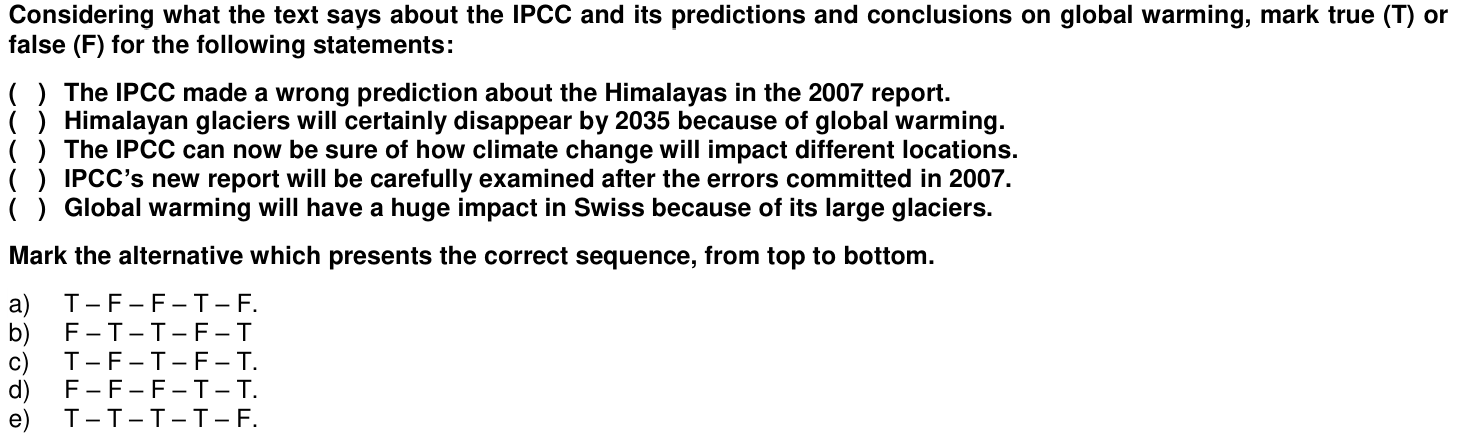
Considering what the text says about the IPCC and its predictions and conclusions on global warming, mark true (T) or false (F) for the following statements:
( ) The IPCC made a wrong prediction about the Himalayas in the 2007 report.
( ) Himalayan glaciers will certainly disappear by 2035 because of global warming.
( ) The IPCC can now be sure of how climate change will impact different locations.
( ) IPCC’s new report will be carefully examined after the errors committed in 2007.
( ) Global warming will have a huge impact in Swiss because of its large glaciers.
Mark the alternative which presents the correct sequence, from top to bottom.
- AT – F – F – T – F.
- BF – T – T – F – T
- CT – F – T – F – T.
- DF – F – F – T – T.
- ET – T – T – T – F.
Você já respondeu questões neste aparelho. Crie sua conta grátis para guardar o histórico e refazer as que errou.
Resposta salva no seu histórico.
Reportar erro na questão
Resolução comentada
Vamos conferir cada afirmação com o texto.
-
Verdadeira. O texto diz que o relatório de 2007 "wrongly predicted that all Himalayan glaciers could melt by 2035" (previu erroneamente que todas as geleiras do Himalaia poderiam derreter até 2035).
-
Falsa. Essa previsão foi justamente o erro de 2007. Além disso, o texto diz "could melt" (poderiam), e não que isso aconteceria com certeza.
-
Falsa. O professor Knutti afirma: "We're less certain than many would hope about the local impacts". Shindell também diz que é mais difícil prever impactos locais ("We can't really tell"). Ou seja, o IPCC não consegue ter certeza sobre os impactos em cada lugar.
-
Verdadeira. O relatório "will face intense scrutiny particularly after errors in the 2007 study", isto é, será examinado com rigor após os erros de 2007. Isso equivale a "carefully examined".
-
Falsa. Reto Knutti é professor em Zurique, mas o texto não fala de impacto na Suíça nem de suas geleiras. É uma informação inventada a partir da menção ao instituto suíço.
Sequência: T – F – F – T – F.
Alternativa A.
Pegadinha: A afirmação 5 engana ao usar o professor suíço do texto para sugerir um impacto na Suíça que o texto nunca menciona.
Por que as outras alternativas estão erradas
- BInverte quase tudo: afirma que a previsão do Himalaia não errou, que o derretimento é certo e que os impactos locais são previsíveis.
- CMarca como verdadeira a certeza sobre impactos locais e como falsa o escrutínio do novo relatório, o contrário do texto.
- DDiz que o IPCC não errou sobre o Himalaia e que haverá grande impacto na Suíça, o que o texto não afirma.
- EAceita como verdadeiros o desaparecimento certo das geleiras e a certeza sobre impactos locais, ambos contrariados pelo texto.
Assunto: Informações explícitas e detalhes.
Reportar erro na resolução
Ver como caiu na prova
Fonte: UFPR 2014 · 1ª fase. Prova oficial ↗