PRÁTICA COM QUESTÕES OFICIAIS
Questão 79 da UFPR 2012 (inglês)
O texto a seguir é referência para as questões 77 a 80. · 1ª fase
School Curriculum Falls Short on Bigger Lessons
By Tara PARKER-POPE
Now that children are back in the classroom, are they really learning the lessons that will help them succeed?
Many child development experts worry that the answer may be no. They say the ever-growing emphasis on academic performance and test scores means many children aren’t developing life skills like self-control, motivation, focus and resilience, which are far better predictors of long-term success than high grades. And it may be distorting their and their parents’ values.
In one set of studies, children who solved math puzzles were praised for their intelligence or for their hard work. The first group actually did worse on subsequent tests, or took an easy way out, shunning difficult problems. The research suggests that praise for a good effort encourages harder work, while children who are consistently told they are smart do not know what to do when confronted with a difficult problem or reading assignment.
Academic achievement can certainly help children succeed, and for parents there can be a fine line between praising effort and praising performance. Words need to be chosen carefully: Instead of saying, “I’m so proud you got an ‘A’ on your test”, a better choice is “I’m so proud of you for studying so hard”. Both replies rightly celebrate the ‘A’, but the second focuses on the effort that produced it, encouraging the child to keep trying in the future.
Praise outside of academics matters, too. Instead of asking your child how many points she scored on the basketball court, say, “Tell me about the game. Did you have fun? Did you play hard?”. Parents also need to teach their children that they do not have to be good at everything, and there is something to be learned when a child struggles or gets a poor grade despite studying hard. One strategy is to teach children that the differences between easy and difficult subjects can provide useful information about their goals and interests. Subjects they enjoy and excel in may become the focus of their careers. Challenging but interesting classes or sports can become hobbies.
(Adapted from www.nyt.com)
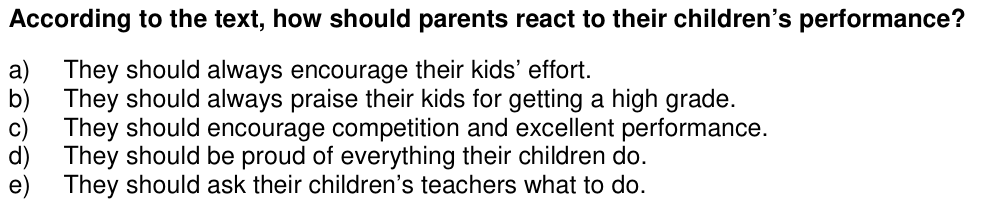
According to the text, how should parents react to their children’s performance?
- AThey should always encourage their kids’ effort.
- BThey should always praise their kids for getting a high grade.
- CThey should encourage competition and excellent performance.
- DThey should be proud of everything their children do.
- EThey should ask their children’s teachers what to do.
Você já respondeu questões neste aparelho. Crie sua conta grátis para guardar o histórico e refazer as que errou.
Resposta salva no seu histórico.
Reportar erro na questão
Resolução comentada
A pergunta é: segundo o texto, como os pais devem reagir ao desempenho dos filhos?
O texto defende que o elogio deve recair sobre o esforço, e não sobre a nota ou a inteligência. Três trechos mostram isso:
-
Nos estudos citados, "praise for a good effort encourages harder work" (elogiar o esforço estimula trabalhar mais). Já as crianças sempre chamadas de inteligentes não sabem o que fazer diante de um problema difícil.
-
Em vez de dizer "I'm so proud you got an 'A'", é melhor dizer "I'm so proud of you for studying so hard", pois a segunda frase foca no esforço e incentiva a criança a continuar tentando.
-
Fora da escola vale o mesmo princípio: em vez de perguntar quantos pontos a filha marcou no basquete, perguntar se ela se divertiu e se jogou com empenho.
Portanto, a ideia central é incentivar o esforço dos filhos, o que corresponde à alternativa A.
As demais alternativas contradizem o texto: elogiar sempre a nota, estimular competição, orgulhar-se de tudo ou consultar professores não aparecem como recomendação.
Alternativa A.
Por que as outras alternativas estão erradas
- BO texto recomenda elogiar o esforço, não a nota alta, que é justamente o que se deve evitar enfatizar.
- CO texto critica a ênfase em notas e desempenho; não recomenda estimular competição.
- DO texto diz que os filhos não precisam ser bons em tudo e que há o que aprender com dificuldades, sem pedir orgulho indiscriminado.
- ENão há menção a consultar professores sobre como reagir.
Assunto: Informações explícitas e detalhes.
Reportar erro na resolução
Ver como caiu na prova
Fonte: UFPR 2012 · 1ª fase. Prova oficial ↗