PRÁTICA COM QUESTÕES OFICIAIS
Questão 73 da UFPR 2012 (inglês)
O texto a seguir é referência para as questões 73 a 76. · 1ª fase
Jorge Mario Pedro Vargas Llosa, was born on March 28, 1936, in the Peruvian provincial city of Arequipa. He is a writer, politician, journalist, essayist, and Nobel Prize laureate. Vargas Llosa is one of Latin America's most significant novelists and essayists, and one of the leading authors of his generation. Some critics consider him to have had a larger international impact and worldwide audience than any other writer of the Latin American Boom. He was awarded the 2010 Nobel Prize in Literature "for his cartography of structures of power and his trenchant images of the individual's resistance, revolt, and defeat".
Vargas Llosa rose to fame in the 1960s with novels such as The Time of the Hero (La ciudad y los perros, literally The City and the Dogs, 1963/1966), The Green House (La casa verde, 1965/1968), and the monumental Conversation in the Cathedral (Conversación en la catedral, 1969/1975). He writes prolifically across an array of literary genres, including literary criticism and journalism. His novels include comedies, murder mysteries, historical novels, and political thrillers. Several, such as Captain Pantoja and the Special Service (1973/1978) and Aunt Julia and the Scriptwriter (1977/1982), have been adapted as feature films.
Many of Vargas Llosa's works are influenced by the writer's perception of Peruvian society and his own experiences as a native Peruvian. Increasingly, however, he has expanded his range, and tackled themes that arise from other parts of the world. Another change over the course of his career has been a shift from a style and approach associated with literary modernism, to a sometimes playful postmodernism.
Like many Latin American authors, Vargas Llosa has been politically active throughout his career; over the course of his life, he has gradually moved from the political left towards liberalism or neoliberalism, a definitively more conservative political position. While he initially supported the Cuban revolutionary government of Fidel Castro, Vargas Llosa later became disenchanted with the Cuban dictator and his authoritarian regime. He ran for the Peruvian presidency in 1990 with the center-right Frente Democrático (FREDEMO) coalition, advocating neoliberal reforms.
(Adapted from www.wikipedia.org)
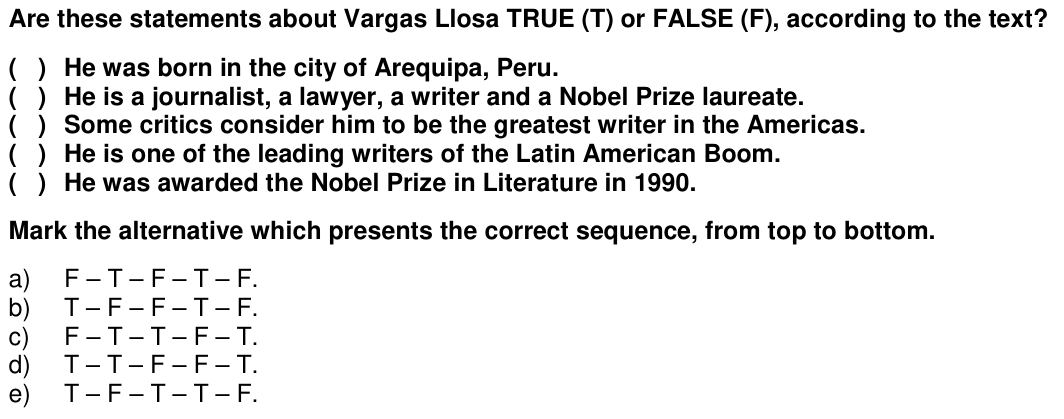
Are these statements about Vargas Llosa TRUE (T) or FALSE (F), according to the text?
( ) He was born in the city of Arequipa, Peru.
( ) He is a journalist, a lawyer, a writer and a Nobel Prize laureate.
( ) Some critics consider him to be the greatest writer in the Americas.
( ) He is one of the leading writers of the Latin American Boom.
( ) He was awarded the Nobel Prize in Literature in 1990.
Mark the alternative which presents the correct sequence, from top to bottom.
- AF – T – F – T – F.
- BT – F – F – T – F.
- CF – T – T – F – T.
- DT – T – F – F – T.
- ET – F – T – T – F.
Você já respondeu questões neste aparelho. Crie sua conta grátis para guardar o histórico e refazer as que errou.
Resposta salva no seu histórico.
Reportar erro na questão
Resolução comentada
Confira cada afirmação com o texto.
-
"Born in the city of Arequipa, Peru": o texto diz que ele nasceu "in the Peruvian provincial city of Arequipa". Verdadeira (T).
-
"Journalist, a lawyer, a writer and a Nobel laureate": o texto cita "writer, politician, journalist, essayist, and Nobel Prize laureate". Em nenhum momento aparece "lawyer" (advogado). Falsa (F).
-
"Some critics consider him to be the greatest writer in the Americas": o texto diz apenas que alguns críticos acham que ele teve maior impacto internacional e público mundial que qualquer outro escritor do Boom latino-americano. Isso é diferente de ser "o maior escritor das Américas". Falsa (F).
-
"One of the leading writers of the Latin American Boom": o texto diz que ele é "one of the leading authors of his generation" e que teve grande impacto entre os escritores do Boom. A afirmação é compatível com o texto. Verdadeira (T).
-
"Awarded the Nobel Prize in Literature in 1990": o texto diz 2010. Em 1990 ele foi candidato à presidência do Peru. Falsa (F).
Sequência: T – F – F – T – F.
Alternativa B.
Pegadinha: A alternativa E engana ao transformar "maior impacto internacional que qualquer outro escritor do Boom" em "o maior escritor das Américas", e a segunda afirmação troca "politician" por "lawyer".
Por que as outras alternativas estão erradas
- AMarca como falsa a primeira afirmação, mas ele nasceu em Arequipa, e como verdadeira a segunda, mas o texto não diz que ele é advogado.
- CAceita "lawyer" e "o maior escritor das Américas", que não estão no texto, e rejeita a afirmação do Boom.
- DAceita "lawyer" e o Nobel em 1990 (o ano correto é 2010) e rejeita a afirmação do Boom.
- EToma o maior impacto internacional dentro do Boom como "maior escritor das Américas" e considera a segunda afirmação falsa mas a terceira verdadeira, invertendo a análise.
Assunto: Informações explícitas e detalhes.
Reportar erro na resolução
Ver como caiu na prova
Fonte: UFPR 2012 · 1ª fase. Prova oficial ↗