PRÁTICA COM QUESTÕES OFICIAIS
Questão 74 da UFPR 2007 (inglês)
Texto-base das questões 73 a 77 · 1ª fase
As questões 73 a 77 referem-se ao texto a seguir.
In Hans Christian Andersens classic tale of *The Emperors New Clothes*, two charlatans come to the Emperors city, posing as weavers of such fine fabrics that only the truly intelligent can see them. The charlatans are hired by the Emperor, and in exchange they will receive gold and silk to weave the fabric. The ruse is simple enough: appeal to the intellectual vanity of the Emperor and his court. Each member of the Emperors court in turn is sent to the charlatansroom to check on the progress of the fabric. Each returns to the Emperor “bedazzled” by the beauty of the fabric. No one in the Emperors court wants to appear dim-witted and admit that there is no fabric to be seen. The ruse is complete on the day the Emperor is to show off his new clothes. There in the dressing room stands the naked Emperor, with his court and the charlatans, each gushing over the beautiful colors and textures of the nonexistent fabric. Although the Emperor can see that he is entirely naked, he too refuses to admit that there is no fabric to be seen. It takes the clear-minded honesty of a child to point out the nakedness of the Emperor.
(http://www.msbp.com/Disordered.htm)
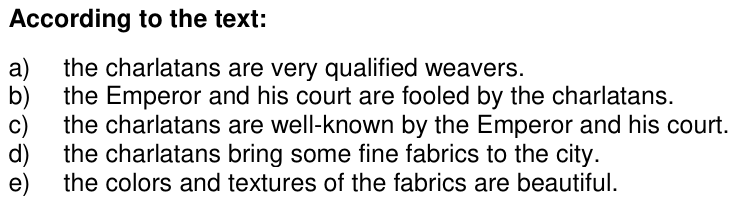
According to the text:
- Athe charlatans are very qualified weavers.
- Bthe Emperor and his court are fooled by the charlatans.
- Cthe charlatans are well-known by the Emperor and his court.
- Dthe charlatans bring some fine fabrics to the city.
- Ethe colors and textures of the fabrics are beautiful.
Reportar erro na questão
Resolução comentada
A questão pede o que o texto afirma de fato. Vamos conferir cada afirmação com o enunciado.
-
Os charlatães se apresentam ("posing as") como tecelões de tecidos tão finos que só os inteligentes os veem. Mas o tecido não existe: é um golpe ("ruse"). Logo, não são tecelões qualificados.
-
O truque apela à vaidade intelectual do Imperador e da corte. Ninguém quer parecer tolo ("dim-witted"), então todos fingem ver o tecido e elogiam suas cores. O Imperador chega a ver que está nu ("he can see that he is entirely naked"), mas também não admite. Ou seja, eles são enganados (ou se deixam enganar) pelos charlatães.
-
Os charlatães "come to the Emperor's city", isto é, chegam à cidade como forasteiros e são contratados. O texto não diz que eram conhecidos.
-
Eles recebem ouro e seda para tecer; não trazem tecidos finos, pois o tecido é inexistente ("nonexistent fabric").
-
As cores e texturas são elogiadas pela corte, mas o tecido não existe, então a beleza não é real.
A única afirmação sustentada pelo texto é que o Imperador e a corte foram enganados pelos charlatães.
Alternativa B.
Pegadinha: A alternativa E engana quem toma os elogios da corte ("beautiful colors and textures") como fato, esquecendo que o tecido é inexistente.
Por que as outras alternativas estão erradas
- AOs charlatães só fingem ser tecelões; o tecido não existe, então não são qualificados.
- CO texto diz que eles chegam à cidade e são contratados, sem indicar que fossem conhecidos.
- DEles recebem ouro e seda para tecer, e o tecido é inexistente; não trazem tecidos.
- EA beleza das cores e texturas é só o elogio fingido da corte a um tecido que não existe.
Assunto: Informações explícitas e detalhes.
Reportar erro na resolução
Ver como caiu na prova
Fonte: UFPR 2007 · 1ª fase. Prova oficial ↗