PRÁTICA COM QUESTÕES OFICIAIS
Questão 89 (2º semestre) da UFG 2014 (inglês)
Read the text and answer questions 89 and 90. · 1ª etapa
For more than half a century, immigrants from the Indian subcontinent and the West Indies have added variety and diversity to the rich patchwork of accents and dialects spoken in the UK. British colonisers originally exported the language to all four corners of the globe and migration in the 1950s brought altered forms of English back to these shores. Since that time, especially in urban areas, speakers of Asian and Caribbean descent have blended their mother tongue speech patterns with existing local dialects producing wonderful new varieties of English, such as London Jamaican or Bradford Asian English. Standard British English has also been enriched by an explosion of new terms, such as balti (a dish invented in the West Midlands and defined by a word that would refer to a 'bucket' rather than food to most South Asians outside the UK) and bhangra (traditional Punjabi music mixed with reggae and hip-hop).
SlangAs with the Anglo-Saxon and Norman settlers of centuries past, the languages spoken by today’s ethnic communities have begun to have an impact on the everyday spoken English of other communities. For instance, many young people, regardless of their ethnic background, now use the black slang terms, nang (‘cool,’) and diss (‘insult’ — from ‘disrespecting’) or words derived from Hindi and Urdu, such as chuddies (‘underpants’) or desi (‘typically Asian’). Many also use the all-purpose tag-question, innit — as in statements such as you’re weird, innit. This feature has been variously ascribed to the British Caribbean community or the British Asian community, although it is also part of a more native British tradition - in dialects in the West Country and Wales, for instance — which might explain why it appears to have spread so rapidly among young speakers everywhere.
Disponível em: <www.bl.uk/learning/lang/lit/sounds/case-studies/minority-ethnic>. Acesso em: 18 fev. 2014. (Adaptado).
Glossário:
patchwork: colcha de retalhos
blended: combinado
regardless: independente de
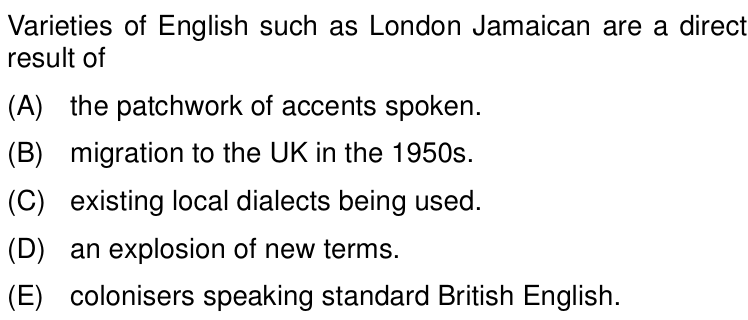
Varieties of English such as London Jamaican are a direct result of
- Athe patchwork of accents spoken.
- Bmigration to the UK in the 1950s.
- Cexisting local dialects being used.
- Dan explosion of new terms.
- Ecolonisers speaking standard British English.
Você já respondeu questões neste aparelho. Crie sua conta grátis para guardar o histórico e refazer as que errou.
Resposta salva no seu histórico.
Reportar erro na questão
Resolução comentada
O primeiro parágrafo explica a origem dessas variedades. Os colonizadores britânicos exportaram o inglês para o mundo. Na década de 1950, a migração trouxe de volta ao Reino Unido formas alteradas da língua ("migration in the 1950s brought altered forms of English back to these shores").
Depois disso, falantes de origem asiática e caribenha, sobretudo em áreas urbanas, misturaram os padrões de fala de sua língua materna com os dialetos locais já existentes. Dessa mistura surgiram variedades como o London Jamaican e o Bradford Asian English.
Portanto, a causa direta é a migração iniciada nos anos 1950. Ela levou esses falantes ao Reino Unido e, com isso, tornou possível o contato linguístico que gerou as novas variedades.
Os outros itens não respondem à pergunta:
- O "patchwork" de sotaques é o resultado, não a causa.
- Os dialetos locais são apenas um dos ingredientes da mistura.
- A explosão de novos termos enriqueceu o inglês padrão, mas é outro fenômeno.
- Os colonizadores apenas exportaram o idioma.
Alternativa B.
Por que as outras alternativas estão erradas
- AO mosaico de sotaques e dialetos é o resultado da diversidade, não a causa do surgimento de variedades como o London Jamaican.
- COs dialetos locais existentes foram combinados com as línguas maternas dos imigrantes, mas isso sozinho não explica a origem; faltou a migração.
- DA explosão de novos termos enriqueceu o inglês padrão britânico; não é a origem das variedades étnicas.
- EOs colonizadores apenas exportaram o inglês pelo mundo; as variedades surgiram depois, com a migração de volta ao Reino Unido.
Assunto: Variação linguística e diversidade cultural.
Reportar erro na resolução
Ver como caiu na prova
Fonte: UFG 2014 · 2º semestre · 1ª etapa. Prova oficial ↗