PRÁTICA COM QUESTÕES OFICIAIS
Questão 86 (2º semestre) da UFG 2014 (inglês)
Read the text and answer questions 86 to 88. · 1ª etapa
In the world of language translation and interpreting, you get used to certain challenges: slang and idiom, poor pronunciation and thick accents, regional dialects that aren’t well-documented, and many other standard problems. At the Olympics, many of these problems raise their ugly heads all at once, and it’s not uncommon to double-up interpreters assigned to press conferences because the language load is so huge and the mental stress so acute that a single interpreter often burns out and falls behind.
This past week, though, something altogether unusual and interesting happened when Sage Kotsenburg won the Gold Medal in the slopestyle snowboard event in Sochi. His triumphant press conference where he attempted to explain his thought process and the resulting routine that won him the Gold was almost like listening to a new language being invented right in front of your eyes – and believe this translation professional when he tells you that every interpreter, translator, and other translation services worker in that room earned their living and then some during that press conference!
A 1620 Japan
Here’s Kotsenburg’s routine as outlined in Snowboarder:
“Landing a cab 270 to switch, half-cab on back 540 off flat down, half-cab layback slide off the cannon back 180 out, cab double cork 1260 holy crail, frontside 1080 off the toes rocket air, then a 1620 Japan.”
Yes, that is all technical jargon and it all actually means something. In a situation like this, no amount of translation experience matters: this is simultaneously a perfectly legitimate sentence in English and completely untranslatable by anyone unless they share a technical snowboarding background and make sense of the word salad of terms there. That last bit, by the way – the 1620 Japan – is the complex move that Kotsenburg decided to add to his routine just a few minutes before competing, and involves rotating in midair exactly four and a half times.
Disponível em: <http://www.onehourtranslation.com/translation/blog/new-language-discovered-sochi-olympics-snowboarder#sthash.0Pd3vMQ6.dpuf> Acesso em: 18 fev. 2014. (Adaptado).
Glossário:
challenges: desafios
double-up interpreters: intérpretes trabalharam em pares
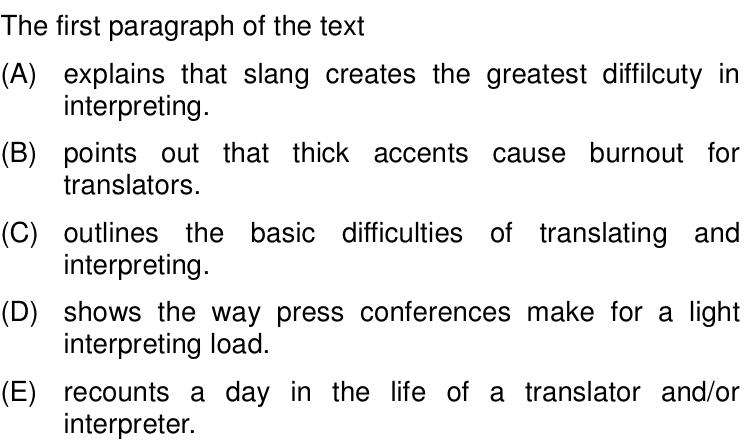
The first paragraph of the text
- Aexplains that slang creates the greatest diffilcuty in interpreting.
- Bpoints out that thick accents cause burnout for translators.
- Coutlines the basic difficulties of translating and interpreting.
- Dshows the way press conferences make for a light interpreting load.
- Erecounts a day in the life of a translator and/or interpreter.
Você já respondeu questões neste aparelho. Crie sua conta grátis para guardar o histórico e refazer as que errou.
Resposta salva no seu histórico.
Reportar erro na questão
Resolução comentada
O primeiro parágrafo começa listando os desafios comuns de quem traduz e interpreta: gíria e expressões idiomáticas, pronúncia ruim e sotaques fortes, dialetos regionais pouco documentados e "muitos outros problemas padrão". Em seguida, diz que nas Olimpíadas esses problemas aparecem todos de uma vez. Por isso é comum escalar intérpretes em dupla nas coletivas, já que a carga de linguagem é enorme e o estresse mental, agudo, a ponto de um único intérprete se esgotar e ficar para trás.
A ideia central do parágrafo é, portanto, apresentar de forma geral as dificuldades básicas da tradução e da interpretação.
Conferindo as demais:
- Gíria é só um item da lista, sem ser apontada como a maior dificuldade.
- Sotaques fortes aparecem como um dos desafios, mas o texto não diz que causam esgotamento. Isso é atribuído à carga de linguagem e ao estresse.
- As coletivas têm carga huge (enorme), o contrário de leve.
- Não há relato de um dia na vida de um tradutor. O parágrafo descreve problemas gerais.
Alternativa C.
Por que as outras alternativas estão erradas
- AA gíria é citada apenas como um dos desafios, sem ser considerada a maior.
- BO esgotamento vem da carga de linguagem e do estresse, não especificamente dos sotaques fortes.
- DO texto diz que a carga é enorme ("so huge"), não leve.
- ENão há narrativa de um dia de trabalho, só a descrição geral das dificuldades.
Assunto: Ideia central e finalidade do texto.
Reportar erro na resolução
Ver como caiu na prova
Fonte: UFG 2014 · 2º semestre · 1ª etapa. Prova oficial ↗