PRÁTICA COM QUESTÕES OFICIAIS
Questão 81 (2º semestre) da UFG 2014 (inglês)
Read the text and answer questions 81 to 83. · 1ª etapa
ELIF BILGIN GOES BANANAS
Sep 25 2013 Bloggers, People
By Chiara Spagnoli Gabardi
Turkish teen Elif Bilgin has thrilled her teachers, parents and those who care about the planet by discovering a way to make bio-plastic from an item commonly found in our waste bins: banana peels. The 16 year old prodigy always showed promise academically. From the 4th grade, she was put into a school for gifted children, where she was encouraged to develop her already advanced skills and talents. Since then, the teen has excelled at her studies and learned more about climate change and the environment. Somewhat alarmed at what she was discovering, she was determined to find an alternative to petroleum produced plastics.
When Elif found that potatoes and mango peels are already used to make bio-plastic, that fact, combined with the knowledge that Thailand alone discards 200 tons of banana peels per day motivated Elif to work on extracting the starch and cellulose needed for bio-plastic production out of banana peels.
Elif's research took a couple of years, and her trials initially failed: the plastics created weren't strong enough and decayed too quickly. But her persistence paid off, since she obtained the result she was pursuing and this discovery made her win the 2013 Science in Action award, Google's third $50,000 annual competition. Now she'll continue competing as a finalist in the Google Science Fair for the 15-16-year-old category, and will travel, along with 14 other contenders, to the company's Mountain View campus in California.
She is enthusiastic that her discovery will make a difference to the planet: “The reason why I chose this particular aspect of science is that the bio-plastic is such a new concept and its range of use has been widening ever since it has been discovered (especially in the 21st century).” The young inventor's dream is to attend medical school in the US and continue with projects concerning the environment, such as building a greenhouse made of waste materials. No doubt whatever Elif does, future generations will thank her.
Disponível em: <http://eluxemagazine.com/people/elif-bilgin/#sthash.kWg4Muw3.dpuf>. Acesso em: 18 fev. 2014. (Adaptado).
Glossário:
has thrilled: emocionou
peels: cascas
environment: meio ambiente
starch: amido
decayed: deterioraram
paid off: compensou
range of use: gama de uso
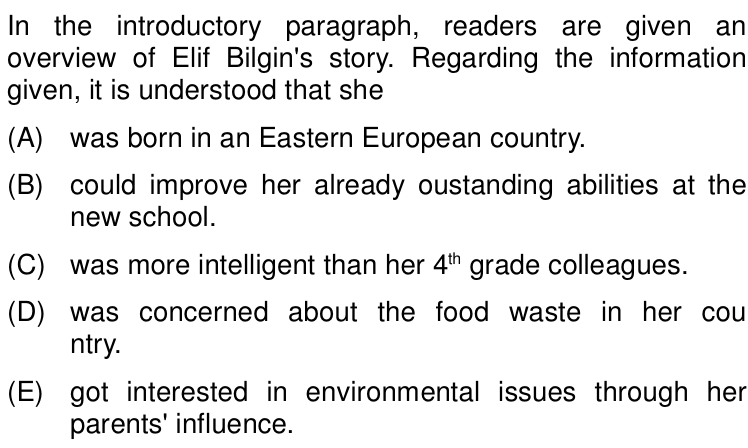
In the introductory paragraph, readers are given an overview of Elif Bilgin's story. Regarding the information given, it is understood that she
- Awas born in an Eastern European country.
- Bcould improve her already oustanding abilities at the new school.
- Cwas more intelligent than her 4th grade colleagues.
- Dwas concerned about the food waste in her country.
- Egot interested in environmental issues through her parents' influence.
Você já respondeu questões neste aparelho. Crie sua conta grátis para guardar o histórico e refazer as que errou.
Resposta salva no seu histórico.
Reportar erro na questão
Resolução comentada
A questão pede o que se entende (inferência) a partir do primeiro parágrafo. Vamos conferir cada informação com o trecho.
- O texto diz que Elif é "Turkish teen", mas não situa a Turquia como país do Leste Europeu. Isso não aparece no texto, então (A) não se sustenta.
- O texto diz: "From the 4th grade, she was put into a school for gifted children, where she was encouraged to develop her already advanced skills and talents." Ou seja, nessa escola ela foi estimulada a desenvolver habilidades que já eram avançadas. Isso corresponde a (B): melhorar suas habilidades já excepcionais na nova escola.
- O texto não compara a inteligência dela com a dos colegas do 4º ano; diz apenas que foi para uma escola de superdotados. Logo, (C) extrapola.
- A preocupação dela era com mudanças climáticas e com o plástico derivado de petróleo, não com o desperdício de comida. Isso descarta (D).
- Ela se interessou pelo meio ambiente ao estudar ("learned more about climate change"). O texto não menciona influência dos pais, que só aparecem como pessoas emocionadas com a descoberta. Isso descarta (E).
Portanto, a única afirmação apoiada pelo parágrafo é a (B).
Alternativa B.
Por que as outras alternativas estão erradas
- AO texto diz apenas que ela é turca; não a coloca na Europa Oriental.
- CNão há comparação com os colegas; só se diz que ela foi para uma escola de superdotados.
- DSua preocupação era com mudanças climáticas e plástico de petróleo, não com desperdício de comida.
- EO interesse veio dos estudos; os pais apenas se emocionaram com a descoberta.
Assunto: Inferência e ponto de vista do autor.
Reportar erro na resolução
Ver como caiu na prova
Fonte: UFG 2014 · 2º semestre · 1ª etapa. Prova oficial ↗