PRÁTICA COM QUESTÕES OFICIAIS
Questão 87 da UFG 2006 (inglês)
Leia o texto a seguir e responda às questões de 84 a 87. · 1ª etapa
NEUROSCIENCE
NO MORE...PLEASE!
A chocolate orgy for science’s sake.
How does your brain know when you’ve had too much of a good thing? Dana Small, a cognitive neuroscientist at Northwestern University’s School of Medicine in Chicago, decided to look into it by feeding people chocolate. She stood in the hallway of her department and recruited nine self-proclaimed cocoa-bean lovers, hooked them up to MRI machines, gave them chocolate, and then measured blood flow in their brains while they ate. Between bites, they were asked two questions: “Do you want another piece?” and “On a scale of minus-10 to plus-10, how much did you like the last piece?”
Of course, in the time the volunteers’ euphoria over tasting the confection turned to satiation, and, as it did, Small saw changes in their brain activity. When the subjects ate chocolate and enjoyed it, a region associated with mood – the medial part of the orbital frontal cortex – was active. But as they began to feel satiated, blood stopped flowing to that area and increased in another region probably responsible for the decision to stop eating – the adjacent lateral orbital frontal cortex.
Such images will help scientists better understand how addiction causes the brain’s normal response to a good thing to go awry. But the research also yielded a curious, unexpected result: Women ate twice as much chocolate as men before getting their fill. And while men stopped eating because they began to find the chocolate unpleasant, women stopped only when their bellies were stuffed. During the course of the study, Small also discovered another interesting fact: People of Asian descent tended to be satisfied after eating only one or two pieces of chocolate. Non-Asians, on the other hand, practically gorged themselves.
SINHA, G. NO MORE...PLEASE! Popular Science. New York, v. 259, n. 7, Jan. 2002, p. 42.
Vocabulário
to go awry: sair do curso normal
gorged themselves: empanturraram-se
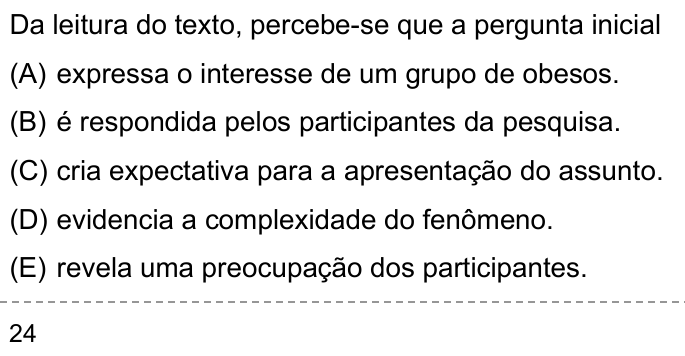
Da leitura do texto, percebe-se que a pergunta inicial
- Aexpressa o interesse de um grupo de obesos.
- Bé respondida pelos participantes da pesquisa.
- Ccria expectativa para a apresentação do assunto.
- Devidencia a complexidade do fenômeno.
- Erevela uma preocupação dos participantes.
Você já respondeu questões neste aparelho. Crie sua conta grátis para guardar o histórico e refazer as que errou.
Resposta salva no seu histórico.
Reportar erro na questão
Resolução comentada
A pergunta inicial é "How does your brain know when you've had too much of a good thing?" ("Como o seu cérebro sabe quando você já teve demais de uma coisa boa?"). Ela abre o texto, antes de qualquer informação sobre a pesquisa. O leitor ainda não sabe do que se trata, e a pergunta desperta a curiosidade dele.
O parágrafo seguinte apresenta o assunto: Dana Small decidiu investigar a questão dando chocolate a voluntários e medindo a atividade cerebral deles. Ou seja, a pergunta serve de gancho para introduzir o tema do estudo.
Veja o que não confere nas outras opções:
- Os obesos não aparecem no texto. Os voluntários eram apenas apreciadores de chocolate ("cocoa-bean lovers").
- As perguntas feitas aos participantes são outras: "Do you want another piece?" e a escala de -10 a +10. A pergunta inicial é dirigida ao leitor.
- O texto não fala em complexidade do fenômeno, e a pergunta não tem essa função.
- Quem se preocupa com o tema é a pesquisadora, e não os participantes.
A função da pergunta é criar expectativa para o assunto.
Alternativa C.
Por que as outras alternativas estão erradas
- AO texto não menciona obesos; os voluntários eram apenas apreciadores de chocolate.
- BOs participantes responderam a outras perguntas (querer outro pedaço e nota de -10 a +10), e a pergunta inicial é dirigida ao leitor.
- DO texto não discute a complexidade do fenômeno, e a pergunta serve para introduzir o tema.
- EA pergunta não expressa preocupação dos participantes; ela introduz a investigação da pesquisadora.
Assunto: Argumentação e organização do texto.
Reportar erro na resolução
Ver como caiu na prova
Fonte: UFG 2006 · 1ª etapa. Prova oficial ↗