PRÁTICA COM QUESTÕES OFICIAIS
Questão 24 (1º exame) da UERJ 2027 (inglês)
Texto-base das questões 23 a 27 · 1º Exame de Qualificação
THE ROLE OF PHOTOGRAPHY IN DOCUMENTING HISTORY
Imagery is more than a way to recall the past – it’s a powerful means of shaping narratives, recording events, and influencing how they are remembered. From landmark social movements to personal milestones, pictures offer a direct link to instances that might otherwise fade. An interesting question, however, is whether people have ever truly grasped the real power of photography.
Photography can evoke emotions, shift perspectives, and bring clarity to complex situations. Photo documentation strengthens both personal and collective memory. Since its inception, photography has been an indispensable tool in documenting history. Family albums, old newspapers, and digital archives all serve as visual time capsules, linking the past with the present. The technology behind imagery has evolved, but its purpose remains untouched: to record, reflect, and inspire.
Photographers – whether professionals or passionate storytellers – carry the responsibility of shaping historical records. Their work not only portrays events but also influences how they will be remembered. Archival photography is, then, a necessary tool in safeguarding cultural heritage, capturing traditions, and preserving historical narratives that might be forgotten. Documenting a social custom, an artistic expression or a communal identity is a way to endure that cultural stories remain alive for future generations. This not only honors the past but also provides a foundation for cultural continuity. It’s a way to perpetuate authentic human experiences. By maintaining and expanding photographic archives, societies can bridge generational gaps, ensuring that lessons from the past remain relevant. Anthropologists and historians have widely used photography to record customs across the world. This ensures that cultural diversity remains visible and accessible.
In this context, photojournalism has played an important role in shaping public policy and stimulating activism. The Civil Rights Movement, anti-war protests, and social justice campaigns have all benefited from impactful imagery. The photo of Alan Kurdi, the Syrian child who drowned while fleeing war, for example, spurred global discussions on refugee policies and humanitarian aid. Since the representation of events can shape opinions and influence politics, ethics in photojournalism is crucial. Issues such as photo manipulation, context distortion, and the invasion of privacy must be carefully managed.
It’s true that, over time, documentary photography has evolved alongside technological advancements. This evolution allows for a broader, more nuanced exploration of social, political, and environmental issues, which accounts for its significant contributions. Beyond this significance, however, photography also acts as a bridge between history and memory, preserving not only the events but also the emotions associated with them. Due to this importance, it is crucial that photographers strive to capture genuine human experiences and observe the principles of right and wrong that govern their professional conduct, adopting narratives that are aligned with what is morally correct and acceptable. By doing so, they can allow people to connect with their roots, offering them a meaningful way to celebrate and reflect on their origins.
JAHMAL GOODE
Adaptado de goodeforyouproductions.com, 29/01/2025.
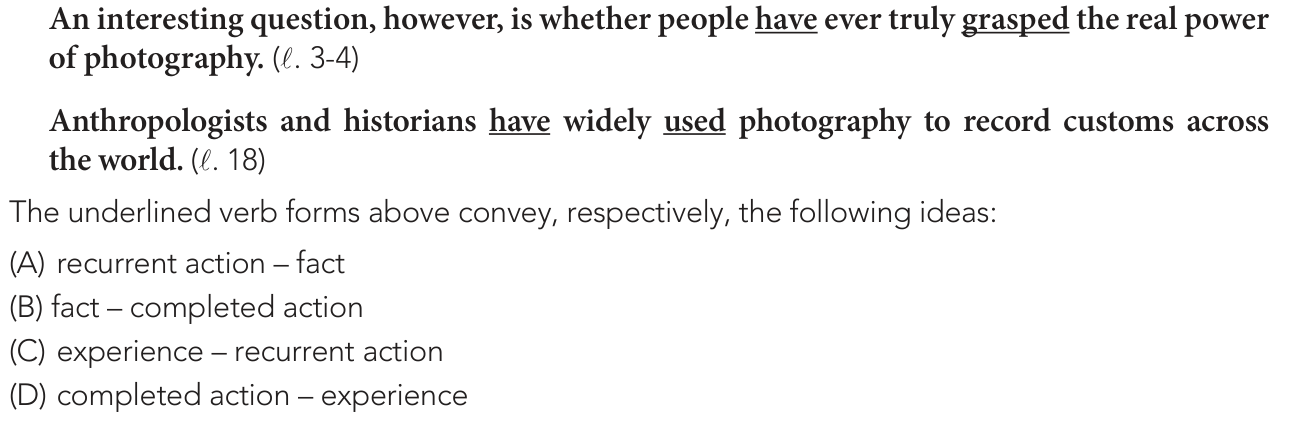
An interesting question, however, is whether people have ever truly grasped the real power of photography. (\ell. 3-4)
Anthropologists and historians have widely used photography to record customs across the world. (\ell. 18)
The underlined verb forms above convey, respectively, the following ideas:
- Arecurrent action – fact
- Bfact – completed action
- Cexperience – recurrent action
- Dcompleted action – experience
Você já respondeu questões neste aparelho. Crie sua conta grátis para guardar o histórico e refazer as que errou.
Resposta salva no seu histórico.
Reportar erro na questão
Resolução comentada
As duas formas sublinhadas são present perfect (have + particípio). Esse tempo liga o passado ao presente e pode expressar ideias diferentes, conforme o contexto.
-
Na primeira frase, "have people ever truly grasped..." usa ever ("alguma vez"). Esse advérbio pergunta sobre experiência de vida: as pessoas já chegaram, em algum momento, a compreender o poder da fotografia? Não há um momento definido, só a vivência em aberto.
-
Na segunda frase, "Anthropologists and historians have widely used photography to record customs" mostra uma prática que se repete ao longo do tempo, de modo amplo. O advérbio widely reforça a ideia de uso habitual, feito muitas vezes e por muita gente: ação recorrente.
-
A ordem pedida é "respectivamente": primeiro experiência, depois ação recorrente.
As alternativas com "fact" ou "completed action" não servem. O present perfect não indica ação concluída em tempo definido (isso seria o simple past, com yesterday, in 1990 etc.). Aqui o período de tempo continua ligado ao presente.
Alternativa C.
Por que as outras alternativas estão erradas
- AInverte a ordem: a 1ª frase, com ever, indica experiência, e a 2ª, com widely, indica ação recorrente.
- BTrata a 1ª como simples fato e a 2ª como ação concluída, mas o present perfect não marca ação encerrada em tempo definido.
- DVê ação concluída na 1ª e experiência na 2ª, invertendo e confundindo o valor do tempo verbal.
Assunto: Tempos verbais e verbos modais.
Reportar erro na resolução
Ver como caiu na prova
Fonte: UERJ 2027 · 1º Exame de Qualificação. Prova oficial ↗