Questão 23 (2º exame) da UERJ 2027 (inglês)
Texto-base das questões 23 a 27 · 2º Exame de Qualificação
THE NEUROSCIENCE OF EMOTIONS: HOW THE BRAIN
CREATES FEAR, JOY, AND LOVE
Emotions are among the most profound and mysterious aspects of human experience. They shape our thoughts, behaviors, and decisions, influence our relationships, and define what it means to be human. From the contagious joy of a child’s laughter to the growing fear in a moment of danger, emotions color our entire perception of the world. But are emotions purely abstract?
Neuroscience, the study of the nervous system and the brain, has made extraordinary progress in uncovering the biological foundations of emotions. Far from being abstract or purely psychological, emotions emerge from concrete physical processes – patterns of neural activity that evolved to help organisms survive, adapt, and connect with others. Understanding the neuroscience of emotions illuminates why humans behave the way they do and offers insights into mental health and disease. It deepens our appreciation of how biology and consciousness intertwine.
Emotions are not random sensations, as they represent complex biological mechanisms. They are shaped by evolution to guide behavior in ways that increase survival and reproduction. Long before humans developed language or culture, emotional systems helped our ancestors react quickly to threats, seek nourishment, form social bonds, and reproduce. Fear, for example, evolved as a survival mechanism to prepare the body for danger – either to fight, flee, or freeze. Joy, or positive affect, reinforces behaviors that are beneficial, such as finding food, achieving goals, or bonding with others. Joy and love are both positive feelings and have to do with pleasant moments. The latter, however, represents a more complete and profound experience, as it binds individuals together, ensuring mutual care, protection, and the raising of offspring.
Emotions, therefore, function as the brain’s motivational compass. They provide rapid, often unconscious assessments of the environment and trigger physiological responses before conscious thought catches up. Modern neuroscience has shown that they are neither purely instinctual nor purely rational. Emotions are thus shaped by a delicate balance between these chemical messengers. Their interactions create the spectrum of feelings that define our mental and social lives. Joy, happiness, and pleasure represent positive emotional states that signal well-being and success in achieving goals. These feelings are primarily governed by the brain’s reward system. Emotions guide the priorities of thought, while cognition refines emotional impulses. Together, they form the essence of intelligence.
In short, emotions are not mysterious forces dissociated from biology, or simply neural or physiological responses – they are the very essence of how the brain connects body, mind, and world. The neuroscience of emotions reveals that what we call the heart is, in many ways, the work of the brain. Yet, understanding this does not diminish the beauty of emotion – it enhances it. Every fear conquered, every joy shared, every love felt, is a testament to the extraordinary intricacy of the brain and its ability to make meaning out of personal experience. Emotions are how the brain translates the physical world into the poetry of human life.
Adaptado de sciencenewstoday.org, 05/11/2025.
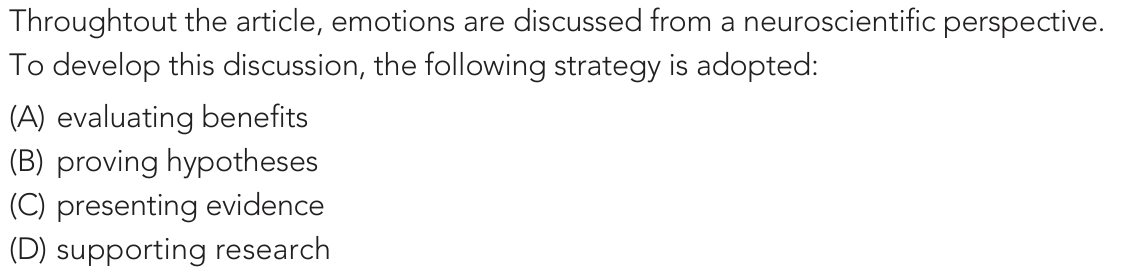
Throughtout the article, emotions are discussed from a neuroscientific perspective.
To develop this discussion, the following strategy is adopted:
- Aevaluating benefits
- Bproving hypotheses
- Cpresenting evidence
- Dsupporting research
Reportar erro na questão
Ver como caiu na prova
Fonte: UERJ 2027 · 2º Exame de Qualificação. Prova oficial ↗