PRÁTICA COM QUESTÕES OFICIAIS
Questão 24 (1º exame) da UERJ 2026 (inglês)
Texto-base das questões 23 a 27 · 1º Exame de Qualificação
Cultural amnesia refers to the phenomenon where societies ignore significant historical events, lessons, and cultural practices, leading to a fragmentation of knowledge and identity. This forgetfulness can arise from various factors, including the rapid pace of modernization, globalization and the overwhelming influence of technology, which often prioritizes immediacy over historical context. As a result, vital lessons from the past may be disregarded, leaving individuals and communities disconnected from their heritage and the wisdom embedded in historical narratives.
It is widely known that this fragmentation frequently undermines a society’s ability to learn from past mistakes. This phenomenon of cultural amnesia is not merely a contemporary issue; it has been observed throughout history. Many societies have experienced periods of forgetting or neglecting significant events due to political motives, societal shifts or collective trauma. For example, the aftermath of wars often sees nations rewriting histories to foster national unity or to justify certain actions, leading to a distorted collective memory. In some cases, governments may actively suppress historical truths to maintain power, creating a dangerous precedent where the past is selectively remembered or entirely erased. Actually, the frequency of cultural amnesia varies across societies and historical contexts, but it is a recurring theme that has profound implications.
Cultural amnesia frequently highlights a troubling tendency to overlook the lessons of history, leading to a fragmented understanding of identity and heritage. When the emphasis is placed on the new and the immediate, the rich tapestry of history can become fragmented, leading to a shallow understanding of cultural identity. To counteract this trend, it is essential for communities to prioritize historical awareness, engage with their narratives.
Addressing cultural amnesia is not simply a matter of saying “Ok, let’s accept that History has a role”. What ordinary citizens should keep in mind is that facts and data provide some of the basic elements of history as a field of study that connects to other areas, but by themselves they have limited meaning. It requires a conscious effort to engage with history, celebrate memories and ensure that significant events and lessons are passed on to the next generations.
It seems unlikely that there would be mutual respect and understanding between different groups without awareness of these narratives. This awareness has been shown to dismantle stereotypes, challenge prejudices and build bridges between different cultural groups, fostering a more cohesive and harmonious society. When societies overlook significant historical events, they may fail to learn from previous injustices, conflicts or failures.
When people recognize the fragility of cultural memory, they may feel compelled to engage with their history, whether through storytelling, education or community activities. This active participation can strengthen communal bonds and promote intergenerational knowledge transfer, ensuring that valuable lessons from the past are not lost to time. Finally, when individuals do engage with the histories and experiences of others, they are more likely to appreciate the complexities of cultural identities and the impact of historical events on various communities.
Adaptado de bohotude.com.
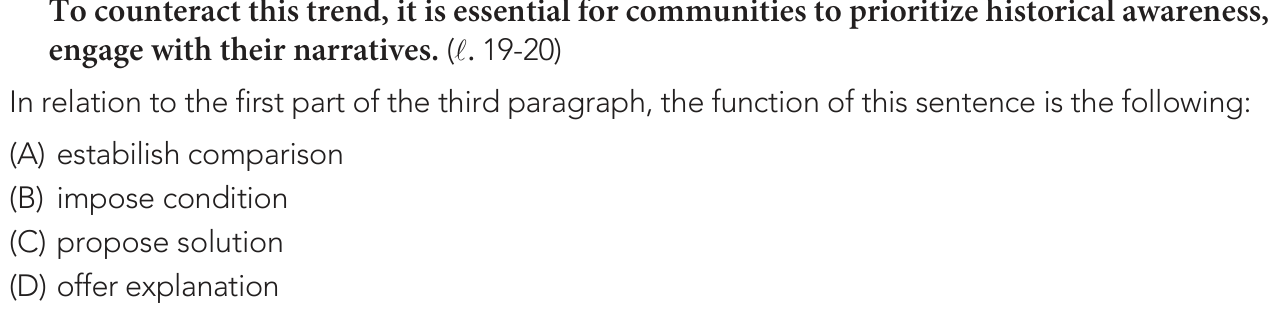
To counteract this trend, it is essential for communities to prioritize historical awareness, engage with their narratives. (\ell. 19-20)
In relation to the first part of the third paragraph, the function of this sentence is the following:
- Aestablish comparison
- Bimpose condition
- Cpropose solution
- Doffer explanation
Você já respondeu questões neste aparelho. Crie sua conta grátis para guardar o histórico e refazer as que errou.
Resposta salva no seu histórico.
Reportar erro na questão
Resolução comentada
A frase em questão está no fim do terceiro parágrafo. Para entender sua função, veja o que vem antes.
-
A primeira parte do parágrafo descreve um problema: a amnésia cultural leva a ignorar as lições da história, e dar ênfase ao novo e ao imediato deixa a compreensão da identidade cultural fragmentada e rasa.
-
A frase final começa com To counteract this trend ("Para combater essa tendência"). Counteract significa neutralizar, agir contra o problema que acabou de ser descrito.
-
Depois vem it is essential for communities to prioritize historical awareness, engage with their narratives ("é essencial que as comunidades deem prioridade à consciência histórica e se envolvam com suas narrativas"). Isso é uma ação recomendada para enfrentar o problema.
Portanto, a primeira parte apresenta o problema e a frase destacada apresenta o caminho para resolvê-lo, ou seja, uma proposta de solução.
Não há comparação (nada é contrastado com outra coisa), nem condição (não há if ou unless impondo requisito) e nem explicação das causas (as causas aparecem no primeiro parágrafo).
Alternativa C.
Por que as outras alternativas estão erradas
- ANão compara duas ideias ou situações; a frase só indica uma ação a tomar.
- BNão há estrutura condicional; "it is essential" expressa recomendação, não condição imposta.
- DNão explica causas ou motivos do problema; apresenta uma medida para combatê-lo.
Assunto: Argumentação e organização do texto.
Reportar erro na resolução
Ver como caiu na prova
Fonte: UERJ 2026 · 1º Exame de Qualificação. Prova oficial ↗