PRÁTICA COM QUESTÕES OFICIAIS
Questão 23 (2º exame) da UERJ 2025 (inglês)
Texto-base das questões 23 a 27 · 2º Exame de Qualificação
People often say “Don’t judge a book by its cover”, and it holds true in many aspects of life. We are all guilty of making snap judgements about others based on their appearance, actions or even just a brief encounter. But have you ever wondered why it’s important not to judge someone before getting to know them? Do you ever consider that?
Imagine that you are at a party and, out of the corner of your eye, you spot a person with a unique hairstyle and an outfit that screams “fashion forward”. Your brain, always ready for action, instantly springs into snap judgement mode. “They must be an avant-garde artist or a fashion model”, it enthusiastically proclaims. This is thin slice judgement! It refers to the action of making lightning-fast judgements based on minimal information. An example is when you are at a job interview, and the person in the hot seat glances at your handwriting before making a quick assessment of your personality. It sounds ludicrous, but our brain has a way of magnifying minor details and turning them into grand narratives. As amusing as it may seem, such judgements can have real-life consequences.
While snap judgements can provide an amusing story to share at parties, they can perpetuate stereotypes, reinforce biases and limit our ability to see the true beauty in diversity. Instead of jumping to conclusions, it’s better to lean into curiosity. Ask questions, seek out diverse perspectives and recognize that everyone has a unique story to tell. By embracing our inquisitive nature, we can uncover the richness of human experiences and challenge our own biases.
Empathy is the secret weapon against prejudice. To truly understand someone, you must put yourself in their shoes and see the world through their eyes. Actually, prejudice is when we form an opinion or make assumptions about someone without having all the facts. It’s like trying to write a book review after only reading the first chapter. We should strive to give people a fair chance before passing judgement. Besides, it’s essential to remember that nobody is perfect, and we should embrace diversity instead of assuming we’re always right. Rather than acting as self-appointed judges, we should approach people with empathy and understanding.
Practicing self-compassion and recognizing our own imperfections can help us show more compassion towards others. Harsh judgement can stem from a variety of factors, such as insecurity, fear or simply our own experiences and biases, but it’s okay, we’ve all been there! What’s important is to take a step back and reflect on why we are quick to judge. And, if we always do that, it’s time to think outside the box.
PATRICK TURNER
Adaptado de appgecet.co.in.
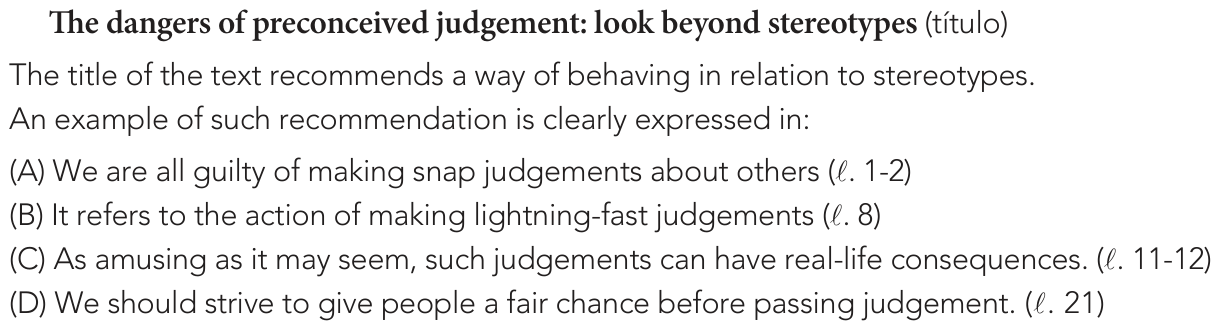
The dangers of preconceived judgement: look beyond stereotypes (título)
The title of the text recommends a way of behaving in relation to stereotypes.
An example of such recommendation is clearly expressed in:
- AWe are all guilty of making snap judgements about others (\ell. 1-2)
- BIt refers to the action of making lightning-fast judgements (\ell. 8)
- CAs amusing as it may seem, such judgements can have real-life consequences. (\ell. 11-12)
- DWe should strive to give people a fair chance before passing judgement. (\ell. 21)
Você já respondeu questões neste aparelho. Crie sua conta grátis para guardar o histórico e refazer as que errou.
Resposta salva no seu histórico.
Reportar erro na questão
Resolução comentada
O título pede que o leitor olhe além dos estereótipos, ou seja, recomenda uma conduta: não julgar as pessoas por aparências e dar a elas uma chance de se mostrarem. A questão pede o trecho que expressa essa recomendação, isto é, um conselho ou uma orientação do que fazer.
Para isso, vale separar o tipo de frase em cada alternativa:
- (A) "We are all guilty of making snap judgements" é uma constatação: diz que todos fazemos julgamentos precipitados. Não aconselha nada.
- (B) "It refers to the action of making lightning-fast judgements" é uma definição de thin slice judgement.
- (C) "such judgements can have real-life consequences" é um alerta sobre os efeitos desses julgamentos, sem dizer como agir.
- (D) "We should strive to give people a fair chance before passing judgement" usa o verbo modal should, que em inglês indica conselho ou recomendação. A tradução é "Devemos nos esforçar para dar às pessoas uma chance justa antes de julgá-las". Isso é exatamente o comportamento sugerido pelo título: não julgar de antemão.
Portanto, só a alternativa D traz uma orientação de conduta, em harmonia com o título.
Alternativa D.
Por que as outras alternativas estão erradas
- AApenas constata que todos fazemos julgamentos precipitados, sem recomendar conduta alguma.
- BÉ uma definição de thin slice judgement, não um conselho.
- CAlerta sobre as consequências dos julgamentos, mas não indica o que fazer.
Assuntos: Inferência e ponto de vista do autor, Tempos verbais e verbos modais.
Reportar erro na resolução
Ver como caiu na prova
Fonte: UERJ 2025 · 2º Exame de Qualificação. Prova oficial ↗