PRÁTICA COM QUESTÕES OFICIAIS
Questão 26 (1º exame) da UERJ 2024 (inglês)
Texto-base das questões 23 a 27 · 1º Exame de Qualificação
THE BENEFITS OF SLOWING DOWN
Hustle culture uses speed as a measure of performance. How fast can you ship a new feature? How many prospective clients can you call in an hour? How much of your day can you devote to work? If you’re not fast, are you even being productive? This harmful mindset results in burnout, poor decision-making and bad communication.
It may seem counterintuitive, but slowing down can be a faster way to achieve your goals. Fighting our urge to live and work faster can lead to clearer thinking, deeper connections and better mental health. The illusory imperative to keep up with everyone else is hurting us. Faster is not always better – far from it. By slowing down, you can build three key pillars to rely on in your life and work.
When we focus on speed, we may blindly follow a path that may not be the most efficient one to reach our goals – whether it’s a path dictated by others, or one that seems the most obvious. Slowing down allows us to be more intentional when making decisions and executing our plans.
Being fast allows us to do more. But “doing more” does not equal “doing what’s best”. Doing things slower means we can achieve a substantial increase in positive results, and even sometimes in the experience itself. Would you design a more polished feature if you had two days, or if you had two weeks? Would you enjoy a landscape better if you are driving over the speed limit, or if you are taking a leisurely walk? Would you learn more about a friend if you had a quick chat or a long conversation? Of course, we may not always have the luxury of slowness, but we should make a conscious effort to question artificial time constraints.
Consistent effort over time is more sustainable than pushing your limits to work as fast as possible. To do our best work, we need mental downtime, space for self-reflection, and a realistic schedule we can actually keep up with.
Overall, slowing down will help you make better decisions, connect deeper with people, have more meaningful experiences, all while improving your mental well-being by avoiding burnout. You may go slower, but you will go further.
Whatever area of your life you are targeting, making space for self-reflection is crucial. Helpful methods to slow down include journaling, meditation and taking breaks. Speed may sometimes be a goal in and of itself, but it should be an intentional goal rather than an automatic need to “keep up” with others.
An easy trick to slow down is to ask “Why the rush?” and to take a step back. Is speed really adding to the quality of the output?
ANNE-LAURE LE CUNFF
Adaptado de nesslabs.com.
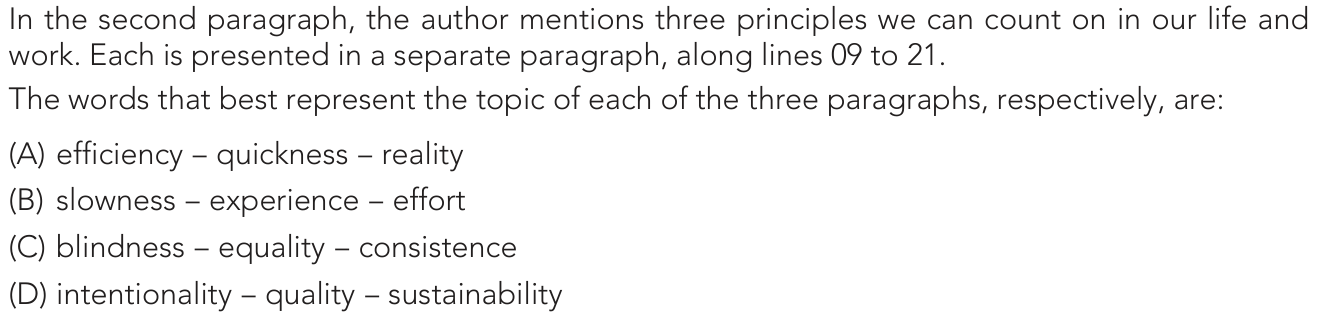
In the second paragraph, the author mentions three principles we can count on in our life and work. Each is presented in a separate paragraph, along lines 09 to 21.
The words that best represent the topic of each of the three paragraphs, respectively, are:
- Aefficiency – quickness – reality
- Bslowness – experience – effort
- Cblindness – equality – consistence
- Dintentionality – quality – sustainability
Você já respondeu questões neste aparelho. Crie sua conta grátis para guardar o histórico e refazer as que errou.
Resposta salva no seu histórico.
Reportar erro na questão
Resolução comentada
O segundo parágrafo diz que, ao desacelerar, construímos "three key pillars" (três pilares). Cada um é desenvolvido num parágrafo seguinte, e basta identificar a ideia central de cada um.
-
Parágrafo que começa com "When we focus on speed, we may blindly follow a path...": termina dizendo que desacelerar "allows us to be more intentional when making decisions and executing our plans". O tema é a intencionalidade (intentionality).
-
Parágrafo que começa com "Being fast allows us to do more. But 'doing more' does not equal 'doing what's best'": contrapõe quantidade a qualidade, falando em um recurso mais bem acabado (polished), em aproveitar melhor a paisagem e em conhecer melhor um amigo. O tema é a qualidade (quality) dos resultados e da experiência.
-
Parágrafo que começa com "Consistent effort over time is more sustainable than pushing your limits...": defende um ritmo que se possa manter, com pausas e um cronograma realista. O tema é a sustentabilidade (sustainability).
A sequência intencionalidade, qualidade, sustentabilidade só aparece na alternativa D.
Alternativa D.
Por que as outras alternativas estão erradas
- A"Quickness" é justamente o que o texto critica, e "reality" não é tema de nenhum dos três parágrafos.
- B"Slowness" é o assunto geral do texto, não de um parágrafo, e a ordem dos temas não bate com a dos parágrafos.
- C"Blindness" aparece como o risco de seguir cegamente um caminho, não como pilar; "equality" não é discutida.
Assunto: Ideia central e finalidade do texto.
Reportar erro na resolução
Ver como caiu na prova
Fonte: UERJ 2024 · 1º Exame de Qualificação. Prova oficial ↗