PRÁTICA COM QUESTÕES OFICIAIS
Questão 17 da UERJ 2023 (inglês)
Texto-base das questões 12 a 18 · Exame Único
Essential reading on, and beyond,
Indigenous Peoples Day
Formerly known as Columbus Day, today is Indigenous Peoples Day in more than 80 (and counting) cities, counties and states. While official recognition of this day began in the late ‘70s, with the UN discussing the replacement of Columbus Day, resistance and challenge to said “holiday” existed in the hearts and minds of indigenous and native peoples long before cities or states began to observe Indigenous Peoples Day.
As land defenders – people who are working for indigenous territories to be protected from contamination and exploitation – we see Indigenous Peoples Day as progress; it signals a crucial shift in our culture to recognize the dark past of colonization. No longer are our communities, towns, cities and states remaining silent and complacent in celebrating the cultural genocide that ensued after Christopher Columbus landed on Turtle Island (a.k.a. North America). Today also means that the erasure of our narrative as indigenous peoples is ending and our truths are rising to the surface. These truths include: Christopher Columbus was not a hero; he was a murderer. The land we all exist on is stolen. The history we’ve been taught is not accurate or complete. And perhaps most important among those truths, indigenous lands are still being colonized, and our people are still suffering the trauma and impacts of colonization.
Across the country, we continue to see the violation of our rights and treaties as extractive projects are proposed and constructed. Across the nation, we continue to grieve our missing and murdered indigenous women, victims of violence brought to their communities by extractive oil and mining projects. We continue to bear the brunt of climate change as our food sovereignty is threatened by dying ecosystems and as our animal relatives are becoming extinct due to land loss, warmer seasons and/or contamination. And now, we are fighting for the very right to resist as anti-protest laws emerge across the country, which aim to criminalize our people for protecting what is most sacred to us.
Yet, despite these challenges, our people and communities are demonstrating incredible bravery and innovation to bring forth healing and justice. Through the tireless work of indigenous organizers, activists, knowledge keepers and artists, we are learning about what is working and what our movements need more of to dismantle systems like white supremacy and systemic racism that colonization has imposed on our communities.
So while we could dive into the stories of how our people are still being attacked by the many forms of colonization, we find it important on this day, a day that symbolizes progress and evolution, to acknowledge what is working in our communities and in our movements. All too often, our people are framed as victims, and while there’s truth in those narratives, it’s also critical, for our self-actualization as indigenous peoples, to have our strengths, our resilience and our creativity seen and honored.
JADE BEGAY AND DALLAS GOLDTOOTH
sierraclub.org, 08/10/2018
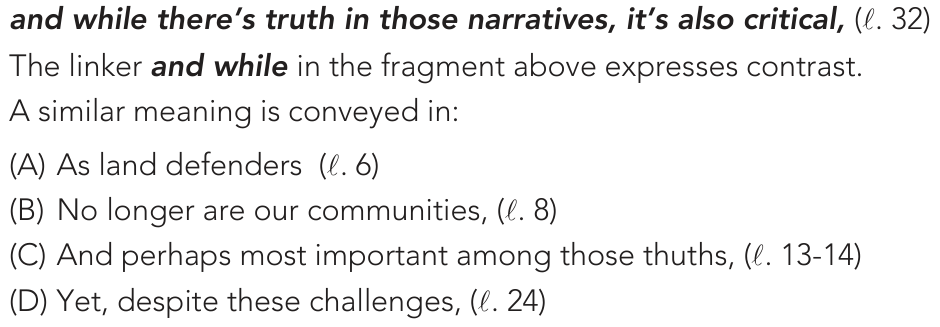
and while there’s truth in those narratives, it’s also critical, (\ell. 32)
The linker and while in the fragment above expresses contrast.
A similar meaning is conveyed in:
- AAs land defenders (\ell. 6)
- BNo longer are our communities, (\ell. 8)
- CAnd perhaps most important among those thuths, (\ell. 13-14)
- DYet, despite these challenges, (\ell. 24)
Você já respondeu questões neste aparelho. Crie sua conta grátis para guardar o histórico e refazer as que errou.
Resposta salva no seu histórico.
Reportar erro na questão
Resolução comentada
O conectivo while ("and while there's truth...") tem sentido de contraste/concessão: equivale a "embora" ou "ainda que". O trecho diz que, embora haja verdade nas narrativas de vítimas, é crucial destacar também as forças e a criatividade dos povos indígenas.
Para responder, é preciso achar o trecho que também marca oposição ou concessão:
- (A) As land defenders: as introduz o papel de "defensores da terra" ("como"). Não há contraste.
- (B) No longer are our communities: no longer indica que algo deixou de acontecer ("não mais"). Expressa mudança de tempo, não contraste.
- (C) And perhaps most important among those truths: and apenas soma uma ideia à lista de verdades, e perhaps indica probabilidade. Não há oposição.
- (D) Yet, despite these challenges: yet significa "no entanto" e despite significa "apesar de". Os dois marcam contraste e concessão. O trecho opõe os desafios à coragem e à inovação das comunidades.
A alternativa D é a única que traz ideia semelhante à de while.
Alternativa D.
Por que as outras alternativas estão erradas
- A"As" aqui significa "como" (na condição de), sem ideia de contraste.
- B"No longer" indica que algo não ocorre mais, ou seja, mudança temporal, não oposição.
- C"And perhaps" adiciona e enfatiza uma verdade, sem opor ideias.
Assunto: Conectivos e relações lógicas.
Reportar erro na resolução
Ver como caiu na prova
Fonte: UERJ 2023 · Exame Único. Prova oficial ↗