PRÁTICA COM QUESTÕES OFICIAIS
Questão 17 da UERJ 2022 (inglês)
Texto-base das questões 12 a 18 · Exame Único
O romance Animal Farm ("A revolução dos bichos"), de George Orwell, se passa numa fazenda onde animais, liderados pelo porco Old Major, decidem fazer uma revolução. São apresentados abaixo dois trechos do romance: o primeiro, de sua parte inicial, quando a fazenda ainda é administrada por Mr. Jones; o segundo, de sua parte final, quando passa a ser controlada pelos animais.
PART 1
Word had gone round during the day that Old Major (...) had had a strange dream on the previous night and wished to communicate it to the other animals. It had been agreed that they should all meet in the big barn as soon as Mr. Jones was safely out of the way.
(...) When Major saw that they had all made themselves comfortable and were waiting attentively, he cleared his throat and began: “Now comrades, what is the nature of this life of ours? Let us face it: our lives are miserable, laborious, and short. (...) Why then do we continue in this miserable condition? Because nearly the whole of the produce of our labour is stolen from us by human beings. There, comrades, is the answer to all our problems. It is summed up in a single word: Man. Man is the only real enemy we have. Remove Man from the scene, and the root cause of hunger and overwork is abolished forever. Man is the only creature that consumes without producing. He does not give milk, he does not lay eggs (...), yet he is lord of all the animals. (...) Is it not crystal clear, then, comrades, that all the evils of this life of ours spring from the tyranny of human beings? Only get rid of Man, and the produce of our labour would be our own. (...) That is my message to you, comrades: Rebellion!”
PART 2
Years passed. The seasons came and went, the short animal lives fled by. A time came when there was no one who remembered the old days before the Rebellion (...).
Somehow it seemed as though the farm had grown richer without making the animals themselves any richer – except, of course, for the pigs and the dogs. (...) It was not that these creatures did not work, after their fashion. There was, as Squealer* was never tired of explaining, endless work in the supervision and organization of the farm. Much of this work was of a kind that the other animals were too ignorant to understand. For example, Squealer told them that the pigs had to expend enormous labours every day upon mysterious things called “files”, “reports”, “minutes” and “memoranda”. These were large sheets of paper which had to be closely covered with writing, and as soon as they were so covered, they were burnt in the furnace. This was of the highest importance for the welfare of the farm, Squealer said. But still, neither pigs nor dogs produced any food by their own labour; and there were very many of them, and their appetites were always good. As for the others, their life, so far as they knew, was as it had always been. They were generally hungry, they slept on straw, they drank from the pool, they laboured in the fields. (...)
And yet the animals never gave up hope. More, they never lost, even for an instant, their sense of honour and privilege in being members of Animal Farm. They were still the only farm in the whole county — in all England! — owned and operated by animals. (...)
* Squealer is the name of a pig.
GEORGE ORWELL
Animal Farm. Londres: Longman, 1945.
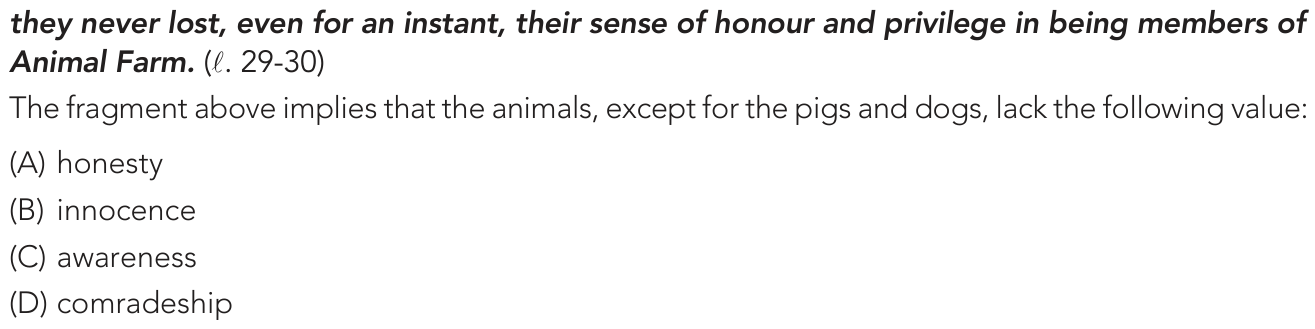
they never lost, even for an instant, their sense of honour and privilege in being members of Animal Farm. (\ell. 29-30)
The fragment above implies that the animals, except for the pigs and dogs, lack the following value:
- Ahonesty
- Binnocence
- Cawareness
- Dcomradeship
Você já respondeu questões neste aparelho. Crie sua conta grátis para guardar o histórico e refazer as que errou.
Resposta salva no seu histórico.
Reportar erro na questão
Resolução comentada
O trecho diz que os animais nunca perderam o "sentido de honra e privilégio" por serem membros da Animal Farm. Só que o contexto mostra que a vida deles não melhorou: continuam com fome, dormem na palha e trabalham nos campos, enquanto porcos e cachorros vivem do trabalho alheio.
O texto também diz que o trabalho dos porcos é de um tipo que "the other animals were too ignorant to understand" (os outros animais eram ignorantes demais para entender). Squealer explica coisas misteriosas, como "files" e "reports", e os animais aceitam tudo sem questionar. Eles não percebem que estão sendo explorados, e que a situação é igual à denunciada por Old Major na Parte 1, só que agora com porcos no lugar dos humanos.
O valor que falta aos animais, portanto, é a consciência (awareness): a capacidade de perceber a realidade e a manipulação que sofrem. O orgulho que sentem é fruto dessa falta de percepção.
Conferindo as demais:
- Honestidade não é tema do trecho; quem mente é Squealer.
- Inocência não é um valor que se possa cobrar deles.
- Companheirismo (comrades) aparece no discurso de Old Major, mas o fragmento não diz que falte entre eles.
Alternativa C.
Por que as outras alternativas estão erradas
- AA desonestidade está em Squealer e nos porcos, e o trecho não diz que os outros animais careçam de honestidade.
- BInocência não é um valor cuja falta o fragmento sugira; o problema é não perceber a exploração.
- DO fragmento não trata de falta de companheirismo entre os animais, e sim de falta de percepção da realidade.
Assuntos: Inferência e ponto de vista do autor, Poemas, canções e textos literários.
Reportar erro na resolução
Ver como caiu na prova
Fonte: UERJ 2022 · Exame Único. Prova oficial ↗