PRÁTICA COM QUESTÕES OFICIAIS
Questão 27 (1º exame) da UERJ 2020 (inglês)
Texto-base das questões 23 a 27 · 1º Exame de Qualificação
Organizers of an annual conference that brings together people who believe that our planet is not round are planning a cruise to the supposed edge of the Earth. They’re looking for the ice wall that holds back the oceans.
The journey will take place in 2020, the Flat Earth International Conference (FEIC) recently announced on its website. The goal? To test so-called flat-Earthers’ assertion that the Earth is a flattened disk surrounded at its edge by a towering wall of ice.
Details about the event, including the dates, are forthcoming, according to the FEIC, which calls the cruise “the biggest, boldest adventure yet”. However, it’s worth noting that nautical maps and navigation technologies such as global positioning systems (GPS) work as they do because the Earth is … a globe.
Believers in a flat Earth argue that images showing a curved horizon are fake and that photos of a round Earth from space are part of a vast conspiracy perpetrated by NASA and other space agencies to hide Earth’s flatness. “This likely began during the cold war”, the Flat Earth Society (FES) says. “The U.S.S.R. and U.S.A. were obsessed with beating each other into space to the point that each faked their accomplishments in an attempt to keep pace with the other’s supposed achievements.” These and other flat-Earth assertions appear on the website of the FES, allegedly the world’s oldest official flat Earth organization, dating to the early 1800s.
However, the ancient Greeks demonstrated that Earth was a sphere more than 2.000 years ago, and the gravity that keeps everything on the planet from flying off into space could exist only on a spherical world.
But in diagrams shared on the FES website, the planet appears as a pancake-like disk with the North Pole smacked in the center and an edge “surrounded on all sides by an ice wall that holds the oceans back”. This ice wall – thought by some flat-Earthers to be Antarctica – is the destination of the promised FEIC cruise.
There’s just one catch: navigational charts and systems that guide cruise ships and other vessels around the Earth’s oceans are all based on the principle of a round Earth, says Henk Keijer, a former cruise ship captain with 23 years of experience.
GPS relies on a network of dozens of satellites orbiting thousands of miles above Earth; signals from the satellites beam down to the receiver inside of a GPS device, and at least three satellites are required to pinpoint a precise position because of Earth’s curvature, Keijer explained. “Had the Earth been flat, a total of three satellites would have been enough to provide this information to everyone on Earth”. He adds: “But it is not enough, because the Earth is round”.
Whether or not, the FEIC cruise will rely on GPS or deploy an entirely new flat-Earth-based navigation system for finding the end of the world remains to be seen.
Adaptado de livescience.com, 30/05/2017.
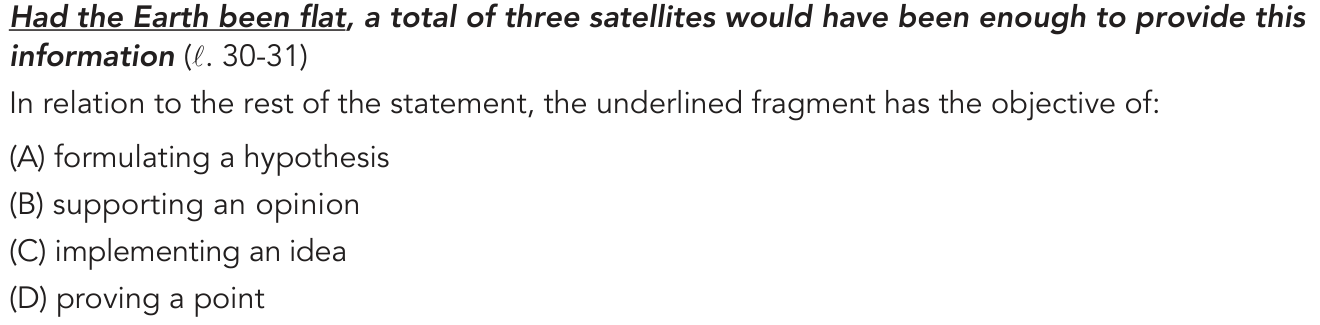
Had the Earth been flat, a total of three satellites would have been enough to provide this information (\ell. 30-31)
In relation to the rest of the statement, the underlined fragment has the objective of:
- Aformulating a hypothesis
- Bsupporting an opinion
- Cimplementing an idea
- Dproving a point
Você já respondeu questões neste aparelho. Crie sua conta grátis para guardar o histórico e refazer as que errou.
Resposta salva no seu histórico.
Reportar erro na questão
Resolução comentada
O trecho sublinhado, Had the Earth been flat, é uma oração condicional com inversão. Em inglês formal, no lugar de If the Earth had been flat, pode-se omitir o if e inverter o auxiliar: Had the Earth been.... Esse é o chamado third conditional, que fala de uma situação irreal, contrária ao fato.
A estrutura completa é: Had + sujeito + particípio, seguida de would have + particípio. Aqui, would have been enough é a consequência.
Portanto:
- A condição é "se a Terra fosse plana", o que, segundo o texto, não é verdade.
- A consequência seria "três satélites bastariam".
- Em seguida o texto afirma: But it is not enough, because the Earth is round, o que confirma que a condição é contrária à realidade.
Assim, o fragmento sublinhado não defende uma opinião, não executa uma ideia e não comprova nada. Ele apenas levanta uma hipótese (irreal), a partir da qual se tira a consequência. A função dele em relação ao resto da frase é formular uma hipótese.
Alternativa A.
Por que as outras alternativas estão erradas
- BA oração condicional não sustenta uma opinião; ela apresenta uma situação imaginada, e a opinião vem na frase seguinte.
- CImplementar uma ideia significa pô-la em prática, e a oração só imagina um cenário irreal.
- DProvar algo exige afirmar fatos, mas a oração trata de algo que não aconteceu e não serve de prova em si.
Assunto: Tempos verbais e verbos modais.
Reportar erro na resolução
Ver como caiu na prova
Fonte: UERJ 2020 · 1º Exame de Qualificação. Prova oficial ↗