PRÁTICA COM QUESTÕES OFICIAIS
Questão 23 (1º exame) da UERJ 2020 (inglês)
Texto-base das questões 23 a 27 · 1º Exame de Qualificação
Organizers of an annual conference that brings together people who believe that our planet is not round are planning a cruise to the supposed edge of the Earth. They’re looking for the ice wall that holds back the oceans.
The journey will take place in 2020, the Flat Earth International Conference (FEIC) recently announced on its website. The goal? To test so-called flat-Earthers’ assertion that the Earth is a flattened disk surrounded at its edge by a towering wall of ice.
Details about the event, including the dates, are forthcoming, according to the FEIC, which calls the cruise “the biggest, boldest adventure yet”. However, it’s worth noting that nautical maps and navigation technologies such as global positioning systems (GPS) work as they do because the Earth is … a globe.
Believers in a flat Earth argue that images showing a curved horizon are fake and that photos of a round Earth from space are part of a vast conspiracy perpetrated by NASA and other space agencies to hide Earth’s flatness. “This likely began during the cold war”, the Flat Earth Society (FES) says. “The U.S.S.R. and U.S.A. were obsessed with beating each other into space to the point that each faked their accomplishments in an attempt to keep pace with the other’s supposed achievements.” These and other flat-Earth assertions appear on the website of the FES, allegedly the world’s oldest official flat Earth organization, dating to the early 1800s.
However, the ancient Greeks demonstrated that Earth was a sphere more than 2.000 years ago, and the gravity that keeps everything on the planet from flying off into space could exist only on a spherical world.
But in diagrams shared on the FES website, the planet appears as a pancake-like disk with the North Pole smacked in the center and an edge “surrounded on all sides by an ice wall that holds the oceans back”. This ice wall – thought by some flat-Earthers to be Antarctica – is the destination of the promised FEIC cruise.
There’s just one catch: navigational charts and systems that guide cruise ships and other vessels around the Earth’s oceans are all based on the principle of a round Earth, says Henk Keijer, a former cruise ship captain with 23 years of experience.
GPS relies on a network of dozens of satellites orbiting thousands of miles above Earth; signals from the satellites beam down to the receiver inside of a GPS device, and at least three satellites are required to pinpoint a precise position because of Earth’s curvature, Keijer explained. “Had the Earth been flat, a total of three satellites would have been enough to provide this information to everyone on Earth”. He adds: “But it is not enough, because the Earth is round”.
Whether or not, the FEIC cruise will rely on GPS or deploy an entirely new flat-Earth-based navigation system for finding the end of the world remains to be seen.
Adaptado de livescience.com, 30/05/2017.
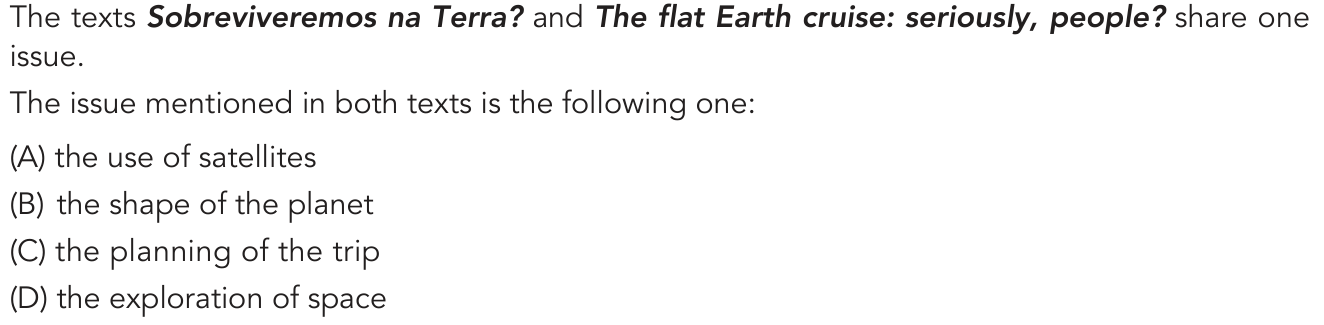
The texts Sobreviveremos na Terra? and The flat Earth cruise: seriously, people? share one issue.
The issue mentioned in both texts is the following one:
- Athe use of satellites
- Bthe shape of the planet
- Cthe planning of the trip
- Dthe exploration of space
Você já respondeu questões neste aparelho. Crie sua conta grátis para guardar o histórico e refazer as que errou.
Resposta salva no seu histórico.
Reportar erro na questão
Resolução comentada
A questão pede o tema comum aos dois textos. Só temos o texto em inglês, mas ele permite testar cada alternativa.
O texto sobre o cruzeiro trata de pessoas que acreditam que a Terra é um disco plano, cercado por um muro de gelo. Contra elas, o texto apresenta argumentos de que a Terra é uma esfera:
- Os mapas náuticos e o GPS funcionam porque a Terra é "um globo".
- Os antigos gregos demonstraram, há mais de 2.000 anos, que a Terra é uma esfera.
- A gravidade só poderia existir em um mundo esférico.
- Seriam necessários pelo menos três satélites por causa da curvatura da Terra.
Portanto, o assunto central do texto é a forma do planeta: plana ou redonda.
As demais alternativas aparecem só como detalhe ou nem aparecem. Os satélites entram como argumento sobre o GPS. O cruzeiro é o fato que dá origem à notícia, mas não é o tema comum. A exploração espacial surge apenas na acusação de que as agências espaciais forjam fotos.
O outro texto, Sobreviveremos na Terra?, não está disponível aqui. Por isso, a escolha se apoia no tema central do texto em inglês, e a forma do planeta é o assunto que atravessa todo ele.
Alternativa B.
Por que as outras alternativas estão erradas
- AOs satélites aparecem só como um argumento (GPS) a favor da Terra esférica, não como o tema central.
- CO planejamento da viagem é o gancho da notícia, mas o debate de fundo é sobre o formato da Terra.
- DA exploração espacial é mencionada apenas na acusação de conspiração da NASA, sendo um detalhe secundário.
Assunto: Argumentação e organização do texto.
Reportar erro na resolução
Ver como caiu na prova
Fonte: UERJ 2020 · 1º Exame de Qualificação. Prova oficial ↗