PRÁTICA COM QUESTÕES OFICIAIS
Questão 23 (2º exame) da UERJ 2020 (inglês)
Texto-base das questões 23 a 27 · 2º Exame de Qualificação
THE POWER OF METAPHORS
Imagine your city isn’t as safe as it used to be. Robberies are on the rise, home invasions are increasing and murder rates have nearly doubled in the past three years. What should city officials do about it? Hire more cops to round up the thugs and lock them away in a growing network of prisons? Or design programs that promise more peace by addressing issues like a faltering economy and underperforming schools?
Your answer – and the reasoning behind it – can hinge on the metaphor being used to describe the problem, according to new research by Stanford psychologists. Your thinking can even be swayed with just one word, they say.
Psychology Assistant Professor Lera Boroditsky and doctoral candidate Paul Thibodeau were curious about how subtle cues and common figures of speech can frame approaches to difficult problems. “Some estimates suggest that one out of every 25 words we encounter is a metaphor”, said Thibodeau, the study’s lead author. “But we didn’t know the extent to which these metaphors influence people”.
In five experiments, test subjects were asked to read short paragraphs about rising crime rates in the fictional city of Addison and answer questions about the city. The researchers gauged how people answered these questions in light of how crime was described – as a beast or a virus.
They found the test subjects’ proposed solutions differed a great deal depending on the metaphor they were exposed to. The results have shown that people will likely support an increase in police forces and jailing of offenders if crime is described as a “beast” preying on a community. But if people are told crime is a “virus” infecting a city, they are more inclined to treat the problem with social reform. According to Boroditsky: “People like to think they’re objective. They want to believe they’re logical. But they’re really being swayed by metaphors”.
To get a sense of how much the metaphor really mattered, the researchers also examined what role political persuasions play in people’s approach to reducing crime. They suspected that Republicans would be more inclined to catch and incarcerate criminals than Democrats, who would prefer enacting social reforms. They found Republicans were about 10 percent more likely to suggest an enforcement-based solution.
“We can’t talk about any complex situation – like crime – without using metaphors”, said Boroditsky. “Metaphors aren’t just used for flowery speech. They shape the conversation for things we’re trying to explain and figure out. And they have consequences for determining what we decide is the right approach to solving problems”.
While their research focused on attitudes about crime, their findings can be used to understand the implications of how a casual or calculated turn of phrase can influence debates and change minds.
Adaptado de news.stanford.edu.
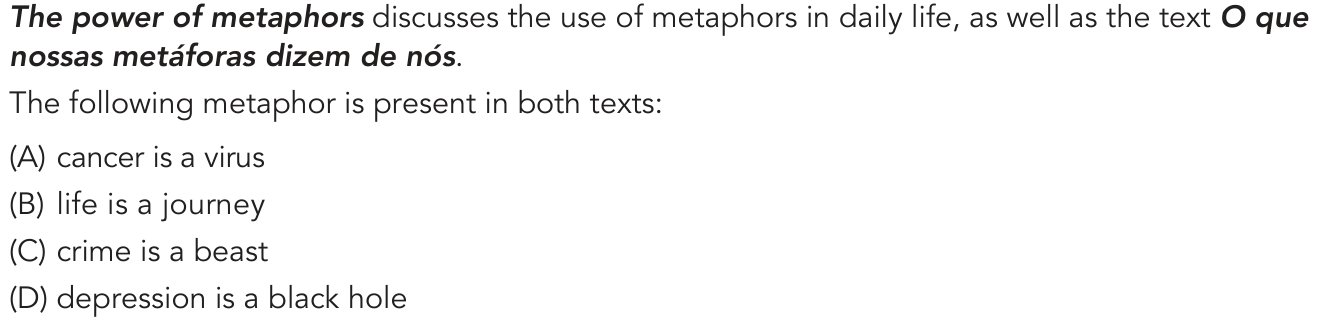
The power of metaphors discusses the use of metaphors in daily life, as well as the text O que nossas metáforas dizem de nós.
The following metaphor is present in both texts:
- Acancer is a virus
- Blife is a journey
- Ccrime is a beast
- Ddepression is a black hole
Você já respondeu questões neste aparelho. Crie sua conta grátis para guardar o histórico e refazer as que errou.
Resposta salva no seu histórico.
Reportar erro na questão
Resolução comentada
A pergunta pede a metáfora que aparece nos dois textos. Só temos o texto em inglês, e ele é a base para eliminar as opções.
No texto "The power of metaphors", os pesquisadores descrevem o crime de duas formas: como uma beast (fera) que ataca a comunidade e como um virus que infecta a cidade.
Ora, a metáfora é "crime is a beast" (o crime é uma fera), que aparece nas frases "if crime is described as a 'beast' preying on a community".
Agora confira as demais opções:
- "Cancer is a virus": o texto fala em crime como vírus, não em câncer.
- "Life is a journey": não aparece no texto em inglês.
- "Depression is a black hole": também não aparece.
Portanto, a única metáfora que o texto em inglês traz literalmente é "crime is a beast". Como o enunciado diz que ela está presente nos dois textos, o outro texto, "O que nossas metáforas dizem de nós", também deve usá-la, e as outras opções não têm base no texto fornecido.
Alternativa C.
Pegadinha: A alternativa A engana por conter "virus", que aparece no texto, mas ligado ao crime e não ao câncer.
Por que as outras alternativas estão erradas
- AO texto compara o crime a um vírus, não o câncer; troca o termo comparado.
- B"Life is a journey" é metáfora comum, mas não aparece no texto em inglês.
- D"Depression is a black hole" não é mencionada no texto em inglês.
Assunto: Linguagem figurada, ironia e humor.
Reportar erro na resolução
Ver como caiu na prova
Fonte: UERJ 2020 · 2º Exame de Qualificação. Prova oficial ↗