PRÁTICA COM QUESTÕES OFICIAIS
Questão 28 (2º exame) da UERJ 2019 (inglês)
Texto-base das questões 24 a 28 · 2º Exame de Qualificação
Ticking away the moments that make up a dull day You fritter and waste the hours in an offhand way Kicking around on a piece of ground in your home town Waiting for someone or something to show you the way
Tired of lying in the sunshine Staying home to watch the rain You are young and life is long And there is time to kill today And then one day you find Ten years have got behind you No one told you when to run You missed the starting gun
And you run and you run to catch up with the sun, but it’s sinking And racing around to come up behind you again The sun is the same in a relative way, but you’re older Shorter of breath and one day closer to death
Every year is getting shorter Never seem to find the time Plans that either come to naught Or half a page of scribbled lines Hanging on in quiet desperation is the English way The time has gone, the song is over Thought I’d something more to say
Home, home again I like to be here when I can And when I come home cold and tired It’s good to warm my bones beside the fire Far away, across the field The tolling of the iron bell Calls the faithful to their knees To hear the softly spoken magic spells
ROGER WATERS
letras.mus.br
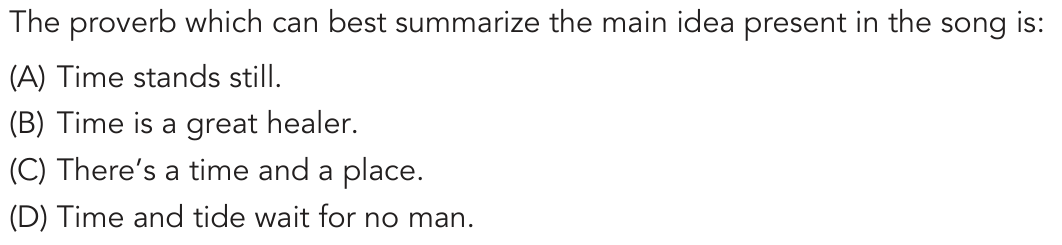
The proverb which can best summarize the main idea present in the song is:
- ATime stands still.
- BTime is a great healer.
- CThere’s a time and a place.
- DTime and tide wait for no man.
Você já respondeu questões neste aparelho. Crie sua conta grátis para guardar o histórico e refazer as que errou.
Resposta salva no seu histórico.
Reportar erro na questão
Resolução comentada
A música é "Time", do Pink Floyd. O eu lírico fala de como o tempo passa sem a gente perceber: o jovem desperdiça as horas ("you fritter and waste the hours"), acha que "life is long" e, de repente, "ten years have got behind you". Ninguém avisa a hora de correr ("No one told you when to run, you missed the starting gun"). Depois, tentar alcançar o sol é inútil, pois ele afunda, e o sujeito fica mais velho, "one day closer to death". Mais adiante: "The time has gone, the song is over".
A ideia central, portanto, é que o tempo passa inexoravelmente, não espera ninguém, e quem o desperdiça perde a chance de aproveitá-lo.
Agora, os provérbios:
- "Time stands still" (o tempo para): contraria o texto, em que o tempo corre.
- "Time is a great healer" (o tempo cura): fala de superar dores, tema ausente.
- "There's a time and a place" (há hora e lugar certos): trata de adequação, não de tempo que foge.
- "Time and tide wait for no man" (o tempo e a maré não esperam ninguém): resume exatamente a passagem implacável do tempo.
Alternativa D.
Por que as outras alternativas estão erradas
- ADiz que o tempo para, o oposto da canção, em que o tempo escapa e corre.
- BFala do tempo como cura de sofrimentos, assunto que a letra não trata.
- CTrata de haver momento e lugar adequados para algo, não da passagem inexorável do tempo.
Assuntos: Expressões idiomáticas e phrasal verbs, Poemas, canções e textos literários.
Reportar erro na resolução
Ver como caiu na prova
Fonte: UERJ 2019 · 2º Exame de Qualificação. Prova oficial ↗