PRÁTICA COM QUESTÕES OFICIAIS
Questão 25 (2º exame) da UERJ 2019 (inglês)
Texto-base das questões 24 a 28 · 2º Exame de Qualificação
Ticking away the moments that make up a dull day You fritter and waste the hours in an offhand way Kicking around on a piece of ground in your home town Waiting for someone or something to show you the way
Tired of lying in the sunshine Staying home to watch the rain You are young and life is long And there is time to kill today And then one day you find Ten years have got behind you No one told you when to run You missed the starting gun
And you run and you run to catch up with the sun, but it’s sinking And racing around to come up behind you again The sun is the same in a relative way, but you’re older Shorter of breath and one day closer to death
Every year is getting shorter Never seem to find the time Plans that either come to naught Or half a page of scribbled lines Hanging on in quiet desperation is the English way The time has gone, the song is over Thought I’d something more to say
Home, home again I like to be here when I can And when I come home cold and tired It’s good to warm my bones beside the fire Far away, across the field The tolling of the iron bell Calls the faithful to their knees To hear the softly spoken magic spells
ROGER WATERS
letras.mus.br
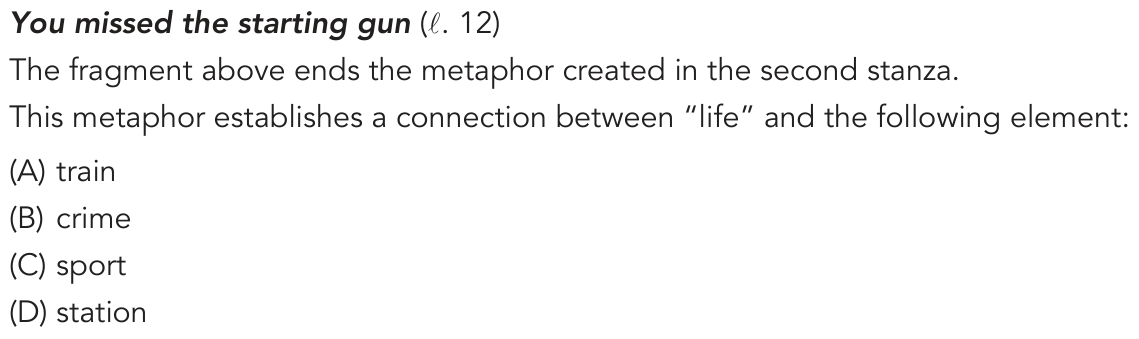
You missed the starting gun (\ell. 12)
The fragment above ends the metaphor created in the second stanza.
This metaphor establishes a connection between “life” and the following element:
- Atrain
- Bcrime
- Csport
- Dstation
Você já respondeu questões neste aparelho. Crie sua conta grátis para guardar o histórico e refazer as que errou.
Resposta salva no seu histórico.
Reportar erro na questão
Resolução comentada
Uma metáfora estabelece uma comparação implícita: o poeta fala de uma coisa (a vida) usando o vocabulário de outra. Por isso, é preciso achar o campo semântico das palavras da segunda estrofe.
Os versos são:
- "Ten years have got behind you": os anos ficam para trás, como alguém que está atrasado numa disputa.
- "No one told you when to run": ninguém avisou quando era a hora de correr.
- "You missed the starting gun": você não ouviu o tiro de largada.
O starting gun é a pistola que dá a largada de uma corrida. Quem perde a largada começa atrás dos outros e precisa correr para alcançá-los. Na estrofe seguinte, a imagem continua: "you run and you run to catch up with the sun" e "racing around". As palavras run, starting gun e racing pertencem todas ao mundo do esporte, mais especificamente das corridas.
Assim, a vida é apresentada como uma competição em que o sujeito, distraído, "matando o tempo" (time to kill), saiu atrasado e passa a perseguir o tempo sem conseguir alcançá-lo.
Não há no texto nenhuma referência a trem, a estação ou a crime. Por isso, a relação é entre vida e esporte.
Alternativa C.
Pegadinha: A alternativa B engana por causa da palavra "gun", que sugere crime, mas aqui é a pistola de largada de uma corrida.
Por que as outras alternativas estão erradas
- ATrem não aparece no trecho; "run" e "starting gun" não remetem a transporte ferroviário.
- BNão há vocabulário de crime; "gun" (arma) engana, mas aqui é a pistola de largada.
- DEstação (station) não é mencionada; a imagem é de corrida, não de viagem.
Assunto: Poemas, canções e textos literários.
Reportar erro na resolução
Ver como caiu na prova
Fonte: UERJ 2019 · 2º Exame de Qualificação. Prova oficial ↗