PRÁTICA COM QUESTÕES OFICIAIS
Questão 27 (1º exame) da UERJ 2018 (inglês)
Texto-base das questões 26 a 30 · 1º Exame de Qualificação
OUR (IM)PERFECT BODIES
Since I write a lot about positive body image, you’d think that I am well over the idea that weight should be something that I allow to define my life. Yet, the vestiges of my past life as a woman obsessed with weight still linger. A good example is vacation pictures. If I show you pictures of all the places I have been in my life, I can give you minute details about the place itself, the food, the sights and the weather. I can also tell you something else simply by looking at those pictures: the exact number on the scale I was at that particular time in my life.
Sometimes my past catches up with me. I like to think of myself as a recovering weight-a-holic.
The fear of being overweight is a constant one of despair at not being personally successful in controlling your own body. What good is being in control of finances, major companies and businesses if you’re not in control of your body?! Silly idea, right? And yet that is exactly the unconscious thought many intelligent women have.
Feeling satisfied with your appearance makes a tremendous amount of difference in how you present yourself to the world. Some women live their entire lives on their perception of their physical selves. But I’ve been there, done that. The hell with that idea! Personally, I became tired of living my life this way.
My friend is an art historian who specializes in the Renaissance period. Talking with him recently gave me a perspective on body image. As we walked through the permanent exhibit of Renaissance Art in the Metropolitan Museum of Art, he pointed out the paintings done of women.
The women came in all sizes, all shapes. Some were curvier than others, but all were beautiful. Some had what we refer to as love handles; some had soft, fuller stomachs that had never suffered through crunches in a gym. Though I had seen them many times, it was actually refreshing to view them in a new light.
We are led to believe our self-worth must be a reflection of our looks. So, in essence, if we don’t believe we look good, we assume we have no worth! Yet, self-worth should have nothing to do with looks and everything to do with an innate feeling that you really are worth it. You are worth going after your dreams, you are worth being in a good relationship, you are worth living a life that fulfills and nourishes you, and you are certainly worthy of being a successful woman.
There is a quote attributed to Michelangelo that I’ve always admired. When a friend complimented him on the glorious Sistine Chapel, the great artist, referring to his art in the feminine form, was said to have replied: “She is worthy of admiration simply because she exists; perfection and imperfection together”.
BRISTEN HOUGHTON
Adaptado de twitter.com.
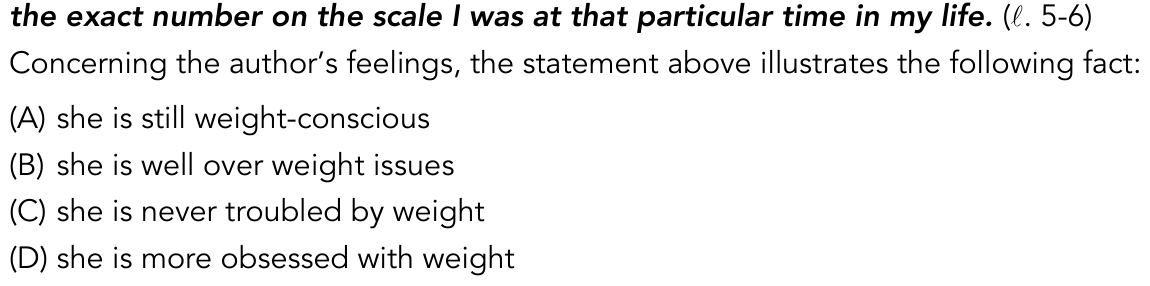
the exact number on the scale I was at that particular time in my life. (\ell. 5-6)
Concerning the author’s feelings, the statement above illustrates the following fact:
- Ashe is still weight-conscious
- Bshe is well over weight issues
- Cshe is never troubled by weight
- Dshe is more obsessed with weight
Você já respondeu questões neste aparelho. Crie sua conta grátis para guardar o histórico e refazer as que errou.
Resposta salva no seu histórico.
Reportar erro na questão
Resolução comentada
O trecho está no primeiro parágrafo. A autora começa dizendo que, como escreve muito sobre imagem corporal positiva, as pessoas pensariam que ela superou a ideia de que o peso define sua vida. Em seguida vem o "Yet" ("Contudo"), que mostra a virada: the vestiges of my past life as a woman obsessed with weight still linger ("os vestígios da minha vida passada como mulher obcecada por peso ainda persistem").
O exemplo que ela dá são as fotos de viagem. Olhando para elas, consegue dizer o lugar, a comida e o clima, mas também the exact number on the scale ("o número exato na balança") naquele momento. Ou seja, até hoje associa memórias ao peso que tinha.
Portanto, o trecho ilustra que ela ainda é preocupada com peso, mesmo já tendo superado boa parte da obsessão do passado.
Conferindo as demais:
- Ela não superou totalmente o tema, pois os vestígios ainda persistem.
- Ela se diz "recuperando" (recovering weight-a-holic), então o problema ainda a incomoda às vezes.
- Ela não está mais obcecada que antes; fala de uma obsessão passada que diminuiu.
Alternativa A.
Pegadinha: A alternativa B engana quem lê só a primeira frase ("you'd think that I am well over the idea") e ignora o "Yet", que inverte a ideia.
Por que as outras alternativas estão erradas
- Bignora o "Yet": ela diz que os vestígios da obsessão ainda persistem, então não superou totalmente.
- Cela afirma que o passado a alcança às vezes e se vê como "recovering weight-a-holic", logo o peso ainda a incomoda.
- Dela fala de obsessão passada que diminuiu; não há aumento, apenas vestígios que permanecem.
Assunto: Inferência e ponto de vista do autor.
Reportar erro na resolução
Ver como caiu na prova
Fonte: UERJ 2018 · 1º Exame de Qualificação. Prova oficial ↗