PRÁTICA COM QUESTÕES OFICIAIS
Questão 25 (2º exame) da UERJ 2018 (inglês)
Texto-base das questões 25 a 29 · 2º Exame de Qualificação
RECENT HUMAN ADAPTATIONS
Human populations live in an extraordinary variety of different habitats: hot and cold, wet and dry; in forests, grasslands and tundra. Different human groups feed on a wide variety of food sources. For many populations, diets shifted further with the development of agriculture in the past 10,000 years. To what extent have these and other factors led to genetic adaptation?
Human populations differ in various phenotypes – observable characteristics that result from interactions between genes and the environment –, but scientific studies have shown that phenotypic differences have a genetic basis and are adaptive. For example, mammals that live in cold climates tend to have larger, rounder bodies and shorter limbs than members of the same or closely related species in warm climates. These patterns do appear to also hold in humans, implying that population movements into colder climates were accompanied by adaptation to larger, stockier body shape, presumably to improve thermal efficiency. At the other end of the spectrum is the pygmy phenotype that has evolved in rainforest populations in Africa, South-East Asia and South America. Research has suggested that this phenotype may be an adaptation to food limitations, high humidity or dense forest undergrowth.
Another impressive example of adaptation is provided by human populations living at high altitude, especially in the Himalayas and the Andes. Compared to related lowland populations, these high- elevation populations show a group of physiological adaptations to low oxygen. These adaptations include markedly increased blood flow and oxygen delivery to the uterus during pregnancy, substantially reducing the risk of babies with low birthweight. Current evidence suggests that these differences are not simply the result of recent acclimation, but are at least partly genetic. If this is the case, then the adaptation must have occurred rapidly, because these high altitude regions were settled within the last 10,000 years.
Skin pigmentation is perhaps the phenotype that varies most obviously among human populations. Dark pigmentation is strongly associated with tropical climates, and the spread of prehistoric humans into northern latitudes was accompanied by a shift to lighter skin color. We now know of at least half a dozen different genes that affect skin, hair or eye pigmentation. In particular, the evolution of light skin color occurred largely in parallel in western Eurasia and east Asia, but we still know few of the relevant genes in east Asia. Adaptation to lighter pigmentation may have been motivated by a need to increase UV absorption for vitamin D synthesis at high latitudes or by sexual selection.
These are only a few cases of genetic adaptation. There are surely some – perhaps many – other factors yet to be found.
sciencedirect.com
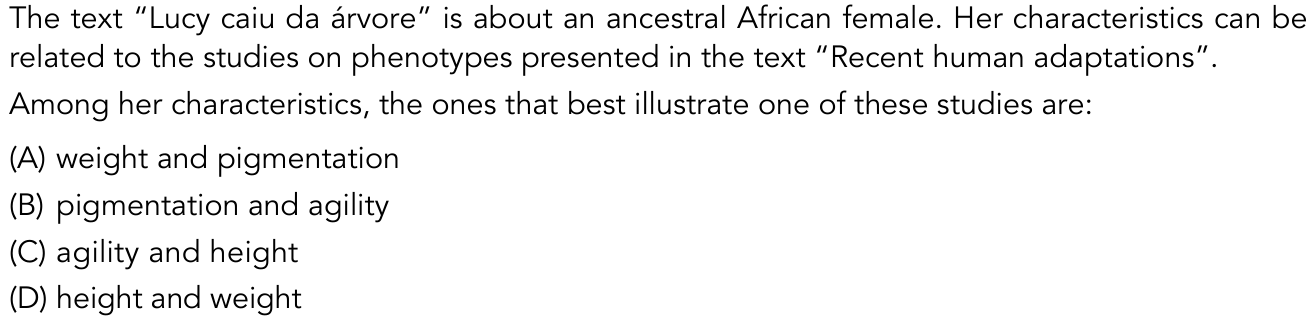
The text “Lucy caiu da árvore” is about an ancestral African female. Her characteristics can be related to the studies on phenotypes presented in the text “Recent human adaptations”.
Among her characteristics, the ones that best illustrate one of these studies are:
- Aweight and pigmentation
- Bpigmentation and agility
- Cagility and height
- Dheight and weight
Você já respondeu questões neste aparelho. Crie sua conta grátis para guardar o histórico e refazer as que errou.
Resposta salva no seu histórico.
Reportar erro na questão
Resolução comentada
A questão cita um texto sobre Lucy (a Australopithecus afarensis, "Lucy caiu da árvore") que não aparece aqui. Por isso, a resolução usa o que se sabe sobre ela e o que o texto "Recent human adaptations" apresenta.
O texto em inglês trata de fenótipos (características observáveis) com base genética e adaptativa. Os exemplos são:
- Corpo maior, mais arredondado e com membros curtos em clima frio. Isso se relaciona a tamanho e peso corporal.
- Fenótipo pigmeu em florestas tropicais, ligado à baixa estatura (height), possivelmente por limitação de alimento, umidade ou vegetação densa.
- Adaptação à altitude, com fisiologia voltada ao baixo oxigênio.
- Pigmentação da pele, com pele escura em clima tropical e pele clara em latitudes altas.
Lucy é uma fêmea africana de pequeno porte, com cerca de 1 m de altura e 25-30 kg. Vivia em ambiente tropical e provavelmente tinha pele escura. A "agilidade" (subir em árvores) é comportamento ou locomoção, não um dos fenótipos estudados no texto, então as alternativas B e C ficam de fora.
Restam A e D. Em ambas aparece o peso; a diferença está em pigmentação ou altura.
O texto liga diretamente o tamanho e a forma do corpo à adaptação: o fenótipo pigmeu e a relação entre massa e membros no frio. Altura e peso formam o par de medidas corporais discutido nesses dois estudos (pigmeus e regra corporal no frio). A pigmentação seria ilustrada pela cor da pele, que o texto de Lucy não descreve com certeza, já que a cor é inferida.
Portanto, as características que melhor ilustram os estudos citados são altura e peso.
Alternativa D.
Por que as outras alternativas estão erradas
- AInclui pigmentação, que em Lucy é só inferida, e deixa de lado a altura, ligada ao fenótipo pigmeu.
- BAgilidade é comportamento ou locomoção, não fenótipo estudado no texto, e a pigmentação de Lucy não é descrita.
- CAgilidade não é um dos fenótipos discutidos no texto sobre adaptações humanas.
Assunto: Informações explícitas e detalhes.
Reportar erro na resolução
Ver como caiu na prova
Fonte: UERJ 2018 · 2º Exame de Qualificação. Prova oficial ↗