PRÁTICA COM QUESTÕES OFICIAIS
Questão 18 (2º exame) da UERJ 2017 (inglês)
Texto-base das questões 17 a 21 · 2º Exame de Qualificação
THE COST OF BEING HAWAIIAN: DEFENDING OUR IDENTITY
A beautiful Polynesian woman moves her hips from side to side, a flower adorning her ear as her hands glide across her body in harmony with the music. She looks like a photograph come to life. Beside her is a dark and handsome man smiling and playing the ukulele*. He sings through his gigantic smile a beautiful love song to the dancing girl. After a time, the man stops playing and the woman stops dancing. The two stare lovingly into each other’s eyes and jump into their canoe, disappearing into the sunset.
This misconception about the Hawaiian culture has always been around, and although I do not profess to be an expert in Hawaiian studies by any means, I know that these ideas are only cheap imitations and generic stereotypes created more to appeal to tourists than to perpetuate and preserve the Hawaiian way of life. The more people are exposed to these misconceptions, the less they understand the true beauty of the Hawaiian people and the richness of their culture steeped in politics, agriculture, aquaculture, dance, storytelling and an oral tradition that include both extensive genealogies and mythology.
Imagine the reaction of our Hawaiian forefathers if they were to view one of the many dinner/ cocktail shows that litter the pages of our tourist guides. What would they think? Would they proudly applaud our efforts to preserve their contributions to history? Or would they laugh at its absurdity? Is the need to be an economically viable state causing us to compromise our true identity as Hawaiians in exchange for the luxuries that come with being a tourist destination?
As a boy, I took trips to the Big Island. Visiting there reminded me that Hawaiians had their own place in history and a proper culture complete with its own form of government, its own form of religion and its own legal system. These discoveries about my heritage filled me with equal portions of pride and wonderment.
The most concerning thing to me as a Hawaiian is the growing commercialization of our culture and its possible consequences. Simplifying the culture merely for financial gain may actually cost Hawaiians more than they think. I do not dispute the fact that the tourism industry brings in much needed revenue to the state, but how long can we tolerate the integrity of our culture being violated simply to earn money? How much longer can we sell these fabricated ideas of the islands before they imbue themselves upon the cultural consciousness of all Hawaiians?
I am not suggesting that we shut down every hula show that makes a profit off of reinforcing stereotypes, but that Hawaiians as a people with a rich heritage and a long cultural history need to be more active in understanding our cultural identity. As western influence grows, we need to take steps to preserve our culture so that our children don’t grow up believing the stereotypes that are so readily conditioned into the mind of every tourist. Tourism will not go away, but we need to take steps as Hawaiians to ensure our traditions are not swallowed up by these superficial shadows.
*ukulele – Hawaiian musical instrument
pupuaoewa.org
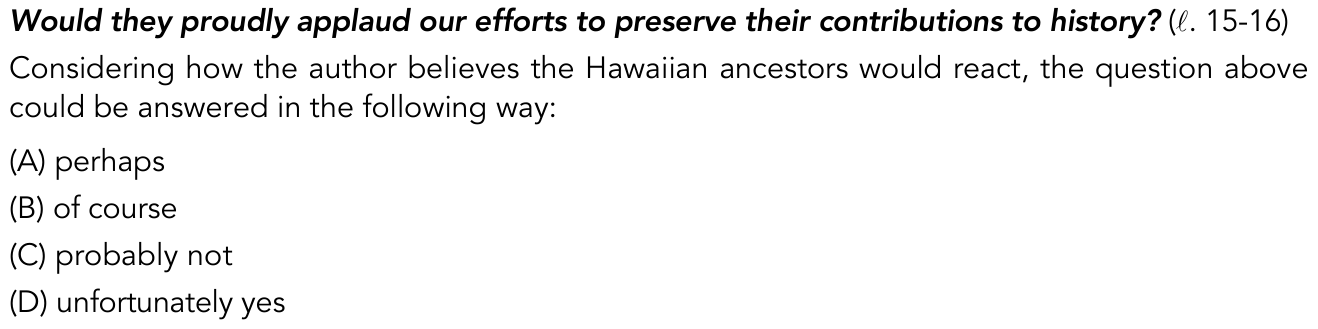
Would they proudly applaud our efforts to preserve their contributions to history? (\ell. 15-16)
Considering how the author believes the Hawaiian ancestors would react, the question above could be answered in the following way:
- Aperhaps
- Bof course
- Cprobably not
- Dunfortunately yes
Você já respondeu questões neste aparelho. Crie sua conta grátis para guardar o histórico e refazer as que errou.
Resposta salva no seu histórico.
Reportar erro na questão
Resolução comentada
A pergunta retórica é: "Eles aplaudiriam com orgulho nossos esforços para preservar suas contribuições para a história?". Para saber a resposta, veja o que o autor pensa dos espetáculos turísticos.
-
No primeiro parágrafo, ele descreve o estereótipo da dançarina e do rapaz do ukulele, e no segundo chama essas ideias de "cheap imitations and generic stereotypes" (imitações baratas e estereótipos genéricos), feitas para agradar turistas.
-
Na sequência, ele propõe a alternativa à pergunta: "Or would they laugh at its absurdity?" (Ou eles ririam do absurdo?). Ou seja, o autor sugere que os ancestrais achariam os shows absurdos, e não motivo de orgulho.
-
No fim do texto, ele fala em tradições "swallowed up by these superficial shadows" (engolidas por sombras superficiais), reforçando a crítica.
Logo, a resposta que o autor daria à pergunta é negativa: os ancestrais não aplaudiriam. A expressão que traduz isso, com o grau de incerteza natural de quem imagina uma reação hipotética, é "probably not" (provavelmente não).
Alternativa C.
Por que as outras alternativas estão erradas
- A"Perhaps" deixa a resposta indecisa, mas o autor sugere claramente que os ancestrais achariam os shows absurdos.
- B"Of course" é afirmativo e contraria a crítica do autor aos shows estereotipados.
- D"Unfortunately yes" também é afirmativo, e o autor não diz que os ancestrais aplaudiriam.
Assunto: Inferência e ponto de vista do autor.
Reportar erro na resolução
Ver como caiu na prova
Fonte: UERJ 2017 · 2º Exame de Qualificação. Prova oficial ↗