PRÁTICA COM QUESTÕES OFICIAIS
Questão 21 (2º exame) da UERJ 2016 (inglês)
Texto-base das questões 17 a 21 · 2º Exame de Qualificação
MAYA ANGELOU: THE ACHE FOR HOME LIVES IN ALL OF US
Maya Angelou, whose passing at age 86 leaves us a bit orphans, said often that although she gave birth to one son, she had thousands of daughters. “I have daughters who are black and white, Asian and Spanish-speaking and native American. I have daughters who are fat and thin, pretty and plain”, she said. “I have all sorts of daughters who I just claim. And they claim me.”
I wonder if Angelou ever knew really how many girls were told about her, named after her or like me, growing up in a suburban corner of England, clinging fiercely to her books and even when not reading them, inhaling the spirit of her struggle from the titles alone: A song flung up to heaven, I know why the caged bird sings and Gather together in my name.
I loved and admired Angelou, but it was the content of her writing that had most power over me, her novels and poems all languishing playfully somewhere on her rich spectrum between poetry and prose.
Here was a woman who had been raised in the America of racial segregation. As the structural injustice of race had become more subtle and sophisticated during her lifetime, she called it by its right name. Therefore, her comment on 9/11: “Living in a state of terror was new to many white people in America, but black people have been living in a state of terror in this country for more than 400 years.”
Here was a woman who was not a historical relic, but a living, breathing one-woman phenomenon. She gave me a language of identity that radiated as much from her very existence as it did from her work. The book that had the most impact on my life was All God’s children need travelling shoes – the fifth instalment in her series of autobiographies – about the time she spent in Africa during the civil rights movement.
Here was a woman who gave voice to the struggle of black people. In Ghana, she was part of a community of African Americans, but her travels stand out as an act of defiance against the view perpetrated by many then that Africans and people of African descent in countries like the US have nothing in common. She didn’t just live it, she wrote about it, warts and all. “If the heart of Africa remained elusive, my search for it had brought me closer to understanding myself and other human beings”, she wrote. “The ache for home lives in all of us, the safe place where we can go as we are and not be questioned.”
With her departure, America has not just lost a talented woman and gifted raconteur. It has lost a connection to its recent past which helped it make sense of its present.
Afva Hirsch
theguardian.com
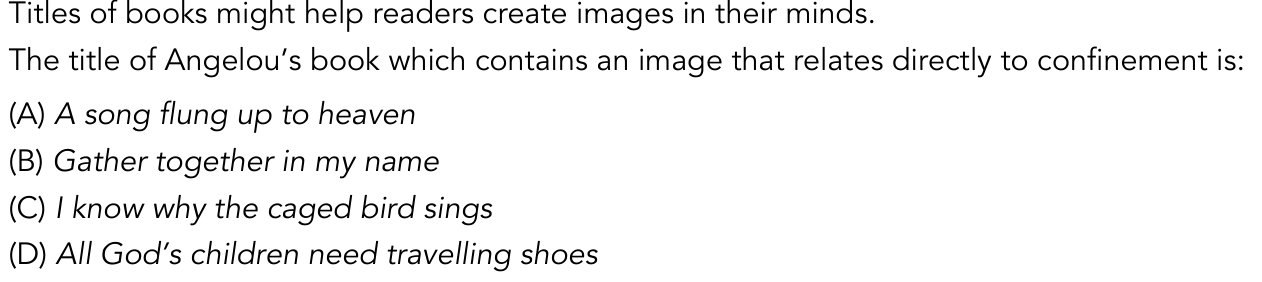
Titles of books might help readers create images in their minds.
The title of Angelou’s book which contains an image that relates directly to confinement is:
- AA song flung up to heaven
- BGather together in my name
- CI know why the caged bird sings
- DAll God’s children need travelling shoes
Você já respondeu questões neste aparelho. Crie sua conta grátis para guardar o histórico e refazer as que errou.
Resposta salva no seu histórico.
Reportar erro na questão
Resolução comentada
A questão pede o título cuja imagem se liga diretamente a confinamento, isto é, a ficar preso, sem liberdade.
O texto cita quatro títulos de Angelou. Vamos ver a imagem que cada um cria:
- A song flung up to heaven ("uma canção lançada ao céu"): a imagem é de elevação, algo que sobe, o oposto de prisão.
- Gather together in my name ("reúnam-se em meu nome"): a imagem é de união, de comunidade.
- I know why the caged bird sings ("eu sei por que o pássaro na gaiola canta"): caged vem de cage, "gaiola". Um pássaro numa gaiola está preso, confinado. A imagem é concreta e remete diretamente à falta de liberdade.
- All God's children need travelling shoes ("todos os filhos de Deus precisam de sapatos de viagem"): a imagem é de deslocamento, de viajar, o contrário de ficar preso.
Só o terceiro título traz uma imagem de confinamento: o pássaro enjaulado. Isso combina com o que o texto diz sobre a "luta" (struggle) que Angelou expressa, mas a resposta depende apenas do vocabulário do título: caged.
Alternativa C.
Por que as outras alternativas estão erradas
- AA imagem de uma canção lançada ao céu sugere elevação e liberdade, não confinamento.
- B"Gather together" evoca reunião e comunidade, sem ideia de prisão.
- D"Travelling shoes" remete a viagem e movimento, o oposto de confinamento.
Assunto: Poemas, canções e textos literários.
Reportar erro na resolução
Ver como caiu na prova
Fonte: UERJ 2016 · 2º Exame de Qualificação. Prova oficial ↗