PRÁTICA COM QUESTÕES OFICIAIS
Questão 18 (2º exame) da UERJ 2015 (inglês)
Texto-base das questões 17 a 21 · 2º Exame de Qualificação
THE GENRE OF AUTOBIOGRAPHY AND AUTOFICTION
Derived from three Greek words meaning “self”, “life” and “write”, autobiography is a style of writing that has been around nearly as long as history has been recorded. Yet, autobiography was not classified as a genre within itself until the late eighteenth century.
In his book, Inside out, E. Stuart Bates offers a functional definition of autobiography as “a narrative of the past of a person by the person concerned”. That definition, however, is too broad for some literary critics. Many, such as Philippe Lejeune, wish to define the genre more narrowly: “(a) retrospective prose narrative produced by a real person concerning his own existence, focusing on his individual life, in particular on the development of his personality”.
Despite disagreements concerning how inclusive the category of autobiography should be, there are characteristics that are common to the majority of autobiographical works. These features are the grammatical perspective of the work, the identity of the self, self- reflection and introspection.
Most autobiographies are written from the first person singular perspective. The author, the narrator and the protagonist must share a common identity for the work to be considered an autobiography. This common identity could be similar, but is not identical. The self that the author constructs becomes a character within the story that may not be a completely factual representation of the author’s actual past self.
In their book The voice within, Roger Porter and H. R. Wolf state that “truth is a highly subjective matter, and no autobiographer can represent exactly what happened back then, any more than a historian can definitively describe the real truth of the past”.
Because the author cannot describe events objectively, even the most accurate autobiographies have fictional elements. The blurring of fiction and truth characteristic of autobiography has even led to the creation of a subdivision within the genre of autobiography that deals with fictionalized self-accounts. For this style of writing that blends characteristics of both fiction and autobiography, Serge Doubrovsky coined the literary term “autofiction”.
The difference between traditional autobiography and the genre of autofiction is that autobiographers are attempting to depict their real life, while writers of autofiction are only basing their work upon real experiences. Writers of autofiction are not expected to be as historically accurate as possible as autobiographers are. According to Alex Hughes, authors of autofiction are saying “this is me and this is not me”. This sums up autofiction. Autofiction draws from the life of the writer with the addition of fictional elements to make the work more than just a life story.
Autobiography is a popular genre. Writers of memoirs and life stories never lack an audience. People are interested in the actual lives of others and want to know about others’ pasts and feelings and desires. Autobiography is a way to organize the story of a life and reflect on the past in order to better understand the present.
hubpages.com
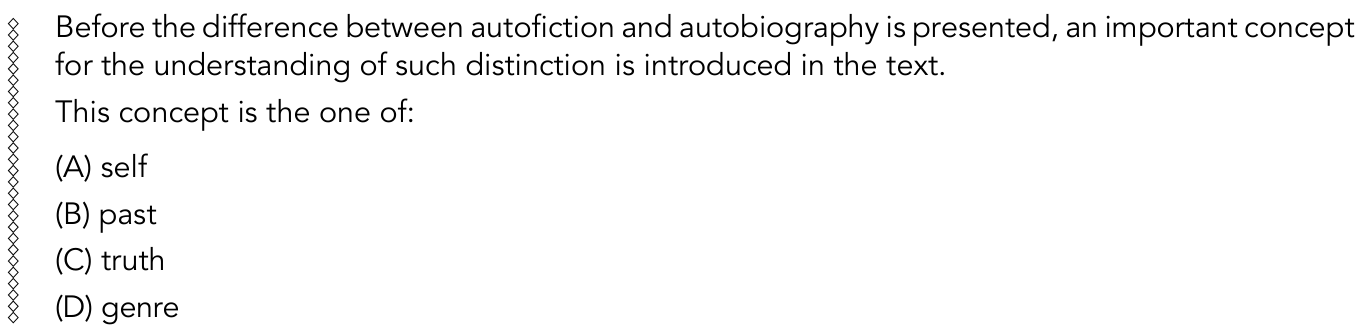
Before the difference between autofiction and autobiography is presented, an important concept for the understanding of such distinction is introduced in the text.
This concept is the one of:
- Aself
- Bpast
- Ctruth
- Dgenre
Reportar erro na questão
Resolução comentada
A pergunta pede o conceito que o texto introduz antes de apresentar a diferença entre autoficção e autobiografia. Essa diferença aparece só no penúltimo parágrafo ("The difference between traditional autobiography and the genre of autofiction is that..."). Então é preciso olhar o que vem antes dele.
- O parágrafo anterior ao da diferença afirma que, como o autor não consegue descrever os eventos objetivamente, "even the most accurate autobiographies have fictional elements" (até as autobiografias mais fiéis têm elementos ficcionais).
- Antes disso, Porter e Wolf são citados: "truth is a highly subjective matter" (a verdade é uma questão altamente subjetiva), e nenhum autobiógrafo reproduz exatamente o que aconteceu.
- É essa noção de verdade subjetiva que explica a mistura entre ficção e realidade, e dela nasce a subdivisão chamada autoficção.
- A distinção entre os dois gêneros depende disso: o autobiógrafo tenta retratar a vida real, enquanto o autor de autoficção apenas se baseia em experiências reais.
Portanto, o conceito introduzido para preparar a distinção é o de verdade (truth).
Alternativa C.
Por que as outras alternativas estão erradas
- A"Self" (identidade do eu) é discutido antes, como característica comum das autobiografias, mas não é o conceito que prepara a distinção entre os gêneros.
- BO passado é o objeto da narrativa autobiográfica, mas o texto não o apresenta como conceito necessário para distinguir autoficção de autobiografia.
- DO gênero (genre) é o tema geral do texto, já mencionado no início, e não o conceito introduzido imediatamente antes da distinção.
Assunto: Informações explícitas e detalhes.
Reportar erro na resolução
Ver como caiu na prova
Fonte: UERJ 2015 · 2º Exame de Qualificação. Prova oficial ↗