PRÁTICA COM QUESTÕES OFICIAIS
Questão 20 (1º exame) da UERJ 2014 (inglês)
Texto-base das questões 17 a 21 · 1º Exame de Qualificação
Wiser and older
Sometimes the world of science and medicine produces something that can only be described as unalloyed good news. We are used to stories about pollution scares and increases in the rates of cancer, but bubbling beneath is the stark reality that we live at a time when humans are healthier and live longer than at any time in our history.
The Office for National Statistics figures, recently released, make heartening if surprising reading. They show that most men are surviving until the age of 85, while women are living four years longer. Furthermore, we can expect these figures to increase as the century progresses. What’s driving this extraordinary increase in human longevity?
The increase has been driven by a number of advances. Firstly, the huge reduction in neonatal and infant deaths. These days, nearly all babies born in a prosperous advanced nation can expect to survive into adulthood. Over half the couples in the world are having fewer than two children each. This is partly because almost everywhere infant mortality is falling, globally faster today than at any time in human history.
Sanitation, vaccination and better diets have increased lifespans once we survive infancy, but they cannot wholly explain why people are living into their eighties and beyond. A cut in physical stress and a huge reduction in exposure to toxic and carcinogenic substances in the environment may explain much of the increase. In the 1950s, thousands died or became very ill during the London smogs. That threat, along with numerous other environmental containments, has gone. We have also begun to stop smoking and we are drinking less, too.
Finally, life is much safer than it used to be. As psychologist Steven Pinker shows in his book, The better angels of our nature, the history of all societies has shown an amazing decline in violence over the past century. We are ten times less likely to be murdered today than we were two hundred years ago, and three times less likely to be killed on the roads than we were in the 1960s.
So, can the increase in longevity continue? According to gerontologists, there is no clear answer. Currently the maximum human lifespan is 122 years, attained by the French woman Jeanne Calment who died in 1997. Significantly, no one has come close to her astonishing record. Instead, more and more of us are dodging the bullets of middle age and living to our personal genetic potential.
So how long is the natural human lifespan? The answer seems to be that, in a world where infectious diseases are kept at bay and where we are safe from predators and starvation, and provided we keep our lifestyles in check, most people should reach 80 or 90.
Something very big is going on, wrote Ban Ki-moon, the United Nations secretary general. He warned that “the social and economic implications of this phenomenon are profound, extending far beyond the individual older person and the immediate family, touching broader society and the global community in unprecedented ways”. What the figures show more than anything is that we need a rapid and radical rethink of how we treat the elderly among us, as they will soon be the majority.
telegraph.co.uk
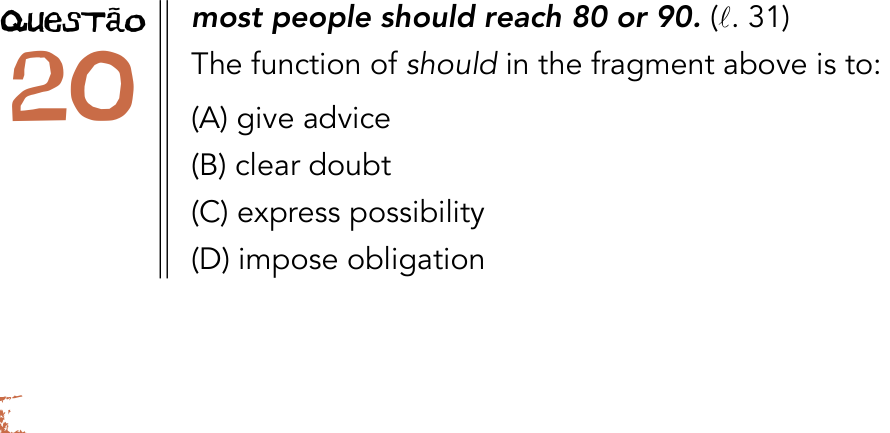
most people should reach 80 or 90. (\ell. 31)
The function of should in the fragment above is to:
- Agive advice
- Bclear doubt
- Cexpress possibility
- Dimpose obligation
Você já respondeu questões neste aparelho. Crie sua conta grátis para guardar o histórico e refazer as que errou.
Resposta salva no seu histórico.
Reportar erro na questão
Resolução comentada
O verbo modal should tem dois usos principais: dar conselho ou obrigação leve ("you should sleep more") e expressar expectativa, probabilidade, algo que é esperado que aconteça ("the bus should arrive soon").
Para decidir, veja o contexto da frase:
- O sujeito é most people (a maioria das pessoas), e o verbo é reach 80 or 90 (chegar aos 80 ou 90 anos).
- O parágrafo fala da duração natural da vida humana, dizendo que, num mundo sem doenças infecciosas, predadores ou fome, e com um estilo de vida controlado, a maioria deve chegar aos 80 ou 90.
- Ninguém está aconselhando nem obrigando as pessoas a viver até essa idade. O autor está dizendo que isso é o resultado esperado, provável, desde que as condições citadas sejam cumpridas.
Portanto, should indica probabilidade, ou seja, uma possibilidade prevista com base nas condições descritas. Tradução: "a maioria das pessoas deve (provavelmente vai) chegar aos 80 ou 90 anos".
O conselho (A) e a obrigação (D) são sentidos comuns de should, mas não cabem aqui. Já "clear doubt" (B) não é função de nenhum modal: should não esclarece dúvidas.
Alternativa C.
Pegadinha: A alternativa A engana por associar should automaticamente a conselho, o sentido mais conhecido do modal, ignorando o contexto de previsão.
Por que as outras alternativas estão erradas
- AConfunde com o uso mais comum de should (conselho), mas a frase não aconselha ninguém, apenas prevê um resultado.
- BEsclarecer dúvida não é função de modal; a frase expressa expectativa, não resolve incerteza.
- DObrigação seria um sentido forte (must); aqui não há ordem nem dever, só probabilidade.
Assunto: Tempos verbais e verbos modais.
Reportar erro na resolução
Ver como caiu na prova
Fonte: UERJ 2014 · 1º Exame de Qualificação. Prova oficial ↗