PRÁTICA COM QUESTÕES OFICIAIS
Questão 20 (2º exame) da UERJ 2014 (inglês)
Texto-base das questões 17 a 21 · 2º Exame de Qualificação
Brazilian protest songs: “Peace without a voice is no peace but fear”
I was born a year after the military coup in Brazil. The dictatorship that followed lasted from 1964 until 1985 – all my childhood and teenage years. But until I was 13 or 14 years old, I had no clue of what was going on in my country. I lived in a small town and my parents were not involved in politics. We listened to the radio, watched the news on TV and had a subscription to a national newspaper, but all the media were completely censored at that time. The fact that the newspaper was sometimes printed with a blank space or a cake recipe in the middle of the news never really caught my attention. It was always like that and I didn’t know any better.
I had my first glimpse of what it really meant to have a military government and what kind of things were going on through songs. There was a song that I liked a lot, O bêbado e a equilibrista, although the lyrics didn’t make much sense to me: “My Brazil… / that dreams of the return / of Henfil’s brother / and so many people that left / on rocket fins”. Henfil was a famous cartoonist, but who was his brother? Who were the people who left? What were they singing about? This was in 1979 and I was 13.
Thanks to this song by João Bosco and Aldir Blanc (sung by Elis Regina) and the questions I started to ask, I heard for the first time about all the artists, journalists and activists that had been persecuted, imprisoned, tortured and exiled. Many had disappeared or been killed by the military regime. This song became an anthem for the amnesty of political prisoners and activists in exile, which was announced later in that same year.
In fact, due to the extreme censorship during the period of military dictatorship in Brazil, songs were one of the few ways to send political messages. Despite the tight surveillance of the censors, they flourished, giving a voice to the resistance movement. Like Para não dizer que não falei das flores, by Geraldo Vandré, which was interpreted as a call for armed struggle.
Words and phrases with double meanings were used to escape censorship and persecution. The greatest master in this art was Chico Buarque de Holanda. His clever lyrics were often approved by the censors, who would only later realise what the songs were really about. But then, of course, it was too late. That was the case with Apesar de você, which was censored only after it had already become an anthem on the streets. At first sight, it appears to be a samba about a lover’s quarrel. Actually, it was a sharp critique of the authoritarian regime and an act of direct defiance aimed at the dictators.
With the advent of democracy and the new freedom of expression in the late 1980s, protest songs played less of a role in Brazil for a while, but in the 1990s they once again became a powerful channel to voice social discontent. One of bands active in this period was O Rappa, with the song A paz que eu não quero. The fight against social inequality, urban and police violence and racial discrimination are the most common themes. Nowadays, the lyrics are explicit and the messages are clear.
Mariângela Guimarães
rnw.nl
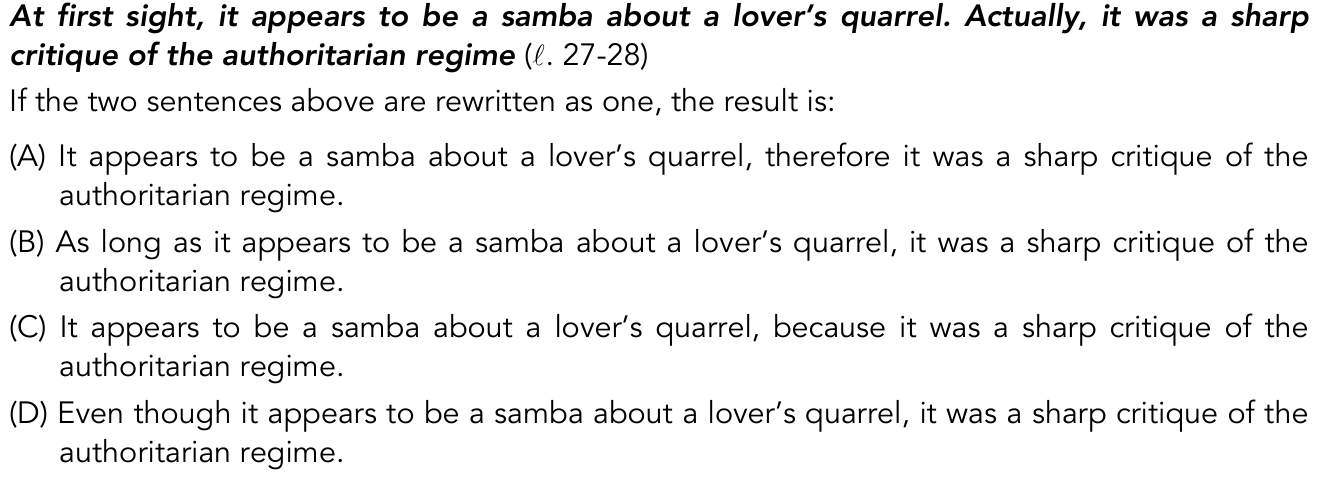
At first sight, it appears to be a samba about a lover’s quarrel. Actually, it was a sharp critique of the authoritarian regime (\ell. 27-28)
If the two sentences above are rewritten as one, the result is:
- AIt appears to be a samba about a lover’s quarrel, therefore it was a sharp critique of the authoritarian regime.
- BAs long as it appears to be a samba about a lover’s quarrel, it was a sharp critique of the authoritarian regime.
- CIt appears to be a samba about a lover’s quarrel, because it was a sharp critique of the authoritarian regime.
- DEven though it appears to be a samba about a lover’s quarrel, it was a sharp critique of the authoritarian regime.
Você já respondeu questões neste aparelho. Crie sua conta grátis para guardar o histórico e refazer as que errou.
Resposta salva no seu histórico.
Reportar erro na questão
Resolução comentada
As duas frases têm uma relação de contraste: "At first sight" (à primeira vista) parece uma coisa, mas "Actually" (na verdade) é outra. Ao juntar as frases, precisamos de um conector concessivo, que indique oposição entre a aparência e a realidade.
Veja o sentido de cada conector:
- therefore = portanto (conclusão). Daria "parece um samba, portanto era uma crítica", o que não faz sentido.
- as long as = contanto que (condição). Também não cabe: a crítica não depende de parecer um samba.
- because = porque (causa). Diria que parece um samba porque era uma crítica, invertendo a lógica.
- even though = embora, ainda que (concessão). Dá "Embora pareça um samba sobre uma briga de amantes, era uma crítica contundente ao regime autoritário", que preserva exatamente o contraste do original.
Portanto, só a opção com even though mantém o sentido das duas frases.
Alternativa D.
Por que as outras alternativas estão erradas
- A"therefore" indica conclusão/consequência, mas a relação entre as frases é de oposição.
- B"as long as" expressa condição (contanto que), ideia ausente do texto.
- C"because" cria uma relação de causa e inverte a lógica: a crítica não é motivo de parecer um samba.
Assunto: Conectivos e relações lógicas.
Reportar erro na resolução
Ver como caiu na prova
Fonte: UERJ 2014 · 2º Exame de Qualificação. Prova oficial ↗