PRÁTICA COM QUESTÕES OFICIAIS
Questão 20 (2º exame) da UERJ 2012 (inglês)
Texto-base das questões 16 a 21 · 2º Exame de Qualificação
What’s in a name?
The trouble with lingo
Remember the campaign in New York for garbage collectors to be called sanitation engineers? Near the top of the strike’s agenda was the matter of getting the respect due to the people doing such essential work. Unfortunately, the new euphemistic title clarified nothing about the work and by now is either simply not heard for what it means, or is used in moments of gentle disdain. A clearer term may have both generated the respect desired and withstood the test of time.
Clarity and sincerity matter. Terms which mislead, confuse or cause offence can become a distraction from the real content of public debate. In the search for consensus, since public understanding is harder to change than terminology, changing the terminology might be a better place to start. No additional prejudice or emotion should be brought to a debate by the terminology used in it. Here are two examples.
Genetic Engineering and Genetic Modification
Despite the insistence of biotech scientists that genes of completely different species are no longer being mixed, the message isn’t being heard. They insist that they are now involved only in developments which simply hasten the natural processes of selective and cross breeding or cross pollination. As farmers and horticulturists have been doing exactly this, unquestioned, for years, they cannot understand public resistance.
The problem may well be the terminology. In this context, the words “scientific” or “genetic” have been irreparably sullied. If “genetic engineering” has, in the public’s view, become synonymous with the indiscriminate mixing of genes, and if the softer label “genetically modified” hasn’t been able to shake off a perception of sinister overtones, these terms might as well be dropped – or left attached only to experiments in Dr. Frankenstein’s laboratory.
Ideally, a new agricultural term would leave out the word “genetic” altogether: it seems to frighten the public. Assuming it described science’s benign genetic activities accurately, the term “productivity breeding” is not a trivial call for a euphemism; besides, it would probably encounter less public opposition.
So, let’s have new terms for selective cross breeding by scientists who simply speed up the same process that is carried out in nature.
Clean coal*
If this new term was intended to be clear, it hasn’t worked.
In “Politics and the English Language” (1946), George Orwell wrote that because so much political speech involves defending the indefensible, it has to consist largely of euphemism. He insisted that, in politics, these euphemisms are “swindles” and “perversions” left deliberately vague in order to mislead. Deliberate or not, “clean coal” is one of these. Aside from being a contradiction in terms, the name is misleading, creating the impression of the existence of a new type of coal. In fact, it is ordinary coal which has been treated to “eliminate” most of its destructive by-products, which are then buried. The whole process produces emissions. This, though, isn’t clear when it is simply labelled “clean coal”. The term just doesn’t seem sincere. It’s a red rag to any green. It’s not asking too much to expect the term describing these procedures to be more accurate. A clearer term would be less provocative.
So, what’s in a name? A lot. There’s the possibility of confusion, prejudice, perversions and swindles. For the sake of fair debate, let’s mean what we say and say what we mean.
* Coal: carvão
SEEARGH MACAULAY
www.londongrip.com
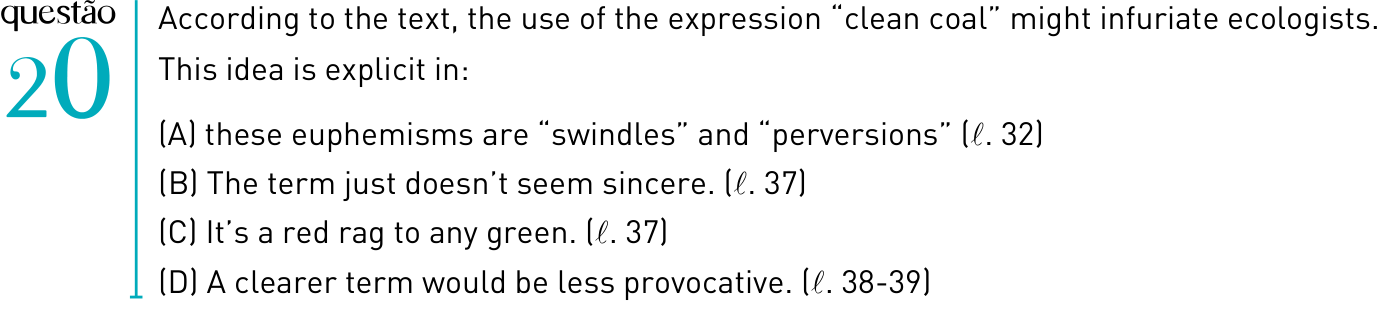
According to the text, the use of the expression “clean coal” might infuriate ecologists.
This idea is explicit in:
- Athese euphemisms are “swindles” and “perversions” (\ell. 32)
- BThe term just doesn’t seem sincere. (\ell. 37)
- CIt’s a red rag to any green. (\ell. 37)
- DA clearer term would be less provocative. (\ell. 38-39)
Reportar erro na questão
Resolução comentada
A questão pede o trecho em que aparece, de forma explícita, a ideia de que "clean coal" pode enfurecer os ecologistas ("infuriate ecologists").
Primeiro, vale entender a expressão idiomática "a red rag to a bull" ("pano vermelho para um touro"): algo que provoca fúria em quem o vê. Em "It's a red rag to any green", o autor troca o touro por "green", palavra que nomeia o ecologista, o adepto das causas verdes. Traduzindo: "É um pano vermelho para qualquer ecologista", isto é, irrita e enfurece qualquer ecologista.
Agora, as demais alternativas:
- (A) fala de eufemismos como "fraudes" e "perversões" na política, citando Orwell. Não menciona ecologistas nem reação de fúria.
- (B) diz que o termo "não parece sincero". É um juízo do autor sobre o termo, sem apontar quem se irrita.
- (D) diz que um termo mais claro seria "menos provocativo". Sugere que o termo atual provoca, mas não diz quem é provocado nem fala de ecologistas.
Só a (C) nomeia o grupo ("green") e expressa a irritação ("red rag"), de modo explícito.
Alternativa C.
Pegadinha: A alternativa D engana por conter "provocative", que lembra irritação, mas não cita os ecologistas; só a C nomeia o grupo ("green") com a ideia de fúria.
Por que as outras alternativas estão erradas
- ACita a opinião de Orwell sobre eufemismos políticos como fraudes e perversões, sem relação com ecologistas ou fúria.
- BCritica a falta de sinceridade do termo, mas não menciona ecologistas nem sua irritação.
- DFala em termo menos provocativo de modo genérico, sem apontar os ecologistas como os provocados.
Assunto: Expressões idiomáticas e phrasal verbs.
Reportar erro na resolução
Ver como caiu na prova
Fonte: UERJ 2012 · 2º Exame de Qualificação. Prova oficial ↗