PRÁTICA COM QUESTÕES OFICIAIS
Questão 18 (2º exame) da UERJ 2012 (inglês)
Texto-base das questões 16 a 21 · 2º Exame de Qualificação
What’s in a name?
The trouble with lingo
Remember the campaign in New York for garbage collectors to be called sanitation engineers? Near the top of the strike’s agenda was the matter of getting the respect due to the people doing such essential work. Unfortunately, the new euphemistic title clarified nothing about the work and by now is either simply not heard for what it means, or is used in moments of gentle disdain. A clearer term may have both generated the respect desired and withstood the test of time.
Clarity and sincerity matter. Terms which mislead, confuse or cause offence can become a distraction from the real content of public debate. In the search for consensus, since public understanding is harder to change than terminology, changing the terminology might be a better place to start. No additional prejudice or emotion should be brought to a debate by the terminology used in it. Here are two examples.
Genetic Engineering and Genetic Modification
Despite the insistence of biotech scientists that genes of completely different species are no longer being mixed, the message isn’t being heard. They insist that they are now involved only in developments which simply hasten the natural processes of selective and cross breeding or cross pollination. As farmers and horticulturists have been doing exactly this, unquestioned, for years, they cannot understand public resistance.
The problem may well be the terminology. In this context, the words “scientific” or “genetic” have been irreparably sullied. If “genetic engineering” has, in the public’s view, become synonymous with the indiscriminate mixing of genes, and if the softer label “genetically modified” hasn’t been able to shake off a perception of sinister overtones, these terms might as well be dropped – or left attached only to experiments in Dr. Frankenstein’s laboratory.
Ideally, a new agricultural term would leave out the word “genetic” altogether: it seems to frighten the public. Assuming it described science’s benign genetic activities accurately, the term “productivity breeding” is not a trivial call for a euphemism; besides, it would probably encounter less public opposition.
So, let’s have new terms for selective cross breeding by scientists who simply speed up the same process that is carried out in nature.
Clean coal*
If this new term was intended to be clear, it hasn’t worked.
In “Politics and the English Language” (1946), George Orwell wrote that because so much political speech involves defending the indefensible, it has to consist largely of euphemism. He insisted that, in politics, these euphemisms are “swindles” and “perversions” left deliberately vague in order to mislead. Deliberate or not, “clean coal” is one of these. Aside from being a contradiction in terms, the name is misleading, creating the impression of the existence of a new type of coal. In fact, it is ordinary coal which has been treated to “eliminate” most of its destructive by-products, which are then buried. The whole process produces emissions. This, though, isn’t clear when it is simply labelled “clean coal”. The term just doesn’t seem sincere. It’s a red rag to any green. It’s not asking too much to expect the term describing these procedures to be more accurate. A clearer term would be less provocative.
So, what’s in a name? A lot. There’s the possibility of confusion, prejudice, perversions and swindles. For the sake of fair debate, let’s mean what we say and say what we mean.
* Coal: carvão
SEEARGH MACAULAY
www.londongrip.com
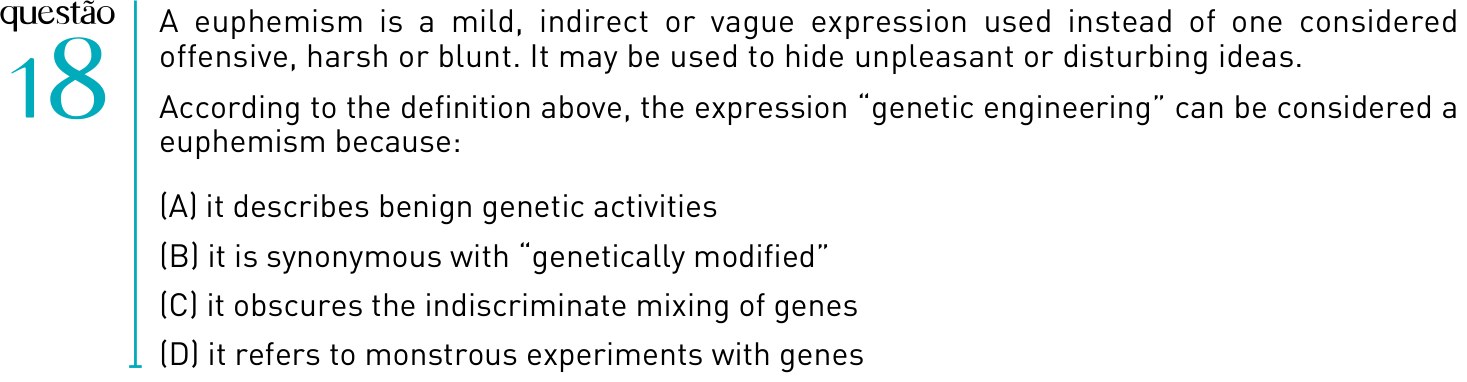
A euphemism is a mild, indirect or vague expression used instead of one considered offensive, harsh or blunt. It may be used to hide unpleasant or disturbing ideas.
According to the definition above, the expression “genetic engineering” can be considered a euphemism because:
- Ait describes benign genetic activities
- Bit is synonymous with “genetically modified”
- Cit obscures the indiscriminate mixing of genes
- Dit refers to monstrous experiments with genes
Reportar erro na questão
Resolução comentada
Um eufemismo, pela definição do enunciado, é uma expressão suave, indireta ou vaga usada no lugar de outra considerada ofensiva ou dura, e que pode esconder ideias desagradáveis. Então a alternativa certa deve dizer que "genetic engineering" esconde algo desagradável.\n\nNo texto, o autor diz que "genetic engineering" se tornou, na visão do público, sinônimo de "the indiscriminate mixing of genes", isto é, a mistura indiscriminada de genes. Para o público, portanto, o termo, que soa técnico e neutro, encobre justamente essa ideia perturbadora.\n\nConferindo cada ideia:\n\n1. O termo soa neutro e científico, mas a realidade que o público associa a ele é a mistura indiscriminada de genes.\n2. Esse contraste entre o nome brando e o que ele esconde é o que define o eufemismo.\n3. Assim, o termo "obscures" (obscurece, oculta) a mistura indiscriminada de genes, que é a ideia desagradável.\n\nAs demais opções não ligam o termo à função de esconder algo: descrever atividades benignas ou ser sinônimo de outra expressão não torna uma palavra eufemística.\n\nAlternativa C.
Por que as outras alternativas estão erradas
- ANo texto, as atividades benignas seriam descritas pelo termo proposto "productivity breeding", não por "genetic engineering"; descrever algo benigno também não é ocultar algo ruim.
- BSer sinônimo de "genetically modified" não implica suavizar ou esconder uma ideia desagradável; é só equivalência entre termos.
- DA referência a Dr. Frankenstein é uma ironia sobre onde os termos poderiam ficar, não o que o termo esconde; dizer "monstruoso" é o oposto de suavizar.
Assunto: Linguagem figurada, ironia e humor.
Reportar erro na resolução
Ver como caiu na prova
Fonte: UERJ 2012 · 2º Exame de Qualificação. Prova oficial ↗