PRÁTICA COM QUESTÕES OFICIAIS
Questão 31 (1º semestre) do Sírio-Libanês 2026
Read the text to answer questions from 31 to 33. · Prova II
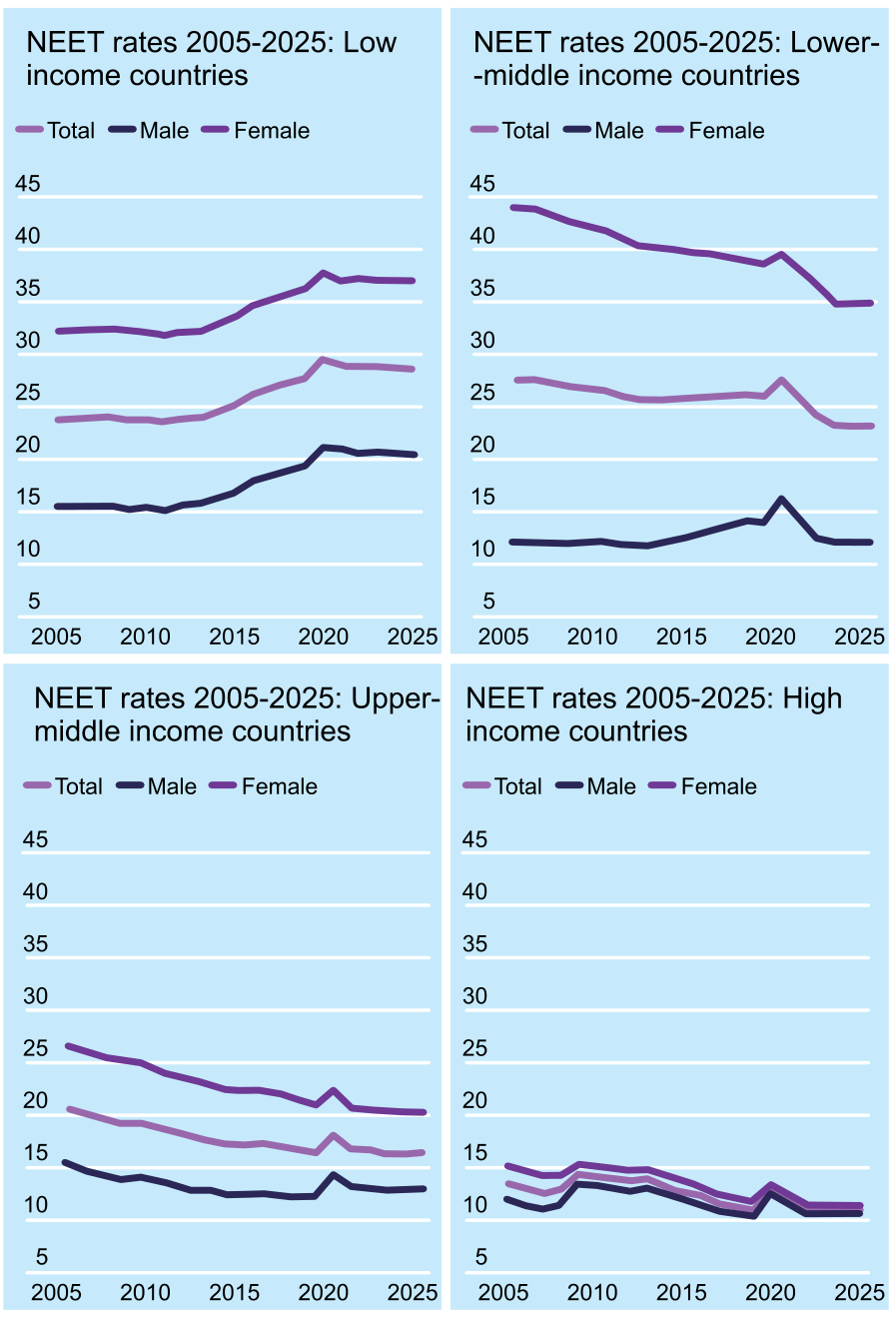
The International Labour Organization (ILO) estimates that in 2025 around 262 million — or one in four — young people aged between 15 and 24 — are neither employed nor studying: they are, in other words, Not in Employment, Education or Training (NEET). In 2015, the United Nations adopted a Sustainable Development Goal (SDG) to substantially reduce the NEET rate — the way in which progress towards achieving the effective integration of young people into the world of work is to be measured internationally. Using this indicator, however, progress until now has been rather modest. According to the ILO’s latest Global Employment Trends for Youth, 2024 edition, 110 countries — where a little over one half of the world’s youth live — are on track to fulfil the SDG goal. In contrast to the rest of the world, low-income1 countries as a whole have experienced a sustained increase in NEET rates in the years following the covid-19 pandemic (figure 1).
Figure 1: NEET rates by sex,
by country income group, 2005-2025
Young NEETs comprise the unemployed — or rather, all young unemployed people who are not at the same time in education — as well as a much larger group of young people who do not have a job and are not engaged in any formal learning activity but who are also, for one reason or another, not actively looking for work.
(Niall O’Higgins. www.ilo.org, 12.08.2025. Adaptado.)
1income: money that is earned from doing work or received from investments.
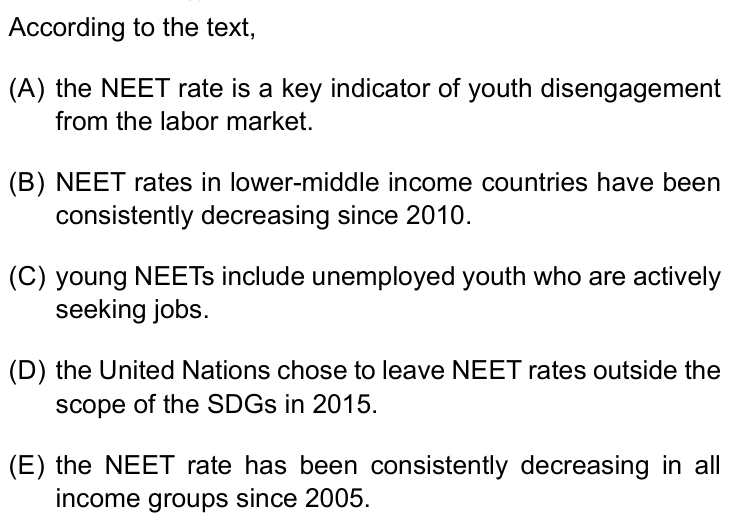
According to the text,
- Athe NEET rate is a key indicator of youth disengagement from the labor market.
- BNEET rates in lower-middle income countries have been consistently decreasing since 2010.
- Cyoung NEETs include unemployed youth who are actively seeking jobs.
- Dthe United Nations chose to leave NEET rates outside the scope of the SDGs in 2015.
- Ethe NEET rate has been consistently decreasing in all income groups since 2005.
Você já respondeu questões neste aparelho. Crie sua conta grátis para guardar o histórico e refazer as que errou.
Resposta salva no seu histórico.
Reportar erro na questão
Resolução comentada
Vamos checar cada afirmação com o texto (e com o gráfico, quando for o caso).
O texto diz que a ONU adotou, em 2015, um Objetivo de Desenvolvimento Sustentável (ODS) para reduzir a taxa de NEET. Ele a descreve como "the way in which progress towards achieving the effective integration of young people into the world of work is to be measured", ou seja, o indicador usado para medir internacionalmente a integração dos jovens no mundo do trabalho. Portanto, a taxa de NEET é um indicador-chave de (des)engajamento dos jovens do mercado de trabalho, o que corresponde à alternativa A.
Conferindo as demais:
- Os NEETs incluem os jovens desempregados que não estudam e também um grupo bem maior que não trabalha, não estuda e nem procura emprego. A alternativa C diz que incluem desempregados em busca de trabalho. Isso é parcialmente verdadeiro, mas o texto fala em "unemployed" de modo geral, e a questão pede a ideia central do texto: a A é a que sintetiza o que ele afirma sobre o indicador.
- O gráfico dos países de renda média-baixa mostra queda desde 2005, mas com alta em torno de 2020, então não foi uma queda constante desde 2010 (B).
- Nos países de baixa renda a taxa subiu (E).
- A ONU incluiu a taxa de NEET nos ODS (D).
Alternativa A.
Pegadinha: A alternativa C engana porque os desempregados que buscam emprego de fato são NEETs; ela é verdadeira em parte, mas a opção mais fiel ao texto é a A.
Por que as outras alternativas estão erradas
- BO gráfico mostra um pico por volta de 2020 nos países de renda média-baixa, logo a queda não foi constante desde 2010.
- CEmbora os desempregados que não estudam sejam NEETs, a alternativa é uma afirmação parcial e não sintetiza o que o texto diz sobre o indicador, que é a ideia central.
- DO texto diz o contrário: em 2015 a ONU adotou um ODS para reduzir a taxa de NEET.
- ENos países de baixa renda a taxa subiu, e houve picos por volta de 2020 em outros grupos.
Assunto: Informações explícitas e detalhes.
Reportar erro na resolução
Ver como caiu na prova
Fonte: Sírio-Libanês 2026 · 1º semestre · Prova II. Prova oficial ↗