Questão 31 (2º semestre) do Sírio-Libanês 2025
Leia o texto para responder às questões de 31 a 34. · Prova II
Leia o texto para responder às questões de 31 a 34.
The excitement surrounding potential benefits of generative artificial intelligence (AI), from improving worker productivity to advancing scientific research, is hard to ignore. While the explosive growth of this new technology has enabled rapid deployment of powerful models in many industries, the environmental consequences of this generative AI boom remain difficult to determine, let alone mitigate.
The computational power required to train generative AI models that often have billions of parameters, such as OpenAI’s GPT-4, can demand a staggering amount of electricity, which leads to increased carbon dioxide emissions and pressures on the electric grid.
Furthermore, deploying these models in real-world applications, enabling millions to use generative AI in their daily lives, and then fine-tuning the models to improve their performance draws large amounts of energy long after a model has been developed. And beyond electricity demands, a great deal of water is needed to cool the hardware used for training, deploying, and fine-tuning generative AI models, which can strain municipal water supplies and disrupt local ecosystems.
(Adam Zewe. https://news.mit.edu, 17.01.2025. Adaptado.)
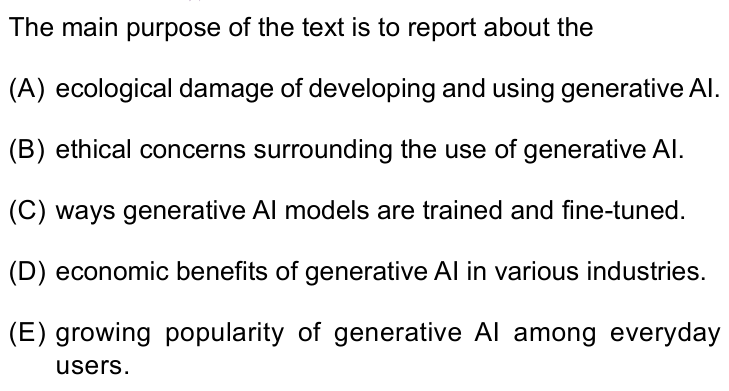
The main purpose of the text is to report about the
- Aecological damage of developing and using generative AI.
- Bethical concerns surrounding the use of generative AI.
- Cways generative AI models are trained and fine-tuned.
- Deconomic benefits of generative AI in various industries.
- Egrowing popularity of generative AI among everyday users.
Reportar erro na questão
Ver como caiu na prova
Fonte: Sírio-Libanês 2025 · 2º semestre · Prova II. Prova oficial ↗