PRÁTICA COM QUESTÕES OFICIAIS
Questão 7 (1º semestre) do São Camilo 2026
Leia o texto para responder às questões de 06 a 09. · Prova II
Artificial intelligence (AI) is not new to the workplace, but the debut of ChatGPT ushered in an era of rapid expansion. American workers have mixed feelings about how this technology will affect jobs in the future.
About half of workers (52%) say they’re worried about the future impact of AI use in the workplace, and 32% think it will lead to fewer job opportunities for them in the long run, according to a new survey. And while 36% of workers also say they feel hopeful about how AI may be used in the workplace in the future, a similar share (33%) say they feel overwhelmed.
About one-in-six workers (16%) say at least some of their work is currently done with AI. And an additional 25% say, while they’re not using it much now, at least some of their work can be done with AI. These shares are significantly higher among young workers and workers with at least a bachelor’s degree.
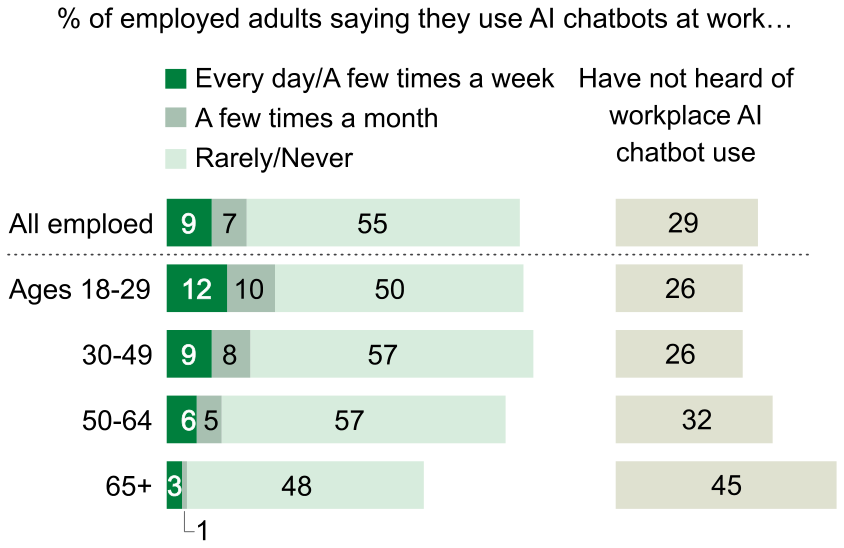
About one-in-ten workers say they use AI chatbots — such as ChatGPT, Gemini or Copilot — at work every day or a few times a week; 7% use them a few times a month.
(Luona Lin and Kim Parker. www.pewresearch.org, 25.02.2025. Adaptado.)
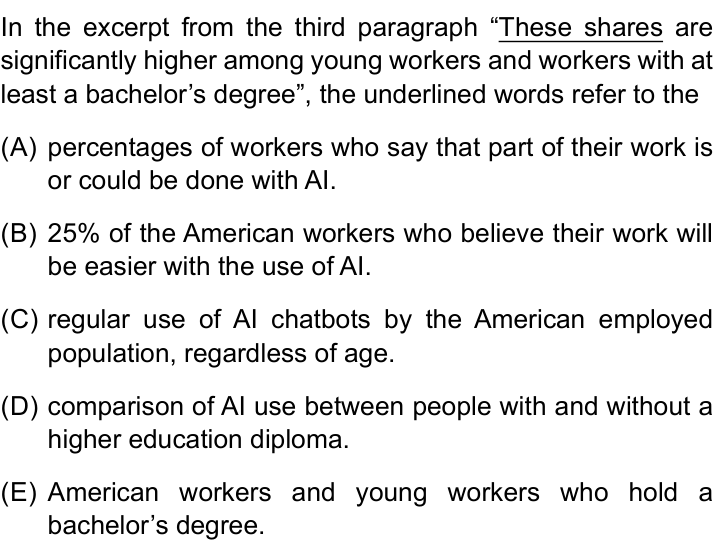
In the excerpt from the third paragraph “These shares are significantly higher among young workers and workers with at least a bachelor’s degree”, the underlined words refer to the
- Apercentages of workers who say that part of their work is or could be done with AI.
- B25% of the American workers who believe their work will be easier with the use of AI.
- Cregular use of AI chatbots by the American employed population, regardless of age.
- Dcomparison of AI use between people with and without a higher education diploma.
- EAmerican workers and young workers who hold a bachelor’s degree.
Você já respondeu questões neste aparelho. Crie sua conta grátis para guardar o histórico e refazer as que errou.
Resposta salva no seu histórico.
Reportar erro na questão
Resolução comentada
"These shares" é um retrato de referência anafórica: o demonstrativo "these" retoma algo mencionado logo antes, e "shares" significa "porcentagens, parcelas".
Veja o que vem imediatamente antes, no mesmo parágrafo:
- "About one-in-six workers (16%) say at least some of their work is currently done with AI."
- "An additional 25% say, while they're not using it much now, at least some of their work can be done with AI."
Os dois números são parcelas de trabalhadores: 16% já têm parte do trabalho feito com IA, e 25% têm parte do trabalho que poderia ser feita com IA. Logo, "these shares" são essas duas porcentagens, e a frase diz que elas são maiores entre jovens e entre quem tem ao menos bacharelado.
O gráfico não é o referente: ele trata do uso de chatbots, assunto do último parágrafo, e a frase em questão vem antes dele.
Portanto, o sintagma se refere às porcentagens de trabalhadores que dizem que parte do trabalho é ou pode ser feita com IA.
Alternativa A.
Por que as outras alternativas estão erradas
- BOs 25% não acreditam que o trabalho ficará mais fácil; dizem que parte do trabalho poderia ser feita com IA, e o 16% também é omitido.
- CTrata do uso regular de chatbots, assunto do último parágrafo e do gráfico, e fala em 'regardless of age', contradizendo a comparação por idade.
- DA comparação por escolaridade é o que a frase afirma, não o referente de 'these shares', que são as porcentagens.
- E'Shares' são porcentagens, não grupos de pessoas; os trabalhadores jovens e com bacharelado são os grupos comparados.
Assunto: Referência pronominal e pronomes.
Reportar erro na resolução
Ver como caiu na prova
Fonte: São Camilo 2026 · 1º semestre · Prova II. Prova oficial ↗