PRÁTICA COM QUESTÕES OFICIAIS
Questão 6 (2º semestre) do São Camilo 2026
Leia o texto para responder às questões de 06 a 10. · Prova II
1 More and more we’re exposed to vast amounts of information and highly sophisticated software that offers to do the thinking for us. In just a few seconds, tools such as ChatGPT or Gemini can draft your emails, generate a birthday message for a friend, or even summarise the plot of a novel you haven’t gotten around to reading. Such increased offloading1 has raised the concern that people will become excessively dependant on AI. This could have unplanned consequences, such as eroding our critical thinking skills and declining our overall cognitive ability.
This fear is justified. Research has suggested the online environment exploits our cognitive tendencies — individual differences in how we think, perceive, and remember. In turn, some people only engage with information superficially. Studies have also linked high AI use to increased laziness, anxiety, lower critical engagement and feelings of dependence.
Yet it may be how we use AI that’s the problem, rather than the fact we do it at all.
Generally, relying on external sources is fine. We all constantly count on each other’s knowledge to function as a society. Doctors provide medical information, engineers are in charge of construction, financial advisers give investment tips, and so on. All this spread of expertise provides each of us with more knowledge than we can individually hold. More importantly, we don’t offload all thinking tasks to one specific person. Instead, we carefully consider the person’s trust and expertise before accepting their advice or support. We also check how the new information fits in with what we already know.
5 As our knowledge grows in a certain area, we rely less on outside support, just as a student relies on a teacher until they learn enough to stand on their own.
(Misia Temler. http://theconversation.com, 09.03.2026. Adaptado.)
1to offload: to transfer (a task or information) to something or someone else.
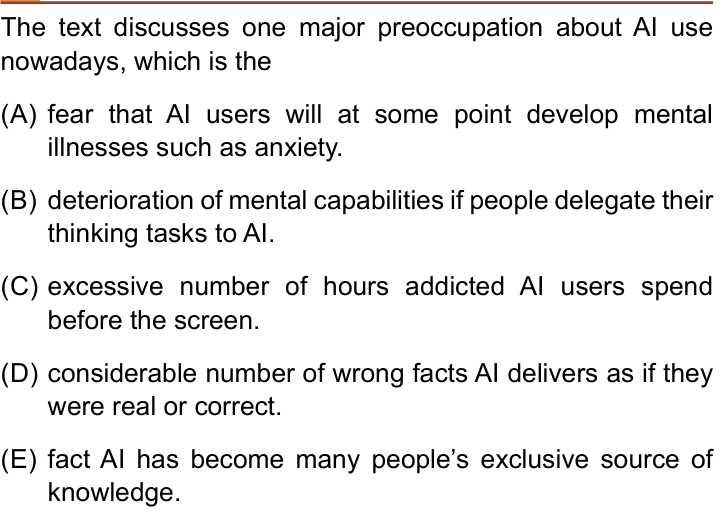
The text discusses one major preoccupation about AI use nowadays, which is the
- Afear that AI users will at some point develop mental illnesses such as anxiety.
- Bdeterioration of mental capabilities if people delegate their thinking tasks to AI.
- Cexcessive number of hours addicted AI users spend before the screen.
- Dconsiderable number of wrong facts AI delivers as if they were real or correct.
- Efact AI has become many people’s exclusive source of knowledge.
Você já respondeu questões neste aparelho. Crie sua conta grátis para guardar o histórico e refazer as que errou.
Resposta salva no seu histórico.
Reportar erro na questão
Resolução comentada
A questão pede a principal preocupação sobre o uso de IA apresentada no texto. Ela aparece logo no primeiro parágrafo.
- O texto diz que ferramentas como ChatGPT e Gemini fazem o "pensar" por nós (redigem e-mails, resumem romances). Isso é o offloading, ou seja, transferir tarefas e informação para algo ou alguém.
- A frase seguinte traz a preocupação: "people will become excessively dependant on AI". Ou seja, as pessoas ficariam dependentes demais da IA.
- A consequência temida vem a seguir: "eroding our critical thinking skills and declining our overall cognitive ability", isto é, a erosão do pensamento crítico e a queda da capacidade cognitiva geral.
Portanto, a preocupação central é a deterioração das capacidades mentais quando delegamos o pensamento à IA. É exatamente o que diz a alternativa B.
As demais fogem do foco. A ansiedade é citada só de passagem, em estudos. Horas de tela e informações falsas não são mencionadas. Já a fonte exclusiva de conhecimento é contrariada pelo texto, que diz que apoiar-se em fontes externas, em geral, é aceitável.
Alternativa B.
Por que as outras alternativas estão erradas
- AA ansiedade aparece apenas como um dos efeitos associados ao uso intenso em estudos, não como a preocupação central, e o texto não fala em doenças mentais.
- CO texto não menciona tempo de tela nem horas de uso.
- DO texto não trata de informações erradas fornecidas pela IA.
- EO texto não diz que a IA virou fonte exclusiva; ao contrário, defende que se avalie a confiança e a expertise das fontes e que o uso de fontes externas é normal.
Assunto: Ideia central e finalidade do texto.
Reportar erro na resolução
Ver como caiu na prova
Fonte: São Camilo 2026 · 2º semestre · Prova II. Prova oficial ↗