PRÁTICA COM QUESTÕES OFICIAIS
Questão 6 (1º semestre) do São Camilo 2025
Leia o texto para responder às questões de 06 a 10. · Prova II
A Prescription for Physicians
One of the chief complaints about physicians (doctors of medicine) these days is that they don’t have enough time and they don’t really listen. So, Dr. Schillinger, a primary care physician at Zuckerberg San Francisco General Hospital and Trauma Center, has written a book, Telltale Hearts, about the importance of patients’ stories. He writes of the power of narrative to build trust that cuts through the barriers that often separate doctors and patients to ultimately improve care.
“What has increasingly been lost as we advance in our technologies, using electronic health records that make us look at the computer and not at the patient, and becoming more constrained from a time perspective, is the most important and common medical procedure — the medical interview,” Dr. Schillinger told. “A lot of people think that the doctor is asking the patient too many questions, but that’s not really how it should go,” he added. “It really should be about bringing out the patient’s perspective on the experience and their social context.”
Science is most important, he said, but the patient’s story is an essential complement. “It’s when we separate the two that we get in trouble,” Dr. Schillinger said. His book is about what he thinks of as “the alchemy of science and story.” Ultimately, however, Telltale Hearts is about a growing area of medical research: the ways in which socioeconomic factors like poverty, racism and marginalization — and associated ills like lack of food, housing insecurity and exposure to pollution and violence — shape the health of many Americans, as well as society’s obligation to do better.
The book is a cry for social change and a plea for the profession “to recognize the patient as one of our own, not just someone to manage and get through the system of health care,” Dr. Schillinger said. “It’s about finding our shared humanity in a world that is constantly pressuring us to take shortcuts and to rely on impersonal ways of managing very complex human problems,” he added.
(Roni Caryn Rabin. www.nytimes.com, 03.08.2024. Adaptado.)
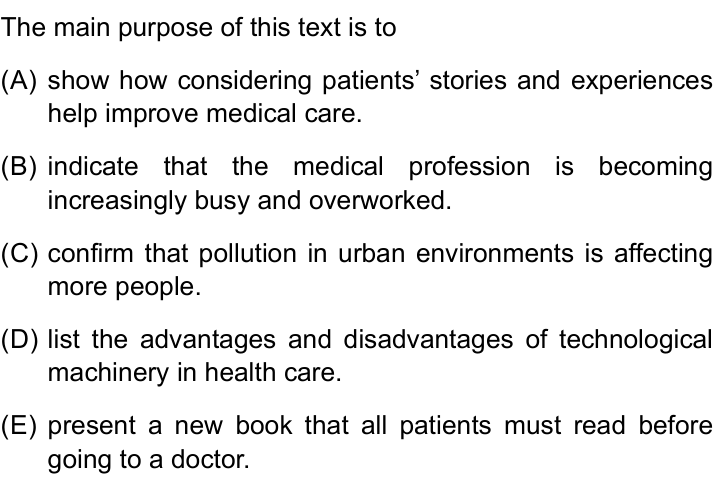
The main purpose of this text is to
- Ashow how considering patients’ stories and experiences help improve medical care.
- Bindicate that the medical profession is becoming increasingly busy and overworked.
- Cconfirm that pollution in urban environments is affecting more people.
- Dlist the advantages and disadvantages of technological machinery in health care.
- Epresent a new book that all patients must read before going to a doctor.
Você já respondeu questões neste aparelho. Crie sua conta grátis para guardar o histórico e refazer as que errou.
Resposta salva no seu histórico.
Reportar erro na questão
Resolução comentada
A pergunta pede o propósito principal do texto, isto é, a ideia que organiza o texto inteiro, e não um detalhe isolado.
O texto apresenta o livro Telltale Hearts, do Dr. Schillinger. Ele defende que a história do paciente ("the patient's story") e seu contexto social devem complementar a ciência. Segundo o médico, isso "builds trust" (constrói confiança) e "improve care" (melhora o atendimento). Ele critica a falta de tempo e o uso de prontuários eletrônicos que afastam o médico do paciente. Diz ainda que a entrevista médica é o procedimento mais importante.
A ideia central é, portanto: ouvir as histórias e experiências dos pacientes melhora o cuidado médico.
Conferindo as alternativas:
- A: resume exatamente essa ideia central.
- B: a falta de tempo aparece só como ponto de partida, não como foco do texto.
- C: a poluição é citada apenas como um dos fatores socioeconômicos que afetam a saúde.
- D: a tecnologia é mencionada só como crítica, sem lista de vantagens e desvantagens.
- E: o livro é o tema, mas o texto não diz que todos os pacientes devem lê-lo antes de ir ao médico.
Alternativa A.
Por que as outras alternativas estão erradas
- BToma a queixa sobre falta de tempo, que é só o ponto de partida, como o objetivo do texto.
- CA poluição aparece só como um exemplo de fator social que afeta a saúde, não é o tema central.
- DA tecnologia é criticada brevemente, e o texto não lista vantagens e desvantagens.
- EO texto apresenta o livro, mas não diz que todos os pacientes devem lê-lo antes da consulta; é exagero.
Assunto: Ideia central e finalidade do texto.
Reportar erro na resolução
Ver como caiu na prova
Fonte: São Camilo 2025 · 1º semestre · Prova II. Prova oficial ↗