PRÁTICA COM QUESTÕES OFICIAIS
Questão 15 da Santa Casa 2024
Leia o texto para responder às questões de 11 a 17. · Conhecimentos Gerais
Some of the world’s leading artificial intelligence (AI) researchers are calling for a pause on research into AI, claiming that safety issues must first be urgently addressed. If not, the outcomes could be devastating for humanity. Others say any pause in development would not only be impractical to enforce on a global scale, but could also stand in the way of advances that could both improve and save lives.
The AI that is currently available already has the power to radically alter society, in new ways that we are seeing every day. So how might it progress over the coming years? Are we on the brink of an artificial intelligence-powered utopia or dystopia?
Firstly, technology has been automating jobs since the Industrial Revolution, though never before has it happened on this scale. Everyone from truck drivers to voice over artists are at risk of being replaced by AI. A recent study found that just over 30 jobs are considered safe from automation in the near future. They range from mechanics to athletes, though they represent just a sliver of the current labour market. While new jobs will be created, there is a significant chance that the majority of the population will be left jobless. This could either lead to:
Utopia: A new leisure class emerges, living off a universal basic income funded by taxes on robots and the companies that operate them.
Dystopia: Mass unemployment results in social unrest, similar to the way laid off factory workers trashed the machines that replaced them. With so many jobs at risk and the potential for huge wealth inequality, some fear it could ultimately result in societal collapse.
Secondly, artificial intelligence is already contributing to major scientific advances, dramatically accelerating the time it takes to make discoveries. It has been used to invent millions of materials that did not previously exist, find potential drug molecules 1,000 times faster than previous methods, and improve our understanding of the universe. This could either lead to:
Utopia: Cancer and all other life-threatening diseases are cured, leading to a new age of health and prosperity. Scientists are already using AI tools to make breakthroughs in longevity medicine, which aims to end or even reverse ageing.
Dystopia: The same AI-enabled technology could be used for malevolent purposes, creating entirely new diseases and viruses. These could be used as bioweapons, capable of devastating populations that don’t have access to cures or the tech needed to develop them.
(Anthony Cuthbertson. www.independent.co.uk, 03.05.2023. Adaptado.)
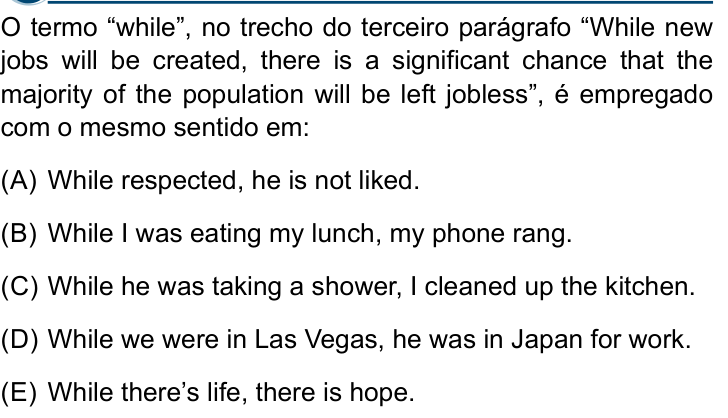
O termo “while”, no trecho do terceiro parágrafo “While new jobs will be created, there is a significant chance that the majority of the population will be left jobless”, é empregado com o mesmo sentido em:
- AWhile respected, he is not liked.
- BWhile I was eating my lunch, my phone rang.
- CWhile he was taking a shower, I cleaned up the kitchen.
- DWhile we were in Las Vegas, he was in Japan for work.
- EWhile there’s life, there is hope.
Você já respondeu questões neste aparelho. Crie sua conta grátis para guardar o histórico e refazer as que errou.
Resposta salva no seu histórico.
Reportar erro na questão
Resolução comentada
No trecho, "while" não indica tempo. Ele liga duas ideias que se opõem: "embora novos empregos sejam criados, há grande chance de a maioria ficar sem emprego". Portanto, "while" tem valor de concessão/contraste, equivalente a "although" ou "whereas".
Veja cada alternativa:
- A) "While respected, he is not liked" = "Embora seja respeitado, ele não é querido". Há concessão: o fato de ser respeitado contrasta com não ser querido. Mesmo sentido do trecho.
- B) "enquanto eu almoçava, meu telefone tocou": simultaneidade (tempo).
- C) "enquanto ele tomava banho, limpei a cozinha": simultaneidade (tempo).
- D) "enquanto estávamos em Las Vegas, ele estava no Japão": também é tempo, duas ações simultâneas, sem ideia de concessão. Pode lembrar contraste, mas o foco é a coincidência temporal.
- E) "While there's life, there is hope" = "Enquanto há vida, há esperança": tempo, no sentido de "enquanto".
Só a alternativa A traz o "while" com o sentido de "embora", como no texto.
Alternativa A.
Pegadinha: A alternativa D engana porque os dois lugares distintos sugerem contraste, mas o "while" ali ainda é temporal (simultaneidade).
Por que as outras alternativas estão erradas
- B"While" indica ações simultâneas no tempo (enquanto), não concessão.
- C"While" marca simultaneidade temporal entre tomar banho e limpar a cozinha.
- DEmbora pareça contrastar lugares, o "while" aqui é temporal: duas situações ao mesmo tempo.
- E"While there's life" significa "enquanto houver vida", sentido temporal.
Assunto: Conectivos e relações lógicas.
Reportar erro na resolução
Ver como caiu na prova
Fonte: Santa Casa 2024 · Conhecimentos Gerais. Prova oficial ↗