PRÁTICA COM QUESTÕES OFICIAIS
Questão 11 da Santa Casa 2024
Leia o texto para responder às questões de 11 a 17. · Conhecimentos Gerais
Some of the world’s leading artificial intelligence (AI) researchers are calling for a pause on research into AI, claiming that safety issues must first be urgently addressed. If not, the outcomes could be devastating for humanity. Others say any pause in development would not only be impractical to enforce on a global scale, but could also stand in the way of advances that could both improve and save lives.
The AI that is currently available already has the power to radically alter society, in new ways that we are seeing every day. So how might it progress over the coming years? Are we on the brink of an artificial intelligence-powered utopia or dystopia?
Firstly, technology has been automating jobs since the Industrial Revolution, though never before has it happened on this scale. Everyone from truck drivers to voice over artists are at risk of being replaced by AI. A recent study found that just over 30 jobs are considered safe from automation in the near future. They range from mechanics to athletes, though they represent just a sliver of the current labour market. While new jobs will be created, there is a significant chance that the majority of the population will be left jobless. This could either lead to:
Utopia: A new leisure class emerges, living off a universal basic income funded by taxes on robots and the companies that operate them.
Dystopia: Mass unemployment results in social unrest, similar to the way laid off factory workers trashed the machines that replaced them. With so many jobs at risk and the potential for huge wealth inequality, some fear it could ultimately result in societal collapse.
Secondly, artificial intelligence is already contributing to major scientific advances, dramatically accelerating the time it takes to make discoveries. It has been used to invent millions of materials that did not previously exist, find potential drug molecules 1,000 times faster than previous methods, and improve our understanding of the universe. This could either lead to:
Utopia: Cancer and all other life-threatening diseases are cured, leading to a new age of health and prosperity. Scientists are already using AI tools to make breakthroughs in longevity medicine, which aims to end or even reverse ageing.
Dystopia: The same AI-enabled technology could be used for malevolent purposes, creating entirely new diseases and viruses. These could be used as bioweapons, capable of devastating populations that don’t have access to cures or the tech needed to develop them.
(Anthony Cuthbertson. www.independent.co.uk, 03.05.2023. Adaptado.)
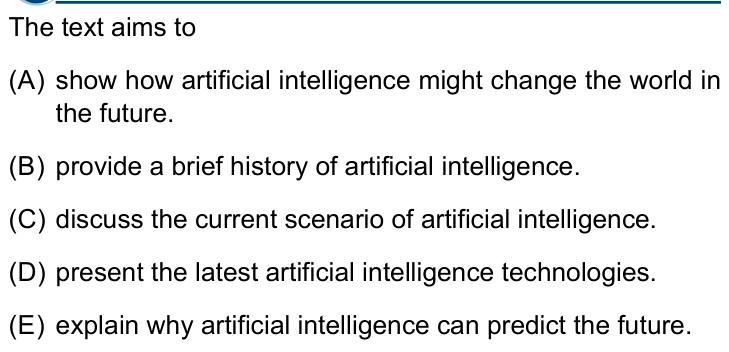
The text aims to
- Ashow how artificial intelligence might change the world in the future.
- Bprovide a brief history of artificial intelligence.
- Cdiscuss the current scenario of artificial intelligence.
- Dpresent the latest artificial intelligence technologies.
- Eexplain why artificial intelligence can predict the future.
Você já respondeu questões neste aparelho. Crie sua conta grátis para guardar o histórico e refazer as que errou.
Resposta salva no seu histórico.
Reportar erro na questão
Resolução comentada
A pergunta pede o objetivo do texto, ou seja, a ideia que organiza o texto inteiro.
-
O primeiro parágrafo apresenta a polêmica: pesquisadores querem pausar as pesquisas em IA, e outros dizem que a pausa seria inviável e prejudicaria avanços.
-
O segundo parágrafo faz a pergunta central: "So how might it progress over the coming years?" ("Como ela pode evoluir nos próximos anos?"). Em seguida, questiona se caminhamos para uma utopia ou uma distopia.
-
O restante do texto trata de dois campos, o mercado de trabalho e a ciência. Para cada um, descreve um cenário futuro positivo (Utopia) e outro negativo (Dystopia), sempre introduzidos por "This could either lead to" ("Isso pode levar a..."). Isso mostra possibilidades futuras, não fatos já consolidados.
Portanto, o texto quer mostrar como a IA pode mudar o mundo no futuro, por meio de cenários possíveis.
As demais opções falham por fugirem desse foco. O texto não conta a história da IA, não descreve o cenário atual como tema principal, não apresenta tecnologias recentes e não afirma que a IA prevê o futuro.
Alternativa A.
Por que as outras alternativas estão erradas
- BO texto não faz nenhum histórico da IA; só cita a Revolução Industrial de passagem, como comparação.
- CO cenário atual serve apenas de ponto de partida; o foco é a evolução nos próximos anos.
- DNão há apresentação de novas tecnologias específicas, apenas usos gerais da IA.
- EO texto especula sobre o futuro da IA, mas não diz que a IA seja capaz de prever o futuro.
Assunto: Ideia central e finalidade do texto.
Reportar erro na resolução
Ver como caiu na prova
Fonte: Santa Casa 2024 · Conhecimentos Gerais. Prova oficial ↗