PRÁTICA COM QUESTÕES OFICIAIS
Questão 48 do ITA 2026
Texto-base das questões 46 a 48 · 1ª fase
The problem with artificial intelligence? It’s neither artificial, nor intelligent.
Elon Musk and Apple’s co-founder Steve Wozniak have recently signed a letter calling for a six-month moratorium on the development of AI systems. The goal is to give society time to adapt to what the signatories describe as an “AI summer”, which they believe will ultimately benefit humanity, as long as the right guardrails are put in place. These guardrails include rigorously audited safety protocols.
It is a laudable goal, but there is an even better way to spend these six months: retiring the hackneyed label of “artificial intelligence” from public debate.
[…]
However, many critics have pointed out that intelligence is not just about pattern-matching. Equally important is the ability to draw generalisations. Marcel Duchamp’s 1917 work of art Fountain is a prime example of this. Before Duchamp’s piece, a urinal was just a urinal. But, with a change of perspective, Duchamp turned it into a work of art. At that moment, he was generalising about art.
[...]
Human intelligence is not one-dimensional. It rests on what the 20th-century Chilean psychoanalyst Ignacio Matte Blanco called bi-logic: a fusion of the static and timeless logic of formal reasoning and the contextual and highly dynamic logic of emotion. The former searches for differences; the latter is quick to erase them. Marcel Duchamp’s mind knew that the urinal belonged in a bathroom; his heart didn’t. Bi-logic explains how we regroup mundane things in novel and insightful ways. We all do this – not just Duchamp.
AI will never get there because machines cannot have a sense (rather than mere knowledge) of the past, the present and the future; of history, injury or nostalgia. Without that, there’s no emotion, depriving bi-logic of one of its components. Thus, machines remain trapped in the singular formal logic.
[...]
But the reason why tools like ChatGPT can do anything even remotely creative is because their training sets were produced by actually existing humans, with their complex emotions, anxieties and all. If we want such creativity to persist, we should also be funding the production of art, fiction and history – not just data centres and machine learning.
That’s not at all where things point now. The ultimate risk of not retiring terms such as “artificial intelligence” is that they will render the creative work of intelligence invisible, while making the world more predictable and dumb.
So, instead of spending six months auditing the algorithms while we wait for the “AI summer,” we might as well go and reread Shakespeare’s A Midsummer Night’s Dream. That will do so much more to increase the intelligence in our world.
Fonte: MOROZOV, Evgeny. The problem with artificial intelligence? It’s neither artificial nor intelligent. The Guardian. 30 mar 2023. Disponível em: https://www.theguardian.com/commentisfree/2023/mar/30/artificial-intelligence-chatgpt-human-mind
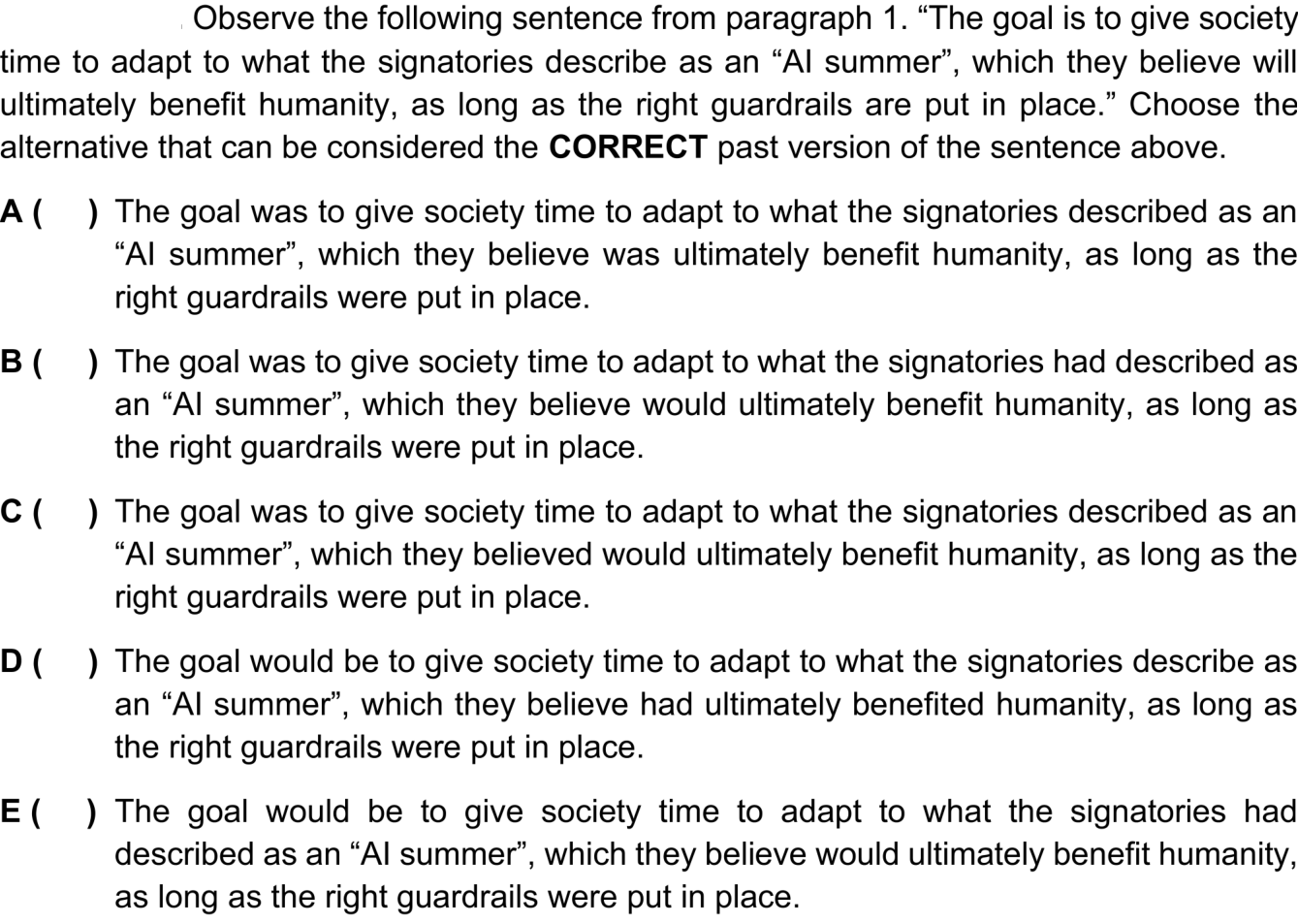
Observe the following sentence from paragraph 1. “The goal is to give society time to adapt to what the signatories describe as an “AI summer”, which they believe will ultimately benefit humanity, as long as the right guardrails are put in place.” Choose the alternative that can be considered the CORRECT past version of the sentence above.
- AThe goal was to give society time to adapt to what the signatories described as an “AI summer”, which they believe was ultimately benefit humanity, as long as the right guardrails were put in place.
- BThe goal was to give society time to adapt to what the signatories had described as an “AI summer”, which they believe would ultimately benefit humanity, as long as the right guardrails were put in place.
- CThe goal was to give society time to adapt to what the signatories described as an “AI summer”, which they believed would ultimately benefit humanity, as long as the right guardrails were put in place.
- DThe goal would be to give society time to adapt to what the signatories describe as an “AI summer”, which they believe had ultimately benefited humanity, as long as the right guardrails were put in place.
- EThe goal would be to give society time to adapt to what the signatories had described as an “AI summer”, which they believe would ultimately benefit humanity, as long as the right guardrails were put in place.
Reportar erro na questão
Resolução comentada
A questão pede a passagem da frase para o passado, o que no inglês exige a correlação de tempos (backshift): todos os verbos do presente recuam para o passado.
Verbo por verbo:
- The goal is to give → The goal was to give.
- what the signatories describe → described (passado simples; o had described também seria possível, mas não é necessário).
- which they believe → believed.
- will ultimately benefit → would ultimately benefit, pois will vira would no passado.
- as long as the right guardrails are put in place → were put in place.
A frase resultante é: The goal was to give society time to adapt to what the signatories described as an “AI summer”, which they believed would ultimately benefit humanity, as long as the right guardrails were put in place.
Ela corresponde exatamente à alternativa C. Nas demais, sobra algum verbo no presente (believe), há um erro de forma (was ultimately benefit), ou o tempo é trocado de modo incoerente (would be com describe no presente, had benefited).
Alternativa C.
Pegadinha: A alternativa B engana por parecer correta no restante (would benefit, were put), mas deixa "believe" no presente.
Por que as outras alternativas estão erradas
- Amantém "believe" no presente e usa "was ultimately benefit", construção agramatical no lugar de "would benefit".
- Bdeixa "they believe" no presente, sem recuar para "believed"; o "had described" também é desnecessário.
- Dusa "would be" no início, mantém "describe" e "believe" no presente e troca "will benefit" por "had benefited", mudando o sentido.
- Ecomeça com "would be" e mantém "believe" no presente, misturando tempos.
Assuntos: discurso indireto, correlação de tempos verbais, past tense.
Reportar erro na resolução
Ver como caiu na prova
Fonte: ITA 2026 · 1ª fase. Prova oficial ↗