PRÁTICA COM QUESTÕES OFICIAIS
Questão 46 do ITA 2026
Texto-base das questões 46 a 48 · 1ª fase
The problem with artificial intelligence? It’s neither artificial, nor intelligent.
Elon Musk and Apple’s co-founder Steve Wozniak have recently signed a letter calling for a six-month moratorium on the development of AI systems. The goal is to give society time to adapt to what the signatories describe as an “AI summer”, which they believe will ultimately benefit humanity, as long as the right guardrails are put in place. These guardrails include rigorously audited safety protocols.
It is a laudable goal, but there is an even better way to spend these six months: retiring the hackneyed label of “artificial intelligence” from public debate.
[…]
However, many critics have pointed out that intelligence is not just about pattern-matching. Equally important is the ability to draw generalisations. Marcel Duchamp’s 1917 work of art Fountain is a prime example of this. Before Duchamp’s piece, a urinal was just a urinal. But, with a change of perspective, Duchamp turned it into a work of art. At that moment, he was generalising about art.
[...]
Human intelligence is not one-dimensional. It rests on what the 20th-century Chilean psychoanalyst Ignacio Matte Blanco called bi-logic: a fusion of the static and timeless logic of formal reasoning and the contextual and highly dynamic logic of emotion. The former searches for differences; the latter is quick to erase them. Marcel Duchamp’s mind knew that the urinal belonged in a bathroom; his heart didn’t. Bi-logic explains how we regroup mundane things in novel and insightful ways. We all do this – not just Duchamp.
AI will never get there because machines cannot have a sense (rather than mere knowledge) of the past, the present and the future; of history, injury or nostalgia. Without that, there’s no emotion, depriving bi-logic of one of its components. Thus, machines remain trapped in the singular formal logic.
[...]
But the reason why tools like ChatGPT can do anything even remotely creative is because their training sets were produced by actually existing humans, with their complex emotions, anxieties and all. If we want such creativity to persist, we should also be funding the production of art, fiction and history – not just data centres and machine learning.
That’s not at all where things point now. The ultimate risk of not retiring terms such as “artificial intelligence” is that they will render the creative work of intelligence invisible, while making the world more predictable and dumb.
So, instead of spending six months auditing the algorithms while we wait for the “AI summer,” we might as well go and reread Shakespeare’s A Midsummer Night’s Dream. That will do so much more to increase the intelligence in our world.
Fonte: MOROZOV, Evgeny. The problem with artificial intelligence? It’s neither artificial nor intelligent. The Guardian. 30 mar 2023. Disponível em: https://www.theguardian.com/commentisfree/2023/mar/30/artificial-intelligence-chatgpt-human-mind
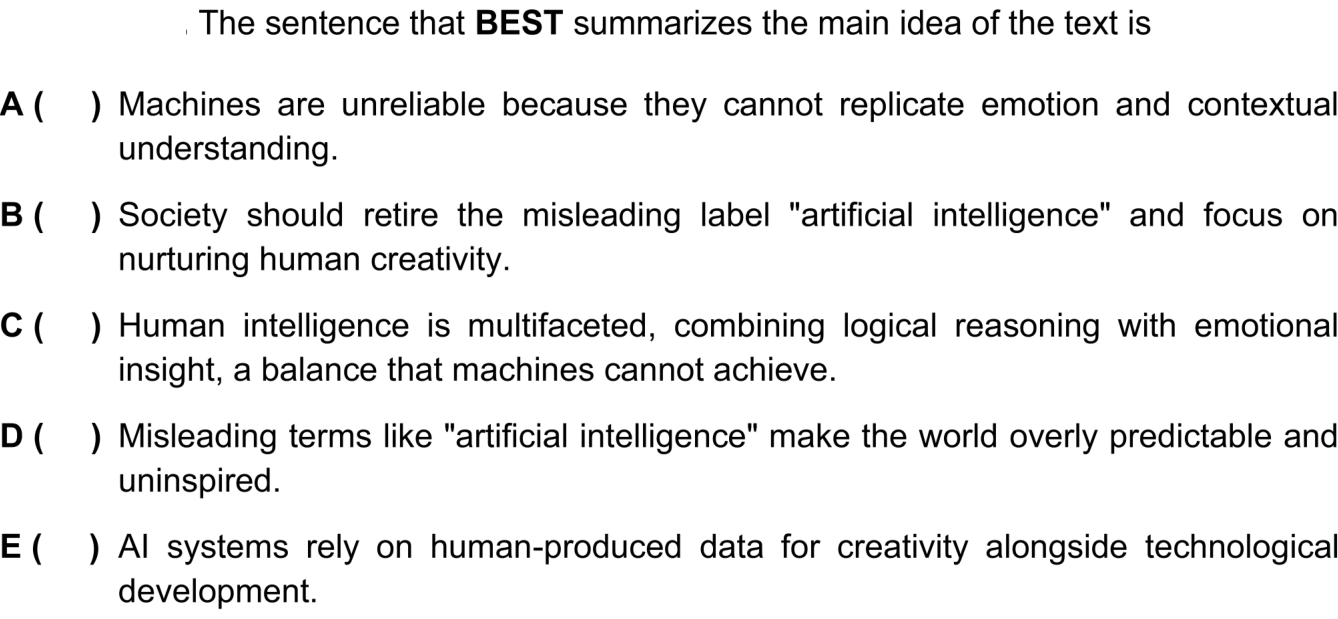
The sentence that BEST summarizes the main idea of the text is
- AMachines are unreliable because they cannot replicate emotion and contextual understanding.
- BSociety should retire the misleading label "artificial intelligence" and focus on nurturing human creativity.
- CHuman intelligence is multifaceted, combining logical reasoning with emotional insight, a balance that machines cannot achieve.
- DMisleading terms like "artificial intelligence" make the world overly predictable and uninspired.
- EAI systems rely on human-produced data for creativity alongside technological development.
Reportar erro na questão
Resolução comentada
A pergunta pede a ideia central do texto, isto é, a tese que organiza todos os parágrafos, e não um argumento isolado.
O autor comenta a carta que pede seis meses de moratória no desenvolvimento de IA. Em seguida, propõe algo melhor para esse período: "retiring the hackneyed label of 'artificial intelligence' from public debate", ou seja, aposentar o rótulo. É a tese do título e do segundo parágrafo.
Os argumentos que a sustentam são:
- A inteligência humana não é só reconhecer padrões: envolve generalizar, como Duchamp fez com o urinol.
- Ela é "bi-lógica": une a lógica formal e a lógica da emoção. As máquinas ficam presas só à lógica formal.
- A criatividade das ferramentas como o ChatGPT vem de dados produzidos por humanos.
A conclusão prática é financiar arte, ficção e história, e não apenas data centers. Isso evita que o rótulo torne invisível o trabalho criativo da inteligência.
A alternativa B reúne a tese (abandonar o rótulo enganoso) e a consequência (cultivar a criatividade humana). As demais retomam apenas um dos argumentos de apoio.
Alternativa B.
Por que as outras alternativas estão erradas
- AFala em máquinas "não confiáveis", ideia que o texto não defende; o foco é o rótulo e a falta de emoção, não a confiabilidade.
- CResume só o argumento da bi-lógica, que é um ponto de apoio, e deixa de fora a tese sobre abandonar o termo "IA".
- DRetoma só um dos riscos do rótulo (um mundo previsível e "burro") e omite a proposta central e a defesa da criatividade humana.
- ETrata apenas de um argumento secundário, a dependência de dados humanos, e não da tese do texto.
Assuntos: interpretação de texto, ideia principal, inglês.
Reportar erro na resolução
Ver como caiu na prova
Fonte: ITA 2026 · 1ª fase. Prova oficial ↗