PRÁTICA COM QUESTÕES OFICIAIS
Questão 44 do ITA 2026
Texto-base das questões 42 a 45 · 1ª fase
Back To School But Not To Screens: States Ramp Up Cellphone Bans
Work has been easier for public high school teacher Brian Kerekes since last August, when he first experienced the impacts of a newly enacted Florida law to restrict students’ cellphone use during class. The longtime statistics instructor, who started a new school year on Monday, now spends less time circling the classroom policing students and more time educating them on how to gather and interpret data.
Before Florida passed the ban in May 2023 - becoming the first of at least eight U.S. states to prohibit or restrict cellphone use in schools - phones proved a constant disruption in Kerekes’ classroom at Tohopekaliga High School in the central Florida city of Kissimmee.
“Students were either using them to talk to someone in a different class or talk to someone on the other side of the room or just to zone out, get on TikTok or whatever,” Kerekes, who’s been a teacher for 17 years, said in an interview.
Fellow teachers nationwide face the same challenge, which explains why more states and districts are moving to limit or outright ban cellphones in the classroom, and even during the school day altogether. [...]
The rules will look different from state to state and district to district, but all stem from the same concerns.
Seventy-two percent of high school teachers cite cellphones as a major distraction in the classroom, according to a fall 2023 Pew Research Center study. Educators also worry that constant access to social media can adversely impact kids’ mental health. [...]
U.S. Surgeon General Vivek Murthy went so far as to issue a health advisory last year, warning that enough evidence exists to show social media can be unsafe for children and teens. “We are in the middle of a national youth mental health crisis,” he said, “and I am concerned that social media is an important driver of that crisis, one that we must urgently address.”
While social media can connect kids, make them feel less alone and offer an entertaining and creative outlet, it also exposes them to harmful content, Murthy pointed out in the advisory released by the U.S. Department of Health and Human Services. And, as educators such as Kerekes note, some students use their phones to bully fellow students online during the school day, and in the most extreme cases, to set up fights and film them. The hope is that cellphone bans will reduce such incidents. Kerekes said he’s hearing they have.
Fonte: KATZ, Leslie. Back To School But Not To Screens: States Ramp Up Cellphone Bans. Forbes, 13 ago. 2024. Disponível em: https://www.forbes.com/sites/lesliekatz/2024/08/13/back-to-school-but-not-to-screens-more-students-face-cellphone-bans/
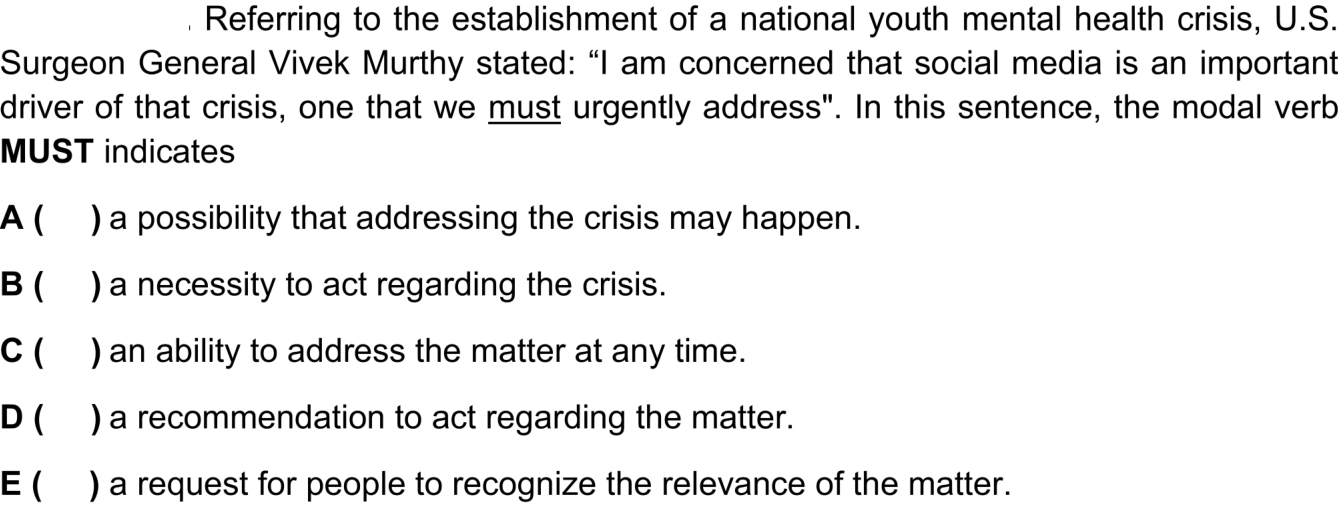
Referring to the establishment of a national youth mental health crisis, U.S. Surgeon General Vivek Murthy stated: “I am concerned that social media is an important driver of that crisis, one that we must urgently address”. In this sentence, the modal verb MUST indicates
- Aa possibility that addressing the crisis may happen.
- Ba necessity to act regarding the crisis.
- Can ability to address the matter at any time.
- Da recommendation to act regarding the matter.
- Ea request for people to recognize the relevance of the matter.
Reportar erro na questão
Resolução comentada
O verbo modal must tem dois usos principais: expressar obrigação ou necessidade forte ("é preciso", "temos de") e expressar dedução lógica ("deve ser que..."). Cada alternativa traduz uma ideia diferente, então basta identificar qual delas cabe aqui.
-
Na frase, Murthy fala de uma crise nacional de saúde mental entre jovens e diz que as redes sociais são um fator importante dela.
-
Ele completa que essa é uma crise "que must urgently address", ou seja, "que temos de enfrentar com urgência".
-
O advérbio urgently reforça o caráter de obrigação: não é sugestão nem possibilidade, é algo que precisa ser feito.
-
Isso corresponde a uma necessidade de agir diante da crise.
Comparando com as demais: possibilidade seria may/might; habilidade seria can; recomendação seria should/ought to, de força menor que must. Pedir que as pessoas reconheçam a relevância do assunto também não aparece, pois o verbo é address (enfrentar, tratar), não recognize.
Alternativa B.
Por que as outras alternativas estão erradas
- APossibilidade seria expressa por may/might; must aqui não indica algo que talvez aconteça.
- CHabilidade seria expressa por can/be able to; a frase não fala de capacidade.
- DRecomendação corresponderia a should, que é mais fraco que must, reforçado ainda por urgently.
- EO verbo é address (enfrentar), não recognize; não há pedido de reconhecimento, e sim exigência de ação.
Assuntos: verbos modais, must, interpretação de texto.
Reportar erro na resolução
Ver como caiu na prova
Fonte: ITA 2026 · 1ª fase. Prova oficial ↗