PRÁTICA COM QUESTÕES OFICIAIS
Questão 37 do ITA 2026
Texto-base das questões 37 a 39 · 1ª fase
The voluminous literature dealing with the idea of human progress is decidedly a mixed bag. While some of these writings are impressive and even inspiring, many of them are superficial, perhaps even ridiculous, in their reiteration (especially during the nineteenth century) of the comforting prospect that every day in every way we are growing better and better.
This kind of foolishness is manifested especially in discussions of such matters as economic, political, and moral progress, and of progress in art.[…]
From time to time, there seems to be real and measurable improvement in these areas. At other times the opposite seems equally to be the case. Thus the fervent belief of writers like the French sociophilosopher Auguste Comte in the inevitability of progress in all fields of human endeavor must be viewed as insupportable. We cannot accept it any longer, even if we once thought it was true.
Progress in human knowledge is another matter. Here it is possible to argue cogently that progress is in the nature of things. “Not only does each individual progress from day to day”, wrote French philosopher, mathematician, and mystic Blaise Pascal, “but mankind as a whole constantly progresses… in proportion as the universe grows older.” The essence of man as a rational being, as a later historian would put it, is that he develops his potential capacities by accumulating the experience of past generations.
Just as in our individual lives we learn more and more from day to day and from year to year because we remember some at least of what we have learned and add our new knowledge to it, so in the history of the race the collective memory retains at least some knowledge from the past to which is added every new discovery.
The memories of individuals fail and the persons die, but the memory of the race is eternal, or at least it can be expected to endure as long as human beings continue to write books and read them, or – which becomes more and more common – store up their knowledge in other mediums for the use of future generations.
Fonte: VAN DOREN, Charles. A History of Knowledge. Past, Present and Future. New York. The Random House Publishing Group. 1991, p. XV-XVI.
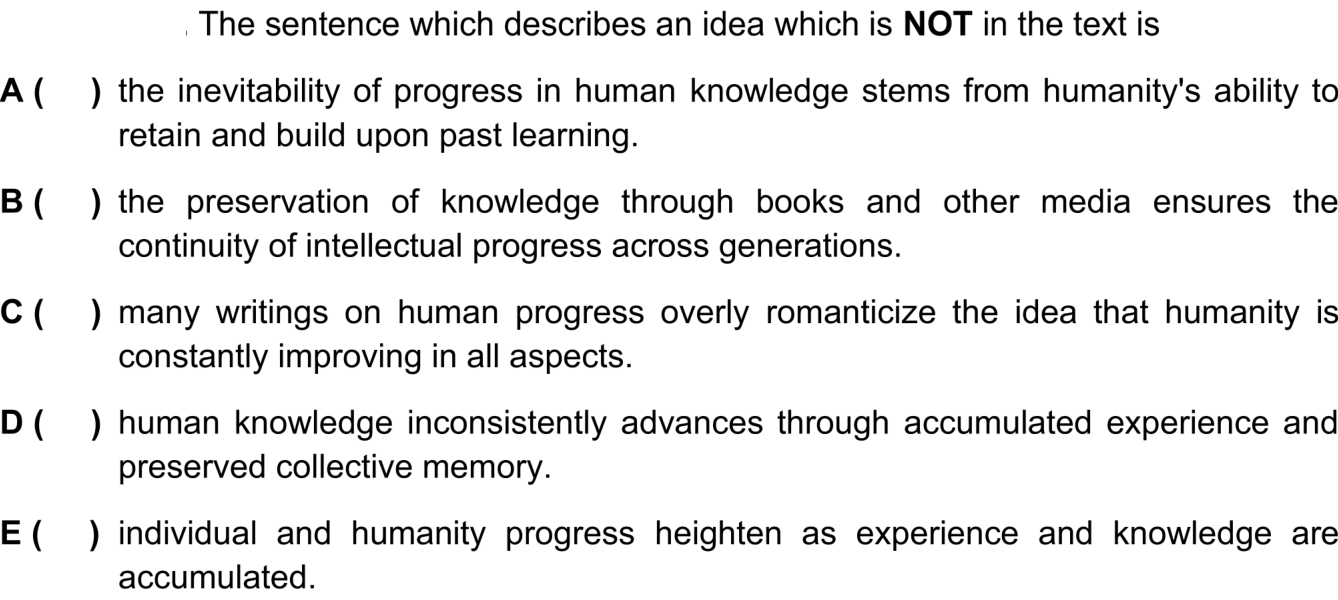
The sentence which describes an idea which is NOT in the text is
- Athe inevitability of progress in human knowledge stems from humanity's ability to retain and build upon past learning.
- Bthe preservation of knowledge through books and other media ensures the continuity of intellectual progress across generations.
- Cmany writings on human progress overly romanticize the idea that humanity is constantly improving in all aspects.
- Dhuman knowledge inconsistently advances through accumulated experience and preserved collective memory.
- Eindividual and humanity progress heighten as experience and knowledge are accumulated.
Reportar erro na questão
Resolução comentada
A questão pede a ideia que não aparece no texto, então confira cada alternativa com o que o autor diz.
- A: o autor afirma que o progresso do conhecimento é "da natureza das coisas" e que isso decorre de lembrarmos o que aprendemos e acrescentarmos o novo. Está no texto.
- B: o último parágrafo diz que a memória da espécie dura enquanto escrevermos e lermos livros, ou guardarmos o saber em outros meios para as gerações futuras. Está no texto.
- C: o primeiro parágrafo chama de superficiais, até ridículos, os escritos que repetem que "every day in every way we are growing better and better". Está no texto.
- D: diz que o conhecimento avança de modo inconsistente. O texto defende o contrário: o progresso do conhecimento é constante e seguro (Pascal: a humanidade "constantly progresses"). A inconsistência aparece no texto só para progresso econômico, político, moral e artístico, que ora melhora, ora piora. Esta ideia não está no texto.
- E: Pascal diz que cada indivíduo progride dia a dia e que a humanidade também progride, pela acumulação de experiência. Está no texto.
Portanto, a única que contradiz o texto é a D.
Alternativa D.
Pegadinha: A alternativa D engana por usar "inconsistently", que lembra a inconsistência do progresso moral, político e artístico, mas o texto diz que o progresso do conhecimento é constante.
Por que as outras alternativas estão erradas
- AEstá no texto: o progresso do conhecimento decorre de reter o que se aprendeu e somar novas descobertas.
- BEstá no texto: a memória da espécie dura enquanto houver livros e outros meios de guardar conhecimento.
- CEstá no texto: o autor critica os escritos superficiais que repetem que sempre melhoramos em tudo.
- EEstá no texto: Pascal diz que tanto o indivíduo quanto a humanidade progridem pela experiência acumulada.
Assuntos: interpretação de texto, inglês.
Reportar erro na resolução
Ver como caiu na prova
Fonte: ITA 2026 · 1ª fase. Prova oficial ↗