PRÁTICA COM QUESTÕES OFICIAIS
Questão 30 do ITA 2024
Leia o texto a seguir para responder às questões de 25 a 30. · 1ª fase
Read Your Way Through Salvador
By Itamar Vieira Junior and translated by Johnny Lorenz. July 19, 2023.
I was born in Salvador, in the Brazilian state of Bahia, and lived in the general vicinity until I reached the age of 15. But it was when I left that I really came to know my city. How was I able to discover more about my birthplace while traveling far from home? It might sound rather clichéd but, I assure you, literature made this possible: It took me on a journey, long and profound, back home, enveloping me in words and imagination.
To understand the formation of our unique society and, consequently, the cityscape of Salvador, one should read, before anything else, “The Story of Rufino: Slavery, Freedom and Islam in the Black Atlantic,” by João José Reis, Flávio dos Santos Gomes and Marcus J.M. de Carvalho. Rufino was an alufá, or Muslim spiritual leader, born in the Oyo empire in present-day Nigeria and enslaved during his adolescence. “The Story of Rufino” is an epic tale, encapsulating the life of one man in search of freedom as well as the history of the development of Salvador itself, a place inextricably linked with the diaspora across the Black Atlantic. Another book for which I have deep affection is “The City of Women,” by the American anthropologist Ruth Landes. It offers an intriguing perspective, focusing on matriarchal power in candomblé, an Afro-Brazilian sacred practice, and revealing how the social organization of its spiritual communities reverberates across the city.
If you want to feel the intensity of life on the streets of Salvador, these two books, both by Amado, are indispensable: “Captains of the Sands” and “Dona Flor and Her Two Husbands.” The first is a coming-of-age story in which we follow a group of children and adolescents living on the streets and on the beaches around the Bay of All Saints. Written more than 80 years ago, the book was banned and even burned in the public square during the dictatorship of Getúlio Vargas in the first half of the 20th century. As a portrait of Salvador, it is still relevant and reveals our deep inequalities. “Dona Flor and her Two Husbands” is one of Amado’s most popular novels, translated into more than 30 languages and adapted many times for theater, cinema, and television. The book is a kind of manifesto for a woman’s liberation. Dona Flor possesses great culinary talent, and oppressed by a patriarchal society, finds herself divided between two men, one being her deceased husband. While the novel captures the daily life of the city in the 1940s, it is also a wonderful guide to the cuisine of Salvador, with its African and Portuguese influences.
I invite readers to travel into the interior of Bahia, many hours by car from Salvador to the region known as the Sertão, whose name translates loosely to “backwoods.” Two books can also transport you there, and they are sides of the same story: “Backlands: The Canudos Campaign,” by Euclides da Cunha, and “The War of the End of the World,” by Mario Vargas Llosa.
“Backlands” is one of the most important works in the history of Brazilian literature. It is a journalistic telling that introduces us not only to the brutal War of Canudos, but also to the intriguing landscape of the Sertão, a place so full of contradictions. In his writing of the conflict, da Cunha tells the story of the genesis of the tough sertanejo: a mythic, cowboyesque figure of the drought-stricken, lawless interior. “The War of the End of the World” is an essential epic that amplifies the narrative of “Backlands,” bringing a more imaginative, creative aspect to the story of Antônio Conselheiro, the spiritual leader of a rebellion, and of the multitude that followed him to their deaths.
[Fonte: “Read Your Way Through Salvador”. In: The New York Times, 19/07/2023, <www.nytimes.com/2023/07/19/books/salvador-bahia-brazil-books.html>. Adaptado. Data de acesso: 01/09/2023.]
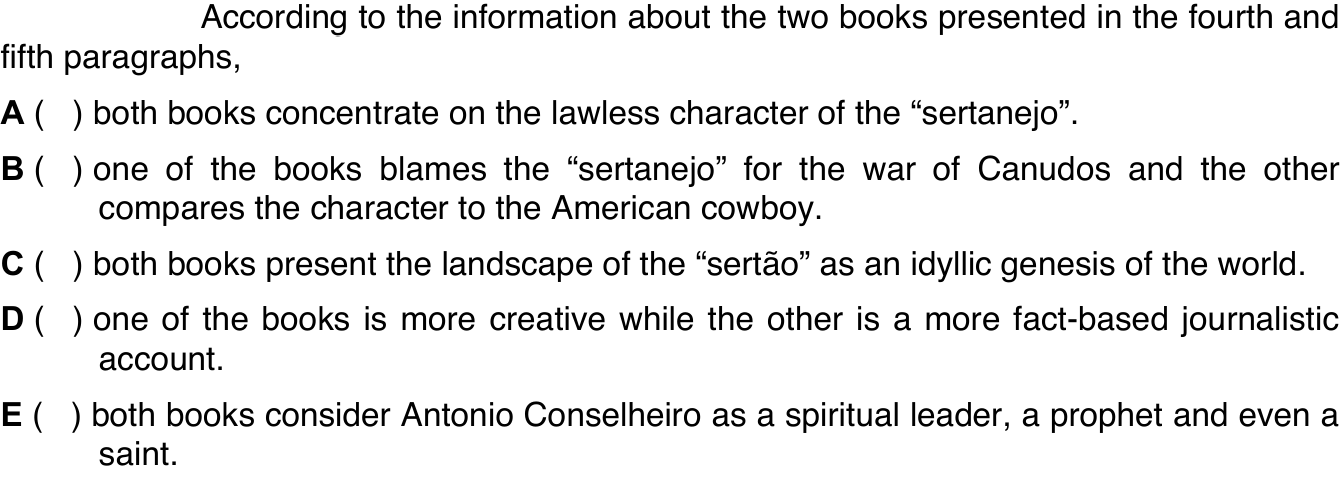
According to the information about the two books presented in the fourth and fifth paragraphs,
- Aboth books concentrate on the lawless character of the “sertanejo”.
- Bone of the books blames the “sertanejo” for the war of Canudos and the other compares the character to the American cowboy.
- Cboth books present the landscape of the “sertão” as an idyllic genesis of the world.
- Done of the books is more creative while the other is a more fact-based journalistic account.
- Eboth books consider Antonio Conselheiro as a spiritual leader, a prophet and even a saint.
Reportar erro na questão
Resolução comentada
A questão pede o que os dois últimos parágrafos dizem sobre os dois livros sobre o Sertão: "Backlands", de Euclides da Cunha, e "The War of the End of the World", de Vargas Llosa.
O que o texto diz de cada um:
- "Backlands" é "a journalistic telling", ou seja, um relato jornalístico. Apresenta a Guerra de Canudos e a paisagem do Sertão, e conta a gênese do sertanejo.
- "The War of the End of the World" "amplifies the narrative of Backlands, bringing a more imaginative, creative aspect" à história de Antônio Conselheiro. Ou seja, é a versão mais criativa e imaginativa.
Logo, um livro é jornalístico, baseado em fatos, e o outro é mais criativo. Isso corresponde exatamente à alternativa D.
As demais afirmam coisas que o texto não sustenta:
- O sertanejo só é tratado no livro de da Cunha.
- Nenhum livro é acusado de culpar o sertanejo pela guerra.
- A paisagem é descrita como cheia de contradições, não como idílica.
- Conselheiro é chamado apenas de líder espiritual, sem menção a profeta ou santo.
Alternativa D.
Por que as outras alternativas estão erradas
- ASó "Backlands" trata da gênese do sertanejo; o texto não diz isso do livro de Vargas Llosa.
- BO texto não diz que um livro culpa o sertanejo pela guerra; a imagem de cowboy é só uma descrição do personagem.
- CA paisagem é descrita como "cheia de contradições", não como uma gênese idílica do mundo.
- EConselheiro é chamado apenas de líder espiritual; profeta e santo não aparecem no texto.
Assuntos: interpretação de texto, reading comprehension.
Reportar erro na resolução
Ver como caiu na prova
Fonte: ITA 2024 · 1ª fase. Prova oficial ↗