PRÁTICA COM QUESTÕES OFICIAIS
Questão 34 do ITA 2023
Leia atentamente o texto a seguir para responder às questões de 34 a 36. · 1ª fase
A hundred years ago this weekend, a group of young artists and writers organised what they called the Modern Art Week in the new and grandiose municipal theatre in São Paulo. In fact, it lasted only for three evenings. It included a show of modernist painting, lectures, poetry recitals and music by Heitor Villa-Lobos, who was to become Brazil’s best-known composer. It has since come to be seen as the founding moment of modern Brazilian artistic culture. Its centenary has brought both commemoration and some criticism.
The event took place in São Paulo, then a fast-industrialising frontier city that was starting to rival Rio de Janeiro, the capital at the time, where the staid cultural establishment was based. The Brazilian modernists had their contradictions. The would-be revolutionaries were also dandies, the scions of the coffee-growing aristocracy, and they were close to the political oligarchy that ran São Paulo and Brazil. Even so, they were disrupters.
The week “was a declaration of cultural independence, that we are not simply a clumsy copy of something else”, says Eduardo Giannetti, a Brazilian philosopher. The modernists’ aims were later formalised in a Manifesto Antropófago (Cannibal Manifesto), written by one of the poets, Oswald de Andrade. This sought to address the dilemma of how to be a Brazilian modern artist when modernism was a European import. The answer: “Absorption of the sacred enemy. To transform him into a totem.” In other words, Brazilians would not simply reproduce other models but digest them and turn them into something that was their own. The group embraced a national identity that, at least in theory, included black and indigenous Brazilians and their beliefs, and tropical fauna and flora.
It was cultural nationalism, but of an open-minded, cosmopolitan and non-xenophobic kind. That was important. Across Latin America, modernist writers and artists were forging new national identities. As the innovative 1920s degenerated into the ideological conflicts of the 1930s, some would embrace communism and others creole fascism in its many variants. The Brazilian modernists would radicalise politically and be co-opted, too, by Getúlio Vargas, Brazil’s nation-builder, who ruled for much of 1930 to 1954, by turns an autocrat and a democrat.
Fonte: How the “Cannibal Manifesto” changed Brazil (Updated Feb 20th 2022). In: www.economist.com/the-americas/2022/02/12/how-the-cannibal-manifesto-changed-brazil. Adaptado. Data de acesso: 20/08/2022.
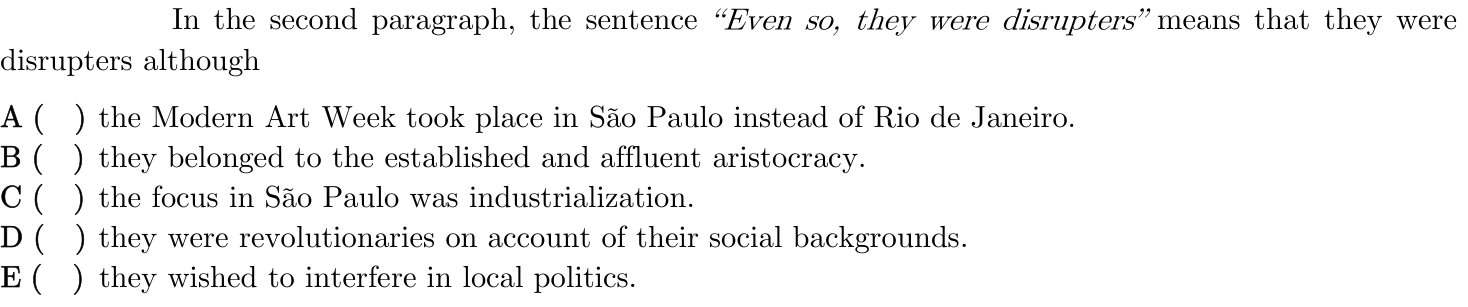
In the second paragraph, the sentence “Even so, they were disrupters” means that they were disrupters although
- Athe Modern Art Week took place in São Paulo instead of Rio de Janeiro.
- Bthey belonged to the established and affluent aristocracy.
- Cthe focus in São Paulo was industrialization.
- Dthey were revolutionaries on account of their social backgrounds.
- Ethey wished to interfere in local politics.
Reportar erro na questão
Resolução comentada
"Even so" é uma expressão concessiva: indica que a ideia seguinte vale apesar do que foi dito antes. Então é preciso olhar a frase anterior ao "Even so, they were disrupters" ("eles eram rompedores, transgressores").
O trecho anterior diz: "The would-be revolutionaries were also dandies, the scions of the coffee-growing aristocracy, and they were close to the political oligarchy that ran São Paulo and Brazil". Ou seja, os modernistas eram dândis, filhos da aristocracia cafeeira e próximos da oligarquia política.
Essa origem social seria um motivo para esperar que defendessem o status quo. Mesmo assim ("even so"), eles foram disruptivos, isto é, romperam com os padrões culturais.
Logo, a frase significa: eram disruptores, embora pertencessem à aristocracia estabelecida e rica. Isso corresponde à alternativa B ("established" = estabelecida; "affluent" = abastada).
As outras opções falam de fatos que não se opõem à ideia de ruptura, ou invertem a relação lógica.
Alternativa B.
Por que as outras alternativas estão erradas
- AA cidade do evento (São Paulo, não Rio) não contradiz ser disruptivo; o contraste do texto é com a origem social.
- CA industrialização de São Paulo é contexto do parágrafo, não algo que se oponha a serem disruptores.
- DInverte a lógica: a origem social não os tornava revolucionários, era o motivo do contraste.
- EA proximidade com a oligarquia é citada, mas o texto não diz que queriam interferir na política local nem isso é a concessão.
Assuntos: interpretação de texto, conectivos concessivos.
Reportar erro na resolução
Ver como caiu na prova
Fonte: ITA 2023 · 1ª fase. Prova oficial ↗