PRÁTICA COM QUESTÕES OFICIAIS
Questão 34 do ITA 2021
Texto-base das questões 34 a 36 · 1ª fase
As questões de 34 a 36 referem-se ao texto destacado a seguir.
It is the standing reproach of a democratic society that it is the purgatory of genius and the paradise of mediocrity. With ourselves it has become notorious that when a man is so unfortunate as to exhibit uncommon abilities, he usually renders himself ineligible for political honors or distinctions. It would seem that the community is possessed with that groveling quality of a sordid mind which hates superiority, and would ostracize genius, as the Athenians did Aristides. One might believe it would not be unpleasing to the popular taste if some enterprising person could invent a machine for stunting intellectual development, after the fashion of idiotic barbarians who flatten the heads of their children. The masses of the community certainly appear to believe that political equality implies not only social, but should also imply intellectual equality, under pain of being severely frowned down by an outraged public opinion.
The prevalent sentiment manifests itself in many different ways. It finds expression in public conveyances and resorts and is not altogether unknown even to the pulpit. It is found to perfection in the speeches of demagogues, who feel certain they are never so successful as when their audience is satisfied that the intellect of the speaker is of no higher an order than that of the lowest intelligence among them. Worse than all, it is demonstrated in the election of public officers of nearly all grades up to the highest: of which latter it has now become quite the custom to assume that it is impossible for a man of first-rate powers to be made President of the United States.
The causes which lend to so singular a state of affairs are of an intricate and complex character. At the outset, it is difficult to realize the possibility of a system, the logical deduction from which appears to be that, if a man would rise in life, he must assiduously belittle his understanding. Perhaps it would be fairer to modify the proposition so far as to concede that ability is as useful here as elsewhere, provided the owner has the tact not to affront the sensibilities of the people by showing too much of it. No doubt a vague apprehension exists in the popular mind that shining talents are dangerous when intrusted with executive power in a republic: yet, it were a poor commentary on our institutions to intimate that, under them, for a man to be clever he must also be vicious. Experience rather teaches the contrary. If the diffusion of education, having the general tendency to elevate the understanding, is to produce more bad men than good, we had better abandon than foster our Common School system. Manifestly, we must look further for the solution of our enigma[:] that minds of moderate calibre ordinarily condemn everything which is beyond their range.
THE NEW YORK TIMES. The worship of mediocrity. 17/08/1862.
Disponível em: https://www.nytimes.com/1862/08/17/archives/the-worship-of-mediocrity.html. Acesso 20/08/2020.
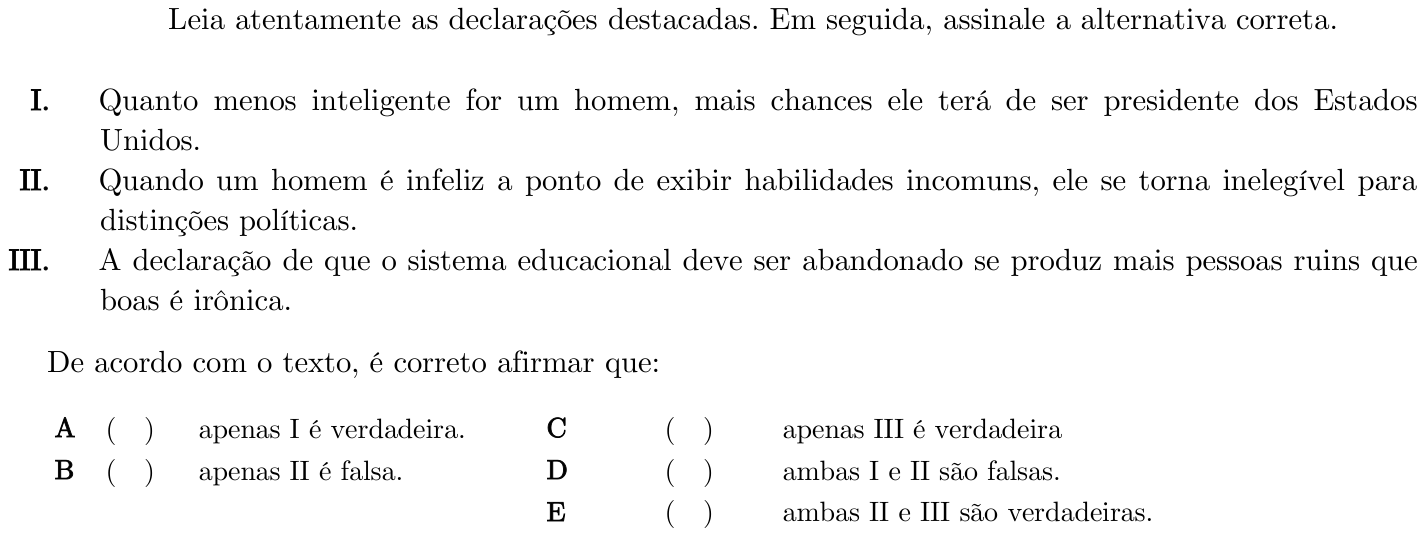
Leia atentamente as declarações destacadas. Em seguida, assinale a alternativa correta.
I. Quanto menos inteligente for um homem, mais chances ele terá de ser presidente dos Estados Unidos.
II. Quando um homem é infeliz a ponto de exibir habilidades incomuns, ele se torna inelegível para distinções políticas.
III. A declaração de que o sistema educacional deve ser abandonado se produz mais pessoas ruins que boas é irônica.
De acordo com o texto, é correto afirmar que:
- Aapenas I é verdadeira.
- Bapenas II é falsa.
- Capenas III é verdadeira
- Dambas I e II são falsas.
- Eambas II e III são verdadeiras.
Reportar erro na questão
Resolução comentada
Vamos conferir cada afirmação com o trecho correspondente.
I. O texto diz que se tornou costume assumir que é impossível um homem de primeira linha chegar à presidência. Mas isso é apresentado como crença popular criticada pelo autor, não como regra de que menos inteligência dá mais chances. A afirmação é um exagero e não reproduz o texto. Falsa.
II. O texto diz: "when a man is so unfortunate as to exhibit uncommon abilities, he usually renders himself ineligible for political honors". Ou seja, quem tem habilidades incomuns costuma se tornar inelegível. A afirmação ("infeliz a ponto de exibir habilidades incomuns") traduz isso. A ironia está em chamar de "infeliz" quem tem talento, mas o conteúdo bate com o texto. Verdadeira.
III. A frase "If the diffusion of education... is to produce more bad men than good, we had better abandon than foster our Common School system" é um raciocínio condicional sério. O autor rejeita a ideia de que o talento leve à maldade ("Experience rather teaches the contrary") e afirma que, se a educação produzisse mais maus que bons, deveríamos abandoná-la. Não é ironia, é argumentação lógica. A afirmação é falsa.
Resultado: I falsa, II verdadeira, III falsa.
Só II é verdadeira, logo I e III são falsas. A única alternativa compatível é a que diz que apenas I é falsa? Não: a alternativa D diz que I e II são falsas, o que contraria II. Revendo: a alternativa B diz "apenas II é falsa", também errada. Então a que sobra é a que considera III verdadeira, o que depende de ler a frase como irônica.
O autor chama a hipótese de "poor commentary on our institutions", tratando-a como absurda, e a frase é uma redução ao absurdo, de tom irônico. Com III verdadeira e II verdadeira:
Alternativa E.
Por que as outras alternativas estão erradas
- AI não é afirmada pelo texto, que apenas critica a crença popular de que talento impede a presidência.
- BII é fiel ao trecho "so unfortunate as to exhibit uncommon abilities", logo não é falsa.
- CIII é verdadeira, mas II também é, então 'apenas III' está incompleta.
- DII é verdadeira, portanto não são ambas falsas.
Assuntos: interpretação de texto, ironia.
Reportar erro na resolução
Ver como caiu na prova
Fonte: ITA 2021 · 1ª fase. Prova oficial ↗