PRÁTICA COM QUESTÕES OFICIAIS
Questão 33 do ITA 2019
Texto-base das questões 33 a 36 · 1ª fase
As questões de 33 a 36 referem-se ao texto a seguir:
Artificial Intelligence (AI) is going to play an enormous role in our lives and in the global economy. It is the key to self-driving cars, the Amazon Alexa in your home, autonomous trading desks on Wall Street, innovation in medicine, and cyberwar defenses.
Technology is rarely good nor evil — it’s all in how humans use it. AI could do an enormous amount of good and solve some of the world’s hardest problems, but that same power could be turned against us. AI could be set up to inflict bias based on race or beliefs, invade our privacy, learn about and exploit our personal weaknesses — and do a lot of nefarious things we can’t yet foresee.
Which means that our policymakers must understand and help guide AI so it benefits society. [...] We don’t want overreaching regulation that goes beyond keeping us safe and ends up stifling innovation. Regulators helped make it so difficult to develop atomic energy, today the U.S. gets only 20% of its electricity from nuclear power. So, while we need a Federal Artificial Intelligence Agency, or FAIA, I would prefer to see it created as a public-private partnership. Washington should bring in AI experts from the tech industry to a federal agency designed to understand and direct AI and to inform lawmakers. Perhaps the AI experts would rotate through Washington on a kind of public service tour of duty.
Importantly, we’re at the beginning of a new era in government — one where governance is software-defined. The nature of AI and algorithms means we need to develop a new kind of agency — one that includes both humans and software. The software will help monitor algorithms. Existing, old-school regulations that rely on manual enforcement are too cumbersome to keep up with technology and too “dumb” to monitor algorithms in a timely way.
Software-defined regulation can monitor software-driven industries better than regulations enforced by squads of regulators. Algorithms can continuously watch emerging utilities such as Facebook, looking for details and patterns that humans might never catch, but nonetheless signal abuses. If Congress wants to make sure Facebook doesn’t exploit political biases, it could direct the FAIA to write an algorithm to look for the behavior.
It’s just as important to have algorithms that keep an eye on the role of humans inside these companies. We want technology that can tell if Airbnb hosts are illegally turning down minorities or if Facebook’s human editors are squashing conservative news headlines.
The watchdog algorithms can be like open-source software — open to examination by anyone, while the companies keep private proprietary algorithms and data. If the algorithms are public, anyone can run various datasets against them and analyze for “off the rails” behaviors and unexpected results.
Clearly, AI needs some governance. As Facebook is proving, we can’t rely on companies to monitor and regulate themselves. Public companies, especially, are incentivized to make the biggest profits possible, and their algorithms will optimize for financial goals, not societal goals. But as a tech investor, I don’t want to see an ill-informed Congress set up regulatory schemes for social networks, search and other key services that then make our dynamic tech companies as dull and bureaucratic as electric companies. [...] Technology companies and policymakers need to come together soon and share ideas about AI governance and the establishment of a software-driven AI agency. [...]
Let’s do this before bad regulations get enacted — and before AI gets away from us and does more damage. We have a chance right now to tee up AI so it does tremendous good. To unleash it in a positive direction, we need to get the checks and balances in place right now.
Adaptado de https://www.marketwatch.com/story/artificial-intelligence-is-too-powerful-to-be-left-to-facebook-amazon-and-other-tech-giants-2018-04-23. Acesso em: jun. 2018.
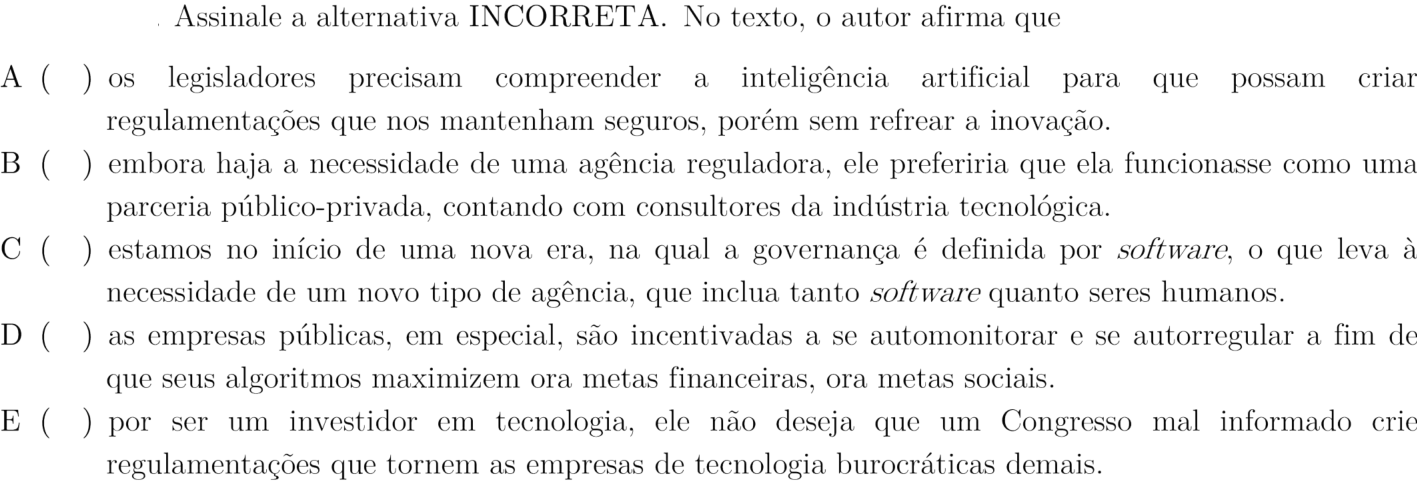
Assinale a alternativa INCORRETA. No texto, o autor afirma que
- Aos legisladores precisam compreender a inteligência artificial para que possam criar regulamentações que nos mantenham seguros, porém sem refrear a inovação.
- Bembora haja a necessidade de uma agência reguladora, ele preferiria que ela funcionasse como uma parceria público-privada, contando com consultores da indústria tecnológica.
- Cestamos no início de uma nova era, na qual a governança é definida por software, o que leva à necessidade de um novo tipo de agência, que inclua tanto software quanto seres humanos.
- Das empresas públicas, em especial, são incentivadas a se automonitorar e se autorregular a fim de que seus algoritmos maximizem ora metas financeiras, ora metas sociais.
- Epor ser um investidor em tecnologia, ele não deseja que um Congresso mal informado crie regulamentações que tornem as empresas de tecnologia burocráticas demais.
Reportar erro na questão
Resolução comentada
A questão pede a alternativa incorreta, ou seja, a que não corresponde ao que o autor diz. Vamos conferir cada uma contra o texto.
- (A) O 3º parágrafo diz que os legisladores precisam entender e ajudar a guiar a IA, sem uma regulação excessiva que "acabe sufocando a inovação". Está de acordo com o texto.
- (B) O autor afirma que precisa de uma agência federal (FAIA), mas prefere que seja uma parceria público-privada, com especialistas da indústria tecnológica. Correta.
- (C) O 4º parágrafo fala do início de uma nova era, com governança "definida por software", e de uma nova agência que inclua humanos e software. Correta.
- (D) No último bloco, o autor diz: "não podemos confiar que as empresas se monitorem e se regulem sozinhas". As empresas de capital aberto são incentivadas a buscar o maior lucro possível, e seus algoritmos otimizam metas financeiras, não metas sociais ("financial goals, not societal goals"). A alternativa inverte a ideia ao dizer que elas são incentivadas a se autorregular e que maximizam "ora metas financeiras, ora sociais". Está incorreta.
- (E) O autor diz que, como investidor em tecnologia, não quer um Congresso mal informado criando regras que deixem as empresas tão burocráticas quanto as companhias elétricas. Correta.
Portanto, a alternativa que contradiz o texto é a D.
Alternativa D.
Pegadinha: A alternativa D engana por misturar termos do texto (empresas públicas, autorregulação, metas) e inverter o sentido: o autor diz que não se pode confiar na autorregulação e que os algoritmos visam só metas financeiras.
Por que as outras alternativas estão erradas
- AReflete fielmente o texto: legisladores devem entender a IA e regular sem sufocar a inovação.
- BEstá de acordo com o texto: agência necessária, mas preferência por parceria público-privada com especialistas da indústria.
- CResume corretamente a ideia de governança definida por software e de uma agência com humanos e software.
- ECorresponde ao trecho em que o investidor rejeita um Congresso mal informado que torne as empresas burocráticas.
Assunto: Informações explícitas e detalhes.
Reportar erro na resolução
Ver como caiu na prova
Fonte: ITA 2019 · 1ª fase. Prova oficial ↗