PRÁTICA COM QUESTÕES OFICIAIS
Questão 3 (Inglês) do ITA 2018
Texto-base das questões 01 a 06 · Inglês
As questões de 1 a 6 referem-se ao texto a seguir:
GOODBYE THINGS, HELLO MINIMALISM: CAN LIVING WITH LESS MAKE YOU HAPPIER?
Fumio Sasaki owns a roll-up mattress, three shirts and four pairs of socks. After deciding to scorn
possessions, he began feeling happier. He explains why.
Let me tell you a bit about myself. I’m 35 years old, male, single, never been married. I work as an editor at a publishing company. I recently moved from the Nakameguro neighbourhood in Tokyo, where I lived for a decade, to a neighbourhood called Fudomae in a different part of town. The rent is cheaper, but the move pretty much wiped out my savings.
Some of you may think that I’m a loser: an unmarried adult with not much money. The old me would have been way too embarrassed to admit all this. I was filled with useless pride. But I honestly don’t care about things like that any more. The reason is very simple: I’m perfectly happy just as I am. The reason? I got rid of most of my material possessions.
Minimalism is a lifestyle in which you reduce your possessions to the least possible. Living with only the bare essentials has not only provided superficial benefits such as the pleasure of a tidy room or the simple ease of cleaning, it has also led to a more fundamental shift. It’s given me a chance to think about what it really means to be happy.
We think that the more we have, the happier we will be. We never know what tomorrow might bring, so we collect and save as much as we can. This means we need a lot of money, so we gradually start judging people by how much money they have. You convince yourself that you need to make a lot of money so you don’t miss out on success. And for you to make money, you need everyone else to spend their money. And so it goes.
So I said goodbye to a lot of things, many of which I’d had for years. And yet now I live each day with a happier spirit. I feel more content now than I ever did in the past.
I wasn’t always a minimalist. I used to buy a lot of things, believing that all those possessions would increase my self-worth and lead to a happier life. I loved collecting a lot of useless stuff, and I couldn’t throw anything away. I was a natural hoarder of knick-knacks that I thought made me an interesting person.
At the same time, though, I was always comparing myself with other people who had more or better things, which often made me miserable. I couldn’t focus on anything, and I was always wasting time. Alcohol was my escape, and I didn’t treat women fairly. I didn’t try to change; I thought this was all just part of who I was, and I deserved to be unhappy.
My apartment wasn’t horribly messy; if my girlfriend was coming over for the weekend, I could do enough tidying up to make it look presentable. On a usual day, however, there were books stacked everywhere because there wasn’t enough room on my bookshelves. Most I had thumbed through once or twice, thinking that I would read them when I had the time.
The closet was crammed with what used to be my favourite clothes, most of which I’d only worn a few times. The room was filled with all the things I’d taken up as hobbies and then gotten tired of. A guitar and amplifier, covered with dust. Conversational English workbooks I’d planned to study once I had more free time. Even a fabulous antique camera, which of course I had never once put a roll of film in.
It may sound as if I’m exaggerating when I say I started to become a new person. Someone said to me: “All you did is throw things away,” which is true. But by having fewer things around, I’ve started feeling happier each day. I’m slowly beginning to understand what happiness is.
If you are anything like I used to be – miserable, constantly comparing yourself with others, or just believing your life sucks – I think you should try saying goodbye to some of your things. [...] Everyone wants to be happy. But trying to buy happiness only makes us happy for a little while.
Fonte: adaptado de https://www.theguardian.com/books/2017/apr/12/goodbye-things-hello-minimalism-can-living-with-less-make-you-happier. Acesso em: 21 mai. 2017.
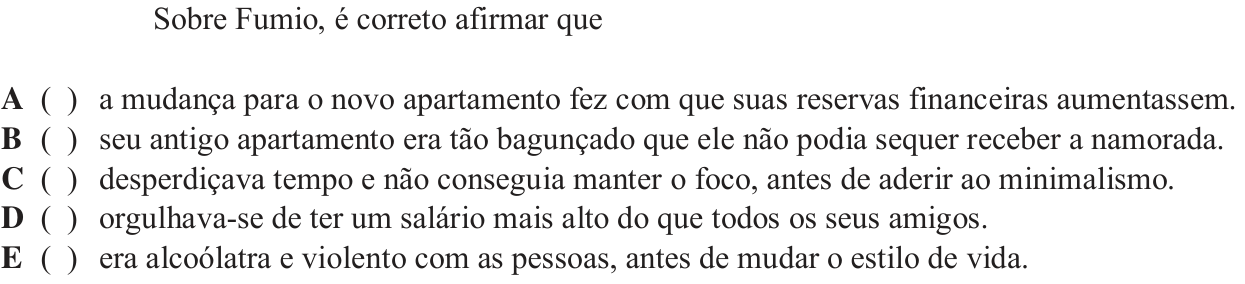
Sobre Fumio, é correto afirmar que
- Aa mudança para o novo apartamento fez com que suas reservas financeiras aumentassem.
- Bseu antigo apartamento era tão bagunçado que ele não podia sequer receber a namorada.
- Cdesperdiçava tempo e não conseguia manter o foco, antes de aderir ao minimalismo.
- Dorgulhava-se de ter um salário mais alto do que todos os seus amigos.
- Eera alcoólatra e violento com as pessoas, antes de mudar o estilo de vida.
Reportar erro na questão
Resolução comentada
Basta confrontar cada alternativa com o texto.
No parágrafo sobre o passado, Fumio diz: "I couldn't focus on anything, and I was always wasting time" ("eu não conseguia me concentrar em nada e estava sempre perdendo tempo"). Isso descreve exatamente a vida dele antes do minimalismo, e é o que diz a alternativa C.
As demais não batem com o texto:
- Sobre a mudança, ele afirma que o aluguel ficou mais barato, mas que a mudança "wiped out my savings", isto é, acabou com suas economias. As reservas diminuíram.
- O apartamento "wasn't horribly messy": quando a namorada ia passar o fim de semana, ele arrumava o suficiente para deixá-lo apresentável. Ele podia, sim, recebê-la.
- Ele não fala em salário alto nem em ganhar mais que os amigos. O que diz é que se comparava a pessoas com mais coisas e que se sentia miserável por isso.
- Ele cita o álcool como "escape" e diz que não tratava bem as mulheres ("didn't treat women fairly"). Isso não equivale a ser alcoólatra nem violento, o que seria extrapolar.
Alternativa C.
Pegadinha: A alternativa E engana por exagerar: o texto fala em álcool como fuga e em tratar mal as mulheres, não em alcoolismo nem violência.
Por que as outras alternativas estão erradas
- AO texto diz que a mudança acabou com suas economias ("wiped out my savings"), ou seja, as reservas diminuíram.
- BEle diz que o apartamento não era muito bagunçado e que, para a namorada, conseguia deixá-lo apresentável.
- DNão há menção a salário maior que o dos amigos; ele se comparava aos outros e se sentia miserável.
- EEle cita o álcool como fuga e o tratamento injusto às mulheres, mas não diz que era alcoólatra nem violento: exagero.
Assunto: Informações explícitas e detalhes.
Reportar erro na resolução
Ver como caiu na prova
Fonte: ITA 2018 · Inglês. Prova oficial ↗