PRÁTICA COM QUESTÕES OFICIAIS
Questão 10 (Inglês) do ITA 2018
Texto-base das questões 07 a 12 · Inglês
As questões de 7 a 12 referem-se ao texto a seguir:
WE RECORDED VCs CONVERSATIONS AND ANALYZED HOW DIFFERENTLY
THEY TALK ABOUT FEMALE ENTREPRENEURS
When venture capitalists (VCs) evaluate investment proposals, the language they use to describe the entrepreneurs who write them plays an important but often hidden role in shaping who is awarded funding and why.[…] We were given access to government venture capital decision making meetings in Sweden and were able to observe the types of language that VCs used over a two-year period. One major thing stuck out: The language used to describe male and female entrepreneurs was radically different. And these differences have very real consequences for those seeking funding — and for society in general.
[…] Worldwide, government venture capital is important for bridging significant financial gaps and supporting innovation and growth, as VCs can take risks where banks are not allowed to. When uncertainty is high regarding assessment of product and market potential, for example, the assessment of the entrepreneur’s potential becomes highly central in government VCs’ decision making.
In Sweden, about one-third of businesses are owned and run by women, although they are not granted a corresponding proportion of government funding. In fact, women-owned businesses receive much less — only 13%–18%, the rest going to male-owned companies.
This brings us back to our research. From 2009 to 2010 we were invited to silently observe governmental VC decision-making meetings and, more important, the conversations they had about entrepreneurs applying for funding. […] We observed closed-room, face-to-face discussions leading final funding decisions for 125 venture applications. Of these, 99 (79%) were from male entrepreneurs and 26 (21%) were from female entrepreneurs. The group of government venture capitalists observed included seven individuals: two women and five men. […]
Aside from a few exceptions, the financiers rhetorically produce stereotypical images of women as having qualities opposite to those considered important to being an entrepreneur, with VCs questioning their credibility, trustworthiness, experience, and knowledge.
Conversely, when assessing male entrepreneurs, financiers leaned on stereotypical beliefs about men that reinforced their entrepreneurial potential. Male entrepreneurs were commonly described as being assertive, innovative, competent, experienced, knowledgeable, and having established networks.
We developed male and female entrepreneur personas based on our findings […]. These personas highlight a few key differences in how the entrepreneurs were perceived depending on their gender. Men were characterized as having entrepreneurial potential, while the entrepreneurial potential for women was diminished. Many of the young men and women were described as being young, though youth for men was viewed as promising, while young women were considered inexperienced. Men were praised for being viewed as aggressive or arrogant, while women’s experience and excitement were tempered by discussions of their emotional shortcomings. Similarly, cautiousness was viewed very differently depending on the gender of the entrepreneur.
Unsurprisingly, these stereotypes seem to have played a role in who got funding and who didn’t. Women entrepreneurs were only awarded, on average, 25% of the applied-for amount, whereas men received, on average, 52% of what they asked for. Women were also denied financing to a greater extent than men, with close to 53% of women having their applications dismissed, compared with 38% of men. […]
Such stereotyping will inevitably influence the distribution of financing, but could also have other major consequences. Because the purpose of government venture capital is to use tax money to stimulate growth and value creation for society as a whole, gender bias presents the risk that the money isn’t being invested in businesses that have the highest potential. This isn’t only damaging for women entrepreneurs; it’s potentially damaging for society as a whole.
Fonte: Adaptado de Harvard Business Review https://hbr.org/2017/05/we-recorded-vcs-conversations-and-analyzed-how-differently-they-talk-about-female-entrepreneurs. Acesso em: 17 mai. 2017.
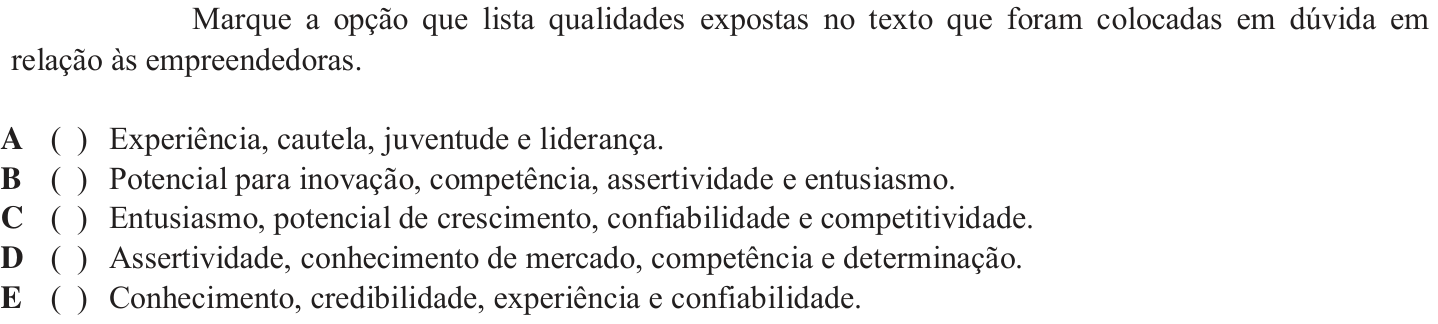
Marque a opção que lista qualidades expostas no texto que foram colocadas em dúvida em relação às empreendedoras.
- AExperiência, cautela, juventude e liderança.
- BPotencial para inovação, competência, assertividade e entusiasmo.
- CEntusiasmo, potencial de crescimento, confiabilidade e competitividade.
- DAssertividade, conhecimento de mercado, competência e determinação.
- EConhecimento, credibilidade, experiência e confiabilidade.
Reportar erro na questão
Resolução comentada
A pergunta pede as qualidades que os investidores questionaram nas mulheres empreendedoras. O trecho decisivo está no parágrafo que começa com "Aside from a few exceptions": os financiadores produzem imagens estereotipadas das mulheres, "with VCs questioning their credibility, trustworthiness, experience, and knowledge". Em português: questionando sua credibilidade, confiabilidade, experiência e conhecimento.
Agora compare com as alternativas:
- Credibilidade, confiabilidade (trustworthiness), experiência e conhecimento aparecem exatamente nessa frase.
- Assertividade, inovação e competência são qualidades atribuídas aos homens ("assertive, innovative, competent, experienced, knowledgeable"), não postas em dúvida nas mulheres.
- Entusiasmo, cautela e juventude aparecem em outro contexto: a juventude era vista como promissora nos homens e como inexperiência nas mulheres, e o entusiasmo delas era "temperado" por suas falhas emocionais. Não são as qualidades que o texto diz terem sido questionadas.
Só uma alternativa reúne os quatro termos da frase-chave.
Alternativa E.
Por que as outras alternativas estão erradas
- AMistura experiência com cautela, juventude e liderança, que não estão entre as qualidades questionadas na frase-chave.
- BInovação, competência e assertividade são qualidades atribuídas aos homens, e o entusiasmo foi apenas 'temperado'.
- CPotencial de crescimento e competitividade não são citados como questionados nas mulheres; o entusiasmo foi moderado, não posto em dúvida.
- DAssertividade e competência foram atribuídas aos homens; determinação nem aparece no texto.
Assunto: Informações explícitas e detalhes.
Reportar erro na resolução
Ver como caiu na prova
Fonte: ITA 2018 · Inglês. Prova oficial ↗