PRÁTICA COM QUESTÕES OFICIAIS
Questão 8 (Inglês) do ITA 2017
Texto-base das questões 08 a 12 · Inglês
As questões de 8 a 12 referem-se ao texto a seguir:
INSIDE THE BILL GATES-BACKED ACCELERATOR THAT'S TRAINING
THE NEXT GENERATION OF VENTURE CAPITALISTS
Lauren Gensler, FORBES STAFF
In an airy converted furniture store in Seattle’s Pioneer Square neighborhood, five novice impact fund managers from Zimbabwe, Guatemala and the Netherlands are rehearsing the sales pitches they’ll make the next day to 60 mostly institutional investors, representing $10 billion in capital.
The presentations will be a graduation ceremony of sorts. Despite their impressive resumes, the five men have just completed a four-week boot camp covering everything from term sheets, accounting and mezzanine debt structures to dealing with corruption to defining and marketing their brands. They’ll head home with golden contacts (investor cocktail hours were built into the packed schedule) and a commitment for up to $500,000 in seed capital from Capria Accelerator, a first-of-its-kind venture whose initial investors include Microsoft cofounder (and world’s richest man) Bill Gates.
One of those rehearsing is Patrick Makanza, 51, an M.B.A. and veteran of Unilever and Barclays Bank, who quit a cushy job at a top Zimbabwe private equity firm and launched Vakayi Capital. The first fund being formed by Vakayi (which means “to build”) will back for-profit businesses providing essential services in Zimbabwe, which has per capita gross domestic product of about $1,000. That fund will make loans (with an option to convert some to equity) for an average of four years to small and medium-size businesses that want to expand and can’t get adequate bank financing. Among potential investments: an eye clinic that’s building a new operating room so it can double its daily procedures and bring down the cost of cataract surgery; an education microlender; and a builder of low-cost housing.
The next day, in their presentation, Makanza and his Vakayi cofounder tackle head-on the tough issues they might be asked about, including Zimbabwe’s endemic corruption, economic challenges and currency dramas–it squelched hyperinflation in 2009 by switching to foreign currencies, primarily the U.S. dollar. But in the question period Tracy Washington, principal investment officer for the International Finance Corp.’s global private equity funds, lobs a personal query at Makanza, a father of four who is partial to conservative business suits and golf. “With your resume”, she asks, “why get involved with so risky an enterprise, and will you stick to it?” Makanza responds that he worked in venture capital back in the 1990s and came to miss the highs and lows of investing in early-stage entrepreneurs. “I still have at least ten years to do this. … It’s a real roller-coaster lifestyle. But I enjoyed it, and I want to have more of that experience again.”
Impact investing – which aims to produce both financial and social or environmental returns – is in vogue. Big names in finance, from BlackRock to Goldman Sachs to Bank of America Merrill Lynch, have been piling in recently, seeing it as a way to appeal to the socially conscious Millennials now building and inheriting wealth.
But this alternative asset class is still small – $77 billion invested worldwide, according to a new survey from the Global Impact Investing Network. To grow, it needs experienced, hands-on fund managers, and those are in short supply, particularly in areas with the greatest needs, such as sub-Saharan Africa.
Fonte: http://www.forbes.com/sites/laurengensler/2016/06/15/capria-bill-gates-impact-investing-accelerator/#56afe1ab1dc4.
(Acesso em 07/07/2016).
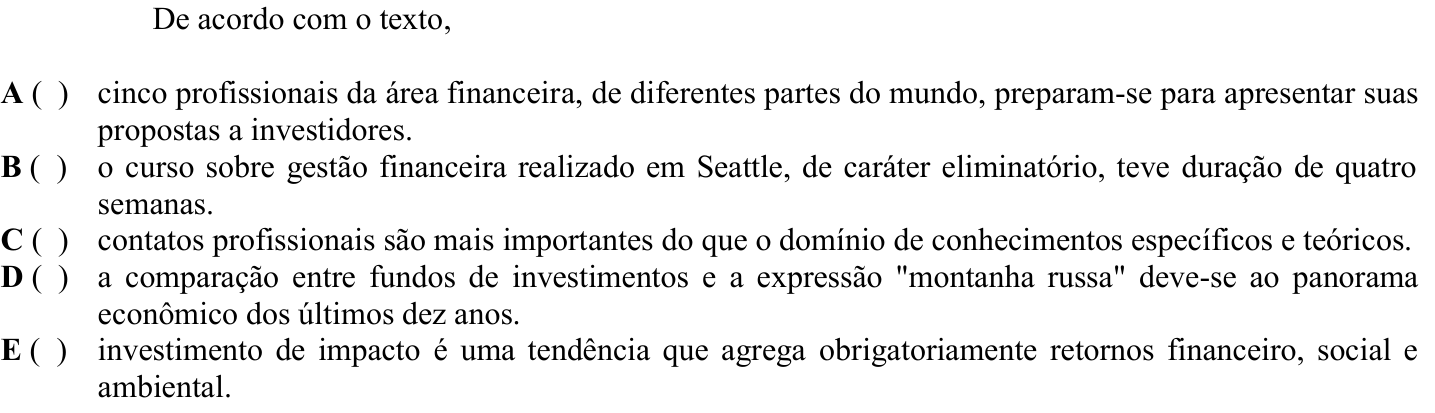
De acordo com o texto,
- Acinco profissionais da área financeira, de diferentes partes do mundo, preparam-se para apresentar suas propostas a investidores.
- Bo curso sobre gestão financeira realizado em Seattle, de caráter eliminatório, teve duração de quatro semanas.
- Ccontatos profissionais são mais importantes do que o domínio de conhecimentos específicos e teóricos.
- Da comparação entre fundos de investimentos e a expressão "montanha russa" deve-se ao panorama econômico dos últimos dez anos.
- Einvestimento de impacto é uma tendência que agrega obrigatoriamente retornos financeiro, social e ambiental.
Você já respondeu questões neste aparelho. Crie sua conta grátis para guardar o histórico e refazer as que errou.
Resposta salva no seu histórico.
Reportar erro na questão
Resolução comentada
Vamos conferir cada alternativa com o que o texto diz.
No primeiro parágrafo, cinco "novice impact fund managers" (novatos na gestão de fundos de impacto) vindos do Zimbábue, da Guatemala e da Holanda ensaiam os discursos de venda (sales pitches) que farão no dia seguinte a 60 investidores. Ou seja, são profissionais de diferentes países se preparando para apresentar suas propostas a investidores. Isso corresponde exatamente à alternativa A.
As demais não se sustentam:
- O boot camp de quatro semanas existe, mas o texto não diz que era eliminatório. Fala em "graduation ceremony" e em compromisso de capital para os participantes.
- Os contatos são chamados de "golden contacts", mas o texto não os compara com o conhecimento técnico, que também é ensinado no curso.
- A imagem da "roller-coaster" é de Makanza e se refere aos altos e baixos de investir em empreendedores iniciantes, não ao panorama econômico dos últimos dez anos. Os dez anos são o tempo que ele ainda pretende trabalhar.
- O texto diz que o impact investing "aims to produce both financial and social or environmental returns", isto é, financeiro e social ou ambiental, e "aims" indica objetivo, não obrigatoriedade.
Alternativa A.
Pegadinha: A alternativa E engana ao transformar o verbo "aims to produce" (visa produzir) em "obrigatoriamente agrega" e ao juntar social e ambiental, que no texto são alternativos ("or").
Por que as outras alternativas estão erradas
- BO curso durou quatro semanas, mas o texto não diz que era eliminatório.
- CO texto não hierarquiza contatos e conhecimento; o curso ensina conteúdo técnico e os contatos são um bônus.
- DA "montanha-russa" é o estilo de vida de investir em empreendedores iniciantes, segundo Makanza, e não o cenário econômico de dez anos.
- EO texto diz que o investimento de impacto "visa" (aims) retorno financeiro e social ou ambiental, sem obrigatoriedade.
Assunto: Informações explícitas e detalhes.
Reportar erro na resolução
Ver como caiu na prova
Fonte: ITA 2017 · Inglês. Prova oficial ↗